
Your firm billed $2.4M last year. So why does your bank account feel like you’re running a $900K operation?
The answer is usually hiding in five bookkeeping gaps that silently drain professional services firms. These aren’t “beginner mistakes” — they’re structural problems that compound at scale. Here’s where the leakage happens and how to plug it.
1. No Project-Level P&L — You’re Flying on Firm-Wide Averages
Most firms track total revenue and total expenses. That’s like knowing your batting average but not knowing which pitcher you can’t hit. Without project-level profitability, you can’t answer the question that actually matters: “Is the Henderson account making us money, or are we subsidizing it with margin from better clients?”
Here’s the math most firms never run:
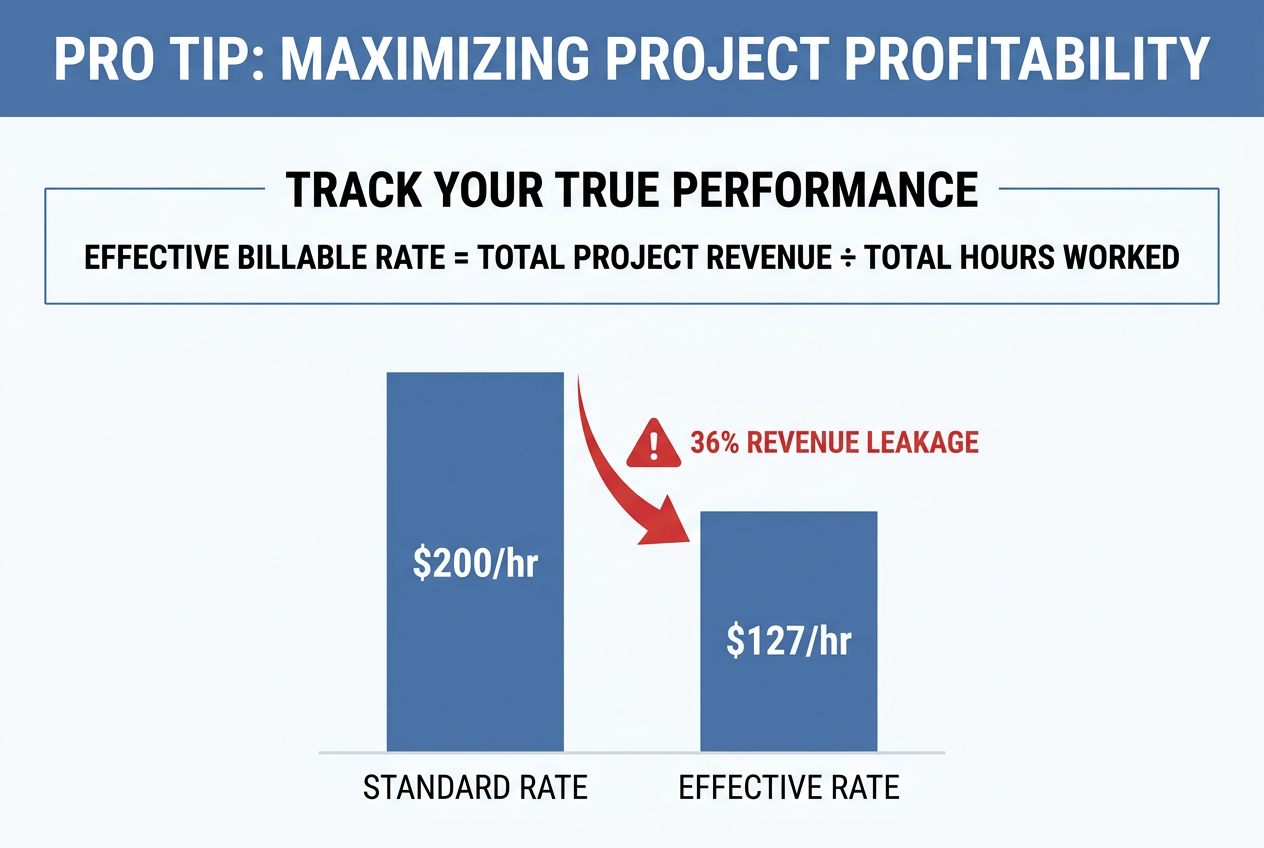
- Effective Billable Rate = Total Project Revenue / Total Hours Worked (including non-billable project hours)
- If your standard rate is $200/hr but your Effective Billable Rate on a project is $127/hr, you have a 36% revenue leakage problem
- Multiply that across 15-20 active projects and you’re looking at six figures in hidden margin loss
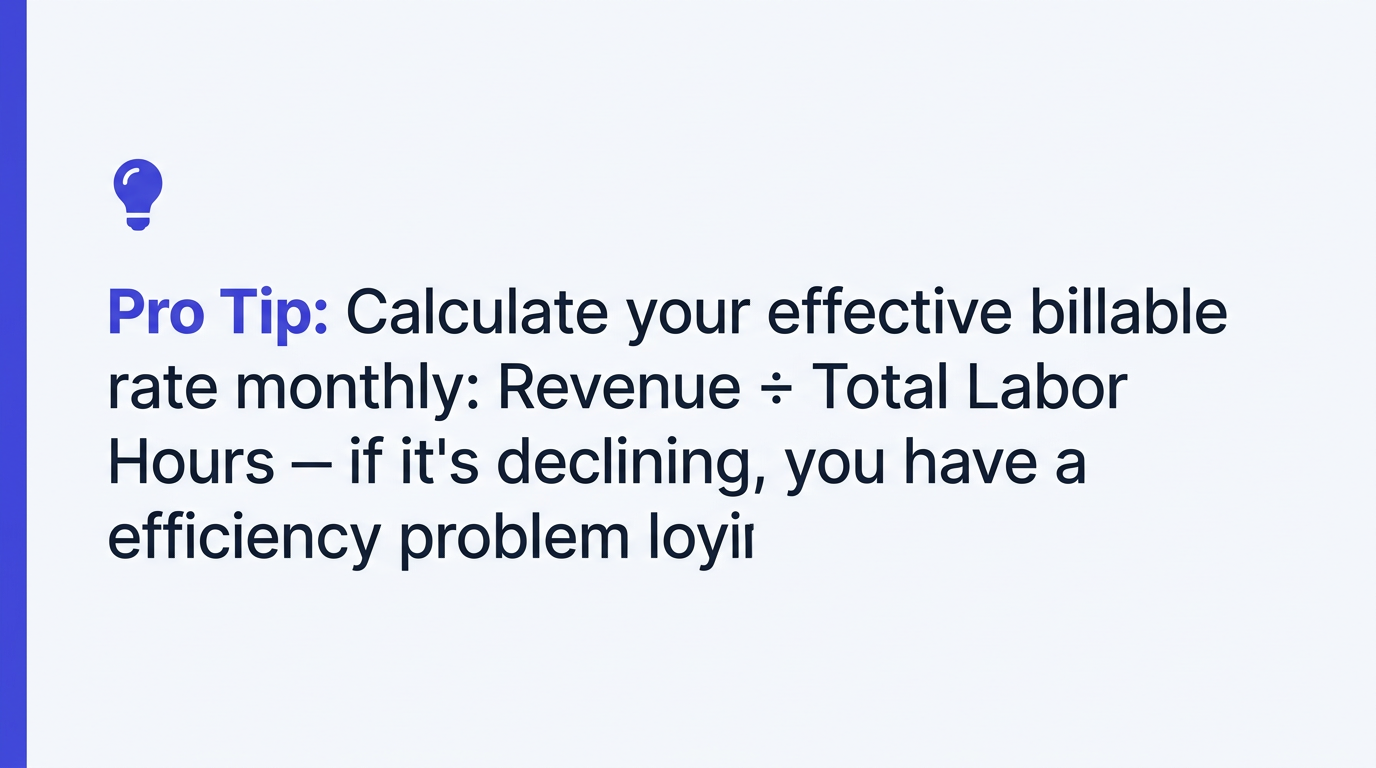
The fix: Set up Classes or Tags in QBO to track revenue and direct costs by project or client. Run a monthly Profit & Loss by Class report. Any project running below a 35% gross margin needs immediate review — renegotiate scope, adjust staffing, or let the client go.
2. Labor Burden Isn’t in Your Project Costing
You’re paying a Senior Associate $95K/year. But that’s not what they cost you. Once you add employer FICA (7.65%), health insurance ($7,200-$14,400/yr), PTO liability, 401(k) match, and overhead allocation — their true labor burden is $125K-$140K. That’s a 32-47% markup over base salary.
When you quote a fixed-fee project using the $95K salary as your cost basis, you’re building in a loss from day one. We see this constantly in architecture, engineering, and consulting firms where fixed-fee work is common.
The formula:
- Fully Loaded Hourly Cost = (Salary + Benefits + Taxes + Overhead) / Billable Hours Per Year
- Example: $135,000 total burden / 1,700 billable hours = $79.41/hr true cost
- If you’re billing them out at $175/hr, your real margin is $95.59/hr — not the $80/hr you thought
The fix: Build a labor burden worksheet for every role. (For a deeper dive on the full cost comparison, see our in-house vs outsourced bookkeeping cost analysis.) Update it annually. Use it as the baseline for all project pricing, not the salary number from the offer letter.
3. Reconciliation Lag — The Compounding Error Problem
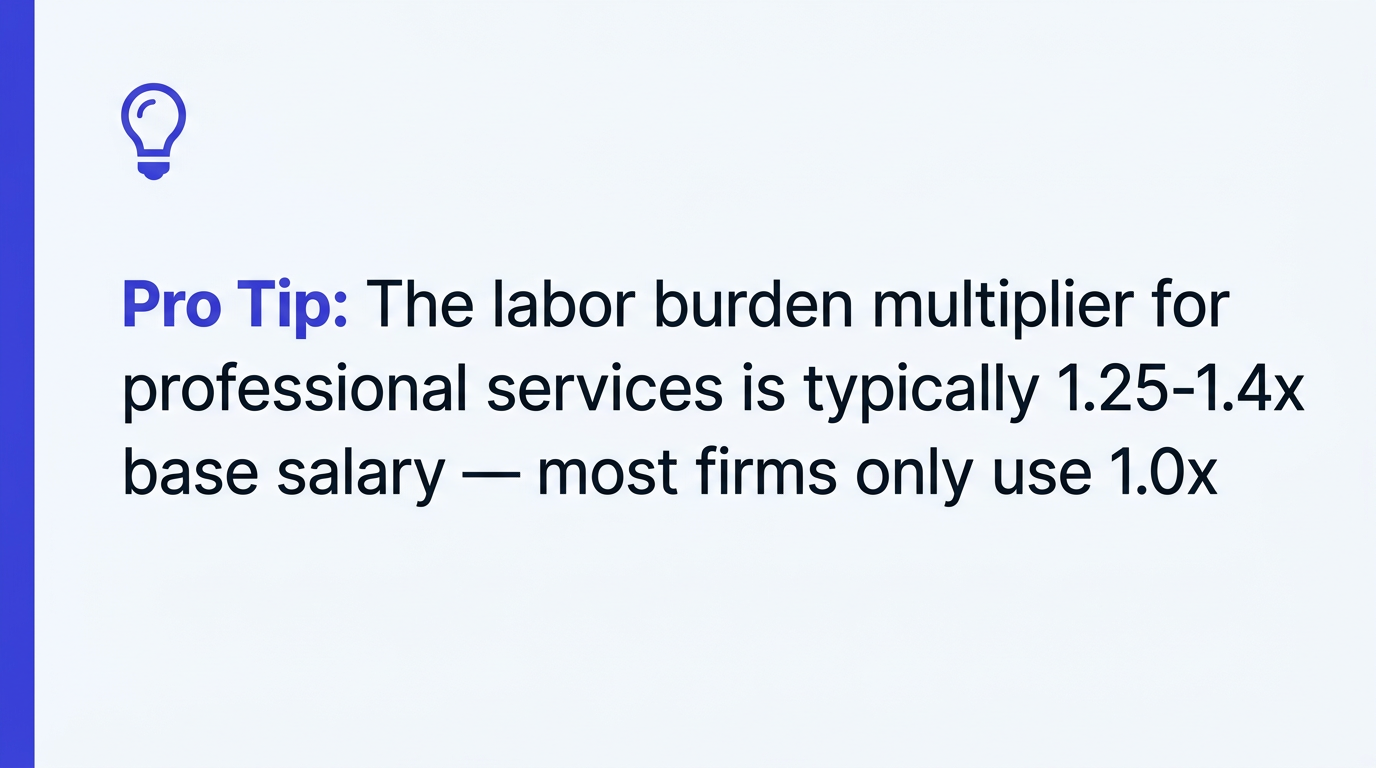
When reconciliation slips from monthly to quarterly (or worse, “before tax season”), errors don’t just accumulate — they compound. A miscategorized vendor payment in January creates a wrong expense allocation that skews your Q1 margins, which feeds bad data into your Q2 pricing decisions.
For firms running $1M+ through their accounts, a 60-day reconciliation lag typically surfaces $15K-$40K in misallocated expenses per quarter. That’s not missing money — it’s money in the wrong bucket, making your reports unreliable for decision-making.
The real cost: It’s not the bookkeeping hours to fix it. It’s the bad hiring decision you made because your project margins looked healthier than they actually were.
The fix: Monthly close by the 15th. No exceptions. If your current process can’t hit that cadence, the process is broken — not the deadline. A dedicated outsourced bookkeeping team with redundancy built in eliminates the “my bookkeeper is on vacation” problem.
4. Contractor Classification Exposure — The $50K+ IRS Surprise
Professional services firms love the flexibility of 1099 contractors. The IRS loves auditing them. If you’re treating someone as a contractor but they work set hours, use your tools, and only serve your firm — you’ve created a classification liability.
The penalty math is ugly:
- 100% of unpaid FICA taxes (employer + employee share)
- Federal Unemployment Tax retroactive liability
- State penalties vary but often add another 25-40%
- For a single misclassified worker earning $80K/year, retroactive liability can exceed $25,000 per year of misclassification
The fix: Audit your current contractor roster against the IRS 20-factor test. Track all 1099 payments in a separate expense category in QBO — not lumped into “Professional Services” or “Subcontractors.” Ensure every contractor has a signed agreement with clear scope, deliverables, and independence language.
5. Cash vs. Accrual Blindness — Revenue Isn’t Cash
Your P&L shows $280K in revenue last month. But $190K of that is unbilled WIP and outstanding receivables. Your actual cash collected was $90K — and payroll is $110K. You’re profitable on paper and insolvent in practice.
This is the #1 “phantom cash flow gap” in professional services. Accrual accounting shows revenue when earned. Cash accounting shows it when collected. If you’re only looking at one view, you’re missing half the picture.
The fix: Run both your P&L (accrual basis) and a Cash Flow Statement monthly. Track your Collection Efficiency Rate: Cash Collected / Revenue Recognized. Healthy firms maintain 85%+ collection efficiency on a rolling 90-day basis. Below 75% means your invoicing or collections process needs immediate attention.
The Pattern Here Is Clear
Every one of these mistakes shares a root cause: your books are set up to satisfy your tax preparer, not to run your business. A tax-ready chart of accounts and a management-ready chart of accounts are two different things. The firms that figure this out stop guessing and start engineering their profitability.
If any of these hit close to home, it’s not a failure — it’s a growth-stage problem. The spreadsheets and processes that worked at $500K break at $2M. That’s normal. What matters is fixing it before the next revenue milestone makes it more expensive.
Want to see where your firm is leaking margin? Request a free bookkeeping diagnostic — or if your books need immediate attention, learn about our catch-up bookkeeping services — we’ll identify the gaps and show you exactly what’s fixable in 30 days.