A Loop law firm running $3.2 million in annual revenue discovered during an audit that they’d been miscalculating Chicago’s Personal Property Lease Transaction Tax on their copier leases for four years. The back taxes, penalties, and interest totaled $18,400 — on a tax most business owners outside Chicago have never heard of. Their national bookkeeping firm hadn’t flagged it because their systems weren’t built for city-level tax obligations.
This is the problem with generic bookkeeping services in Chicago. The city layers its own taxes on top of Cook County and Illinois requirements, creating a compliance environment that’s genuinely unique in the Midwest. Between Chicago’s lease tax, amusement tax, use tax, and a business license system that triggers different reporting obligations depending on your industry, a bookkeeper who doesn’t know Chicago-specific rules will cost you more in missed obligations than they save in monthly fees.
This guide breaks down every Chicago-specific tax, payroll, and licensing requirement that affects your books — plus the Illinois credits and deductions that Chicago businesses routinely miss. Whether you’re running a small business in Wicker Park or a professional services firm in the Loop, these are the bookkeeping details that matter.
Chicago businesses don’t just file federal and state returns. The city imposes at least six distinct taxes that require separate tracking, calculation, and filing. Miss one and the Department of Finance will find you — Chicago is aggressive about enforcement.
When your business purchases tangible goods from out-of-state vendors that don’t collect Chicago sales tax — think office furniture from an online retailer, equipment from an out-of-state supplier, or software delivered on physical media — you owe Chicago Use Tax at 1.0% of the purchase price. This is on top of the Illinois use tax.
Most small businesses ignore this entirely. Chicago doesn’t. The city audits purchase records and cross-references them with vendor registrations. If you bought $50,000 in equipment from vendors who didn’t collect Chicago tax, that’s $500 you owe — plus penalties and interest if you didn’t self-report.
Bookkeeping implication: Your chart of accounts needs a liability account specifically for Chicago Use Tax. Every out-of-state purchase must be flagged and assessed for use tax applicability.
This is the tax that catches most businesses off guard. Chicago imposes a 9% tax on the lease or rental of personal property — including copiers, postage meters, water coolers, IT equipment, and even cloud-hosted software (the “cloud tax” portion). If your monthly copier lease is $400, you owe $36/month to the city.
The cloud computing aspect is especially problematic. Chicago taxes SaaS subscriptions that are used within city limits at 9%. That $200/month project management tool? Add $18 in Chicago lease tax. The $500/month CRM? Another $45.
Bookkeeping implication: Every lease and SaaS subscription needs a separate tax calculation line. Your bookkeeper must maintain a lease inventory and file the Lease Transaction Tax return.
If your business hosts events, sells tickets, or — crucially — pays for streaming services used in the office, the Chicago Amusement Tax applies. The rate is 9% on amusement charges, and since 2015, Chicago has applied this to streaming services like Spotify, Netflix, and other digital entertainment accessed within city limits.
For restaurants and entertainment venues, this is a major compliance item. But even standard office businesses owe it on their Spotify business account or the YouTube Premium subscription in the break room.
Since 2017, Chicago has imposed a $0.07 per bag tax on checkout bags provided by retail stores. If you run a retail operation — even a small boutique in Bucktown or a specialty shop on Michigan Avenue — you’re responsible for collecting this from customers and remitting it to the city.
Bookkeeping implication: Bag tax collected is a liability, not revenue. It needs its own line item in your books, and the quarterly filing must reconcile bags distributed against tax remitted.
Pro Tip: Chicago’s Department of Finance has an online portal for filing and paying most city taxes. Bookmark it: chicago.gov/fin. Late filing penalties start at 25% of the tax due, and interest accrues at 12% annually — among the steepest municipal rates in the country.
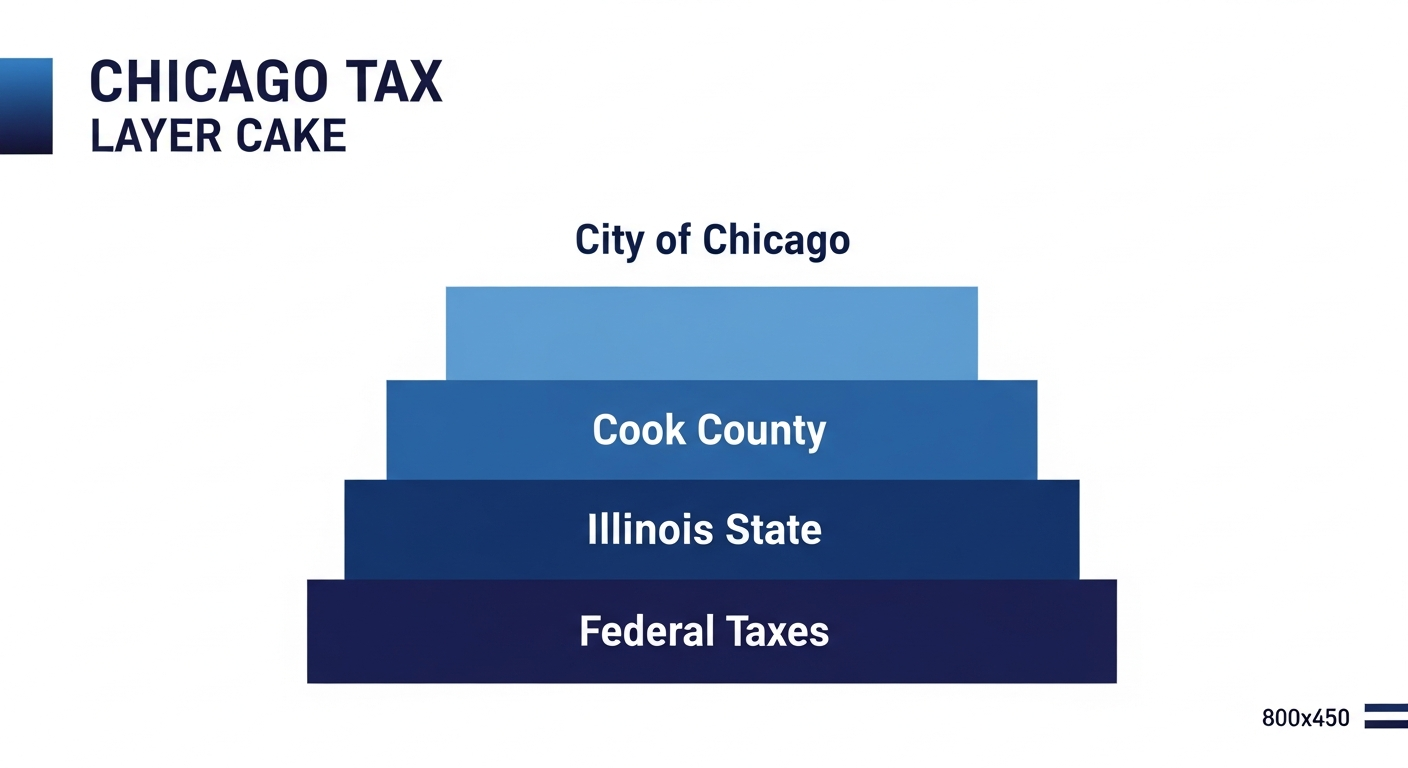
Chicago sits within Cook County, so you inherit county-level taxes on top of the city’s. Two are particularly relevant for bookkeeping.
The Cook County Sweetened Beverage Tax ($0.01/ounce) was in effect from August to December 2017 before being repealed. If you’re a food service business that operated during that period and haven’t been audited, you should still have clean records. More importantly, the political environment means similar taxes could return — and your bookkeeping systems should be flexible enough to add new per-unit taxes without a complete overhaul.
For current operations, Chicago’s existing restaurant tax surcharge of 0.25% still applies to food and beverages sold at restaurants, and the Metropolitan Pier and Exposition Authority (MPEA) tax adds another 1.0% on food and beverages in the downtown area.
If your business operates parking facilities or validates employee parking, Cook County imposes taxes on parking transactions. The combined Chicago + Cook County rate on non-residential parking reaches 30% in the Loop. Your bookkeeper needs to separate these from operating expenses and track the tax component correctly.
Illinois has its own set of rules that interact with Chicago and Cook County taxes. Three deserve special attention.
Illinois uses a flat 4.95% individual income tax rate and a 9.50% corporate income tax rate (7.0% corporate + 2.5% replacement tax). Unlike progressive-tax states, there’s no bracket planning — every dollar of taxable income is hit at the same rate.
For pass-through entities (S-corps, partnerships, LLCs), this means the owners pay 4.95% on their share of business income on their personal returns. But there’s an important election available.
Since 2021, Illinois allows pass-through entities to elect to pay state income tax at the entity level rather than passing it through to individual owners. This is a direct workaround for the federal $10,000 SALT deduction cap.
How it works: The entity pays the 4.95% Illinois tax directly, deducts it as a business expense on the federal return (bypassing the SALT cap), and the owners claim a credit on their Illinois personal returns.
Example: A Chicago law firm structured as an S-corp with $800,000 in net income saves roughly $39,600 in federal taxes by making the PTE election (4.95% × $800,000 = $39,600 entity-level deduction at a ~33% federal marginal rate = ~$13,000 in actual federal tax savings).
Bookkeeping implication: The PTE election requires estimated quarterly payments at the entity level, a separate tax liability account, and coordination with your CPA. Your bookkeeper needs to track estimated PTE payments alongside regular estimated taxes.
Critical: The PTE election must be made annually, and the deadline aligns with the original return due date. Miss the election window and you lose the SALT cap workaround for the entire tax year. Your bookkeeper should flag this deadline in Q1 every year.
Good news: Illinois fully eliminated the franchise tax as of January 1, 2024. Previously, Illinois corporations and LLCs paid an annual franchise tax based on paid-in capital. If you’re still seeing franchise tax line items in your books from a prior accountant, those can be removed — but make sure any prior-year liabilities are resolved first.
| Illinois Tax Item | Rate / Status | Bookkeeping Action |
|---|---|---|
| Individual income tax | 4.95% flat | Track estimated quarterly payments |
| Corporate income tax | 7.0% + 2.5% replacement | Separate liability accounts for each |
| PTE election | 4.95% at entity level | Quarterly estimated payments + annual election |
| Franchise tax | Eliminated (Jan 2024) | Remove from chart of accounts; resolve prior liabilities |
| Sales tax (Chicago) | 10.25% combined | Collect, track, and file monthly or quarterly |
| Vehicle use tax | Based on purchase price | One-time filing within 30 days of purchase |
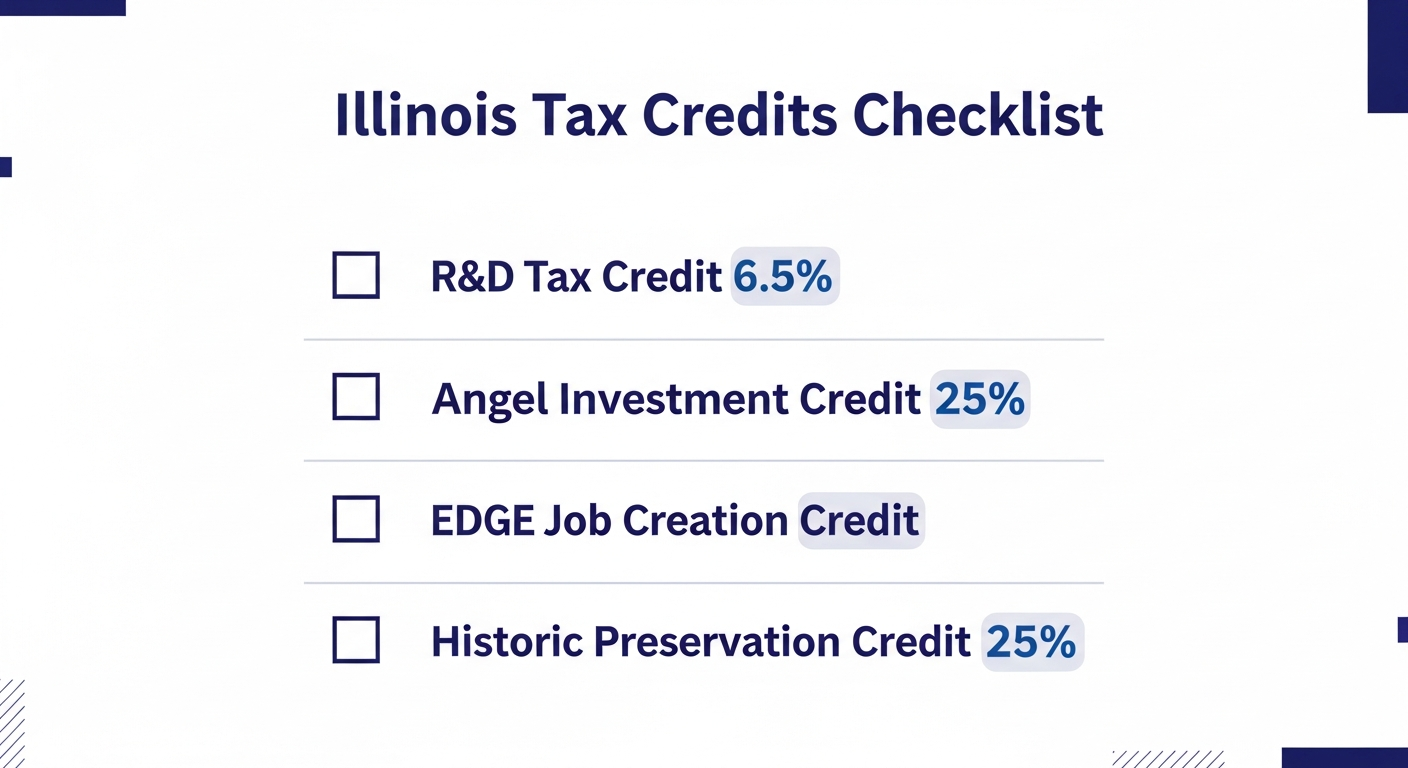
Your bookkeeper’s job isn’t just tracking obligations — it’s making sure you’re capturing every credit and incentive you qualify for. Illinois offers several that Chicago businesses routinely leave on the table.
Illinois offers an R&D tax credit equal to 6.5% of qualifying research expenditures that exceed a base amount. This isn’t just for tech companies. If your architecture firm is developing new construction methodologies, your agency is building proprietary software tools, or your consulting firm is creating original frameworks — you may qualify.
The credit is calculated on a rolling base, so consistent R&D spending compounds the benefit. Most Chicago professional services firms never claim it because they don’t think of their work as “research.”
If you’re investing in early-stage Illinois companies, the Angel Investment Tax Credit provides a 25% credit on investments in qualified new business ventures. The business must be headquartered in Illinois and meet certain criteria. Chicago’s startup ecosystem makes this relevant for business owners who angel invest on the side.
The EDGE program provides tax credits to businesses that create jobs in Illinois. The credit is based on the personal income tax generated by the new employees — essentially, the state returns a portion of the income tax your new hires pay.
Eligibility: Your business must create a minimum number of new full-time jobs (typically 5-25 depending on business size) and make a capital investment. Chicago businesses in growth mode should evaluate this annually.
Pro Tip: Most of these credits require documentation that starts at the bookkeeping level — payroll records, capital expenditure tracking, R&D time logs. If your bookkeeper isn’t capturing this data throughout the year, you can’t claim the credits at tax time regardless of whether you qualify.
Chicago’s business license system is managed by the Business Affairs and Consumer Protection (BACP) department. Unlike many cities where a single general business license covers everything, Chicago issues activity-specific licenses that carry their own fees, renewal schedules, and compliance requirements.
Most professional services firms — law firms, accounting firms, consulting agencies, marketing firms — need a Limited Business License ($250 for two years). This is the baseline. But if your business involves any of the following, you need additional licenses:
Bookkeeping implication: License fees are deductible business expenses, but the renewal dates vary. Your bookkeeper should maintain a license calendar and accrue the expenses over the license period rather than expensing them in the month paid.
Businesses in certain industries — collection agencies, home repair contractors, pawnbrokers, and others — require a Regulated Business License with additional compliance requirements including surety bonds and financial statement disclosures.
For construction firms on the South Side or contractors operating across the city, this means additional bookkeeping for bond premiums, compliance documentation, and inspection fees.
Payroll in Chicago involves state and local requirements that differ from other major metros.
New employers in Illinois start with a UI tax rate of 3.95% on the first $13,590 of each employee’s wages (2026 taxable wage base). Experienced employers get a rate based on their claims history, ranging from 0.55% to 7.35%. Your bookkeeper needs to track UI liability by employee and monitor your experience rating annually.
Every employee working in Illinois is subject to the 4.95% flat withholding regardless of where they live. No local income tax in Chicago itself, but the state withholding applies uniformly. File Form IL-941 quarterly (or monthly if withholding exceeds $1,000/month).
The Regional Transportation Authority (RTA) tax adds 1.00% to sales in Cook County, and employers in the RTA region are subject to payroll-related transit funding obligations. While not a direct payroll tax, these affect your total cost of employment calculations.
As of 2026, Chicago’s minimum wage is $16.20/hour for employers with 21+ employees (higher than the Illinois minimum of $14.00). The Chicago Paid Leave and Paid Sick Leave Ordinance requires employers to provide 40 hours of paid leave and 40 hours of paid sick leave per 12-month period.
Bookkeeping implication: You need separate accrual tracking for paid leave and paid sick leave. These are distinct banks — employees can’t be forced to use paid leave for sick days. The accrual rates, carryover rules, and payout requirements all need to be tracked per employee.
| Payroll Item | Illinois / Chicago Requirement | Bookkeeping Action |
|---|---|---|
| Minimum wage | $16.20/hr (Chicago, 21+ employees) | Verify compliance; separate from state minimum |
| State income tax | 4.95% flat withholding | Monthly or quarterly filing (IL-941) |
| Unemployment insurance | 3.95% new employer rate, $13,590 base | Track per employee; monitor experience rating |
| Paid leave | 40 hrs paid leave + 40 hrs sick leave | Separate accrual accounts per employee |
| Workers’ compensation | Required for all employers | Track premium payments; classify by job code |
| PTE estimated payments | Quarterly if election made | Separate liability account |
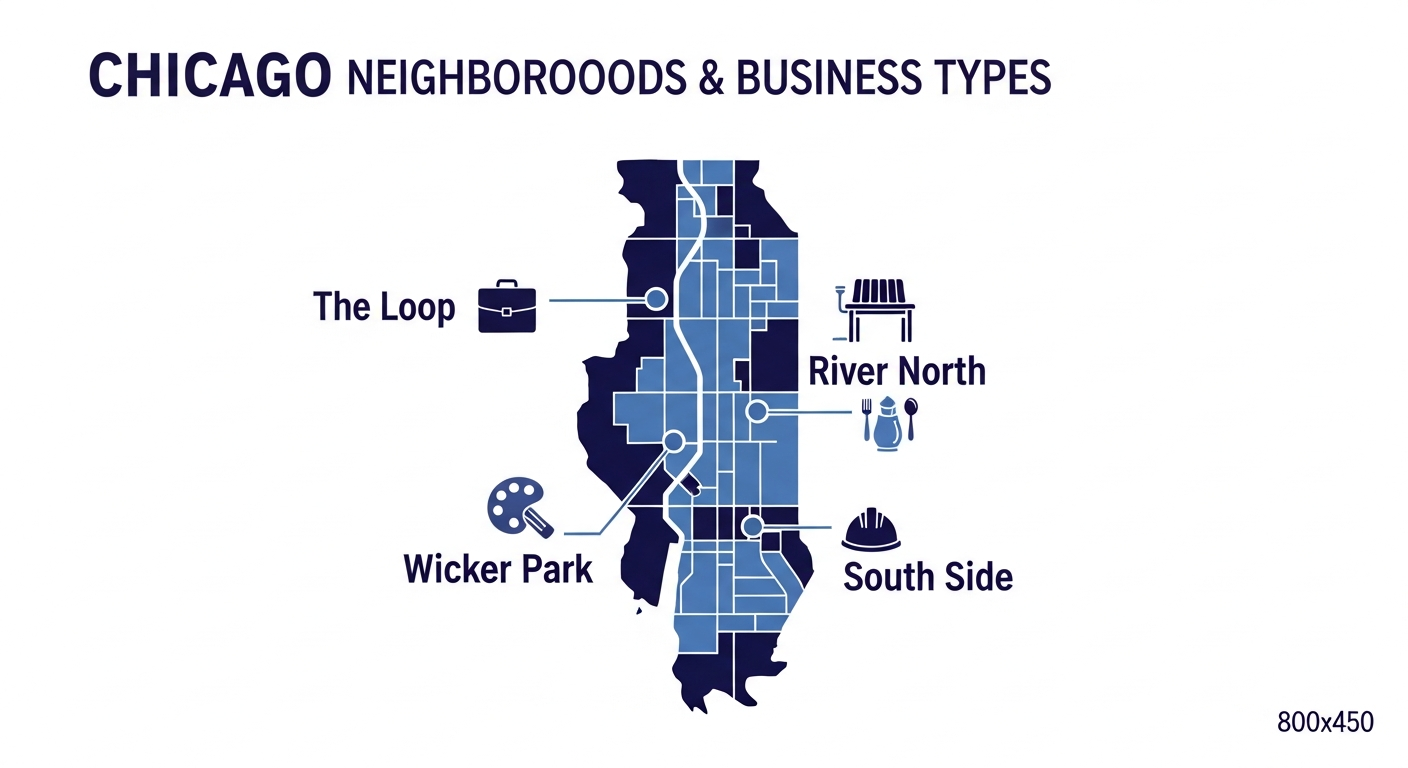
Chicago’s bookkeeping needs vary dramatically by neighborhood and industry cluster. Understanding these patterns helps explain why a bookkeeper who knows Chicago outperforms a generic national service.
The densest concentration of law firms, financial advisors, consulting firms, and corporate offices in the Midwest. Bookkeeping complexity here centers on trust accounting (IOLTA for law firms), retainer management, partner distributions, and high-volume accounts receivable with 60-90 day collection cycles.
These firms need bookkeeping services that understand matter-level billing, work-in-progress tracking, and the interplay between practice management software (Clio, PracticePanther) and QuickBooks.
Chicago’s restaurant scene generates unique bookkeeping challenges: tip reporting and allocation, food cost tracking (target 28-32% of revenue), liquor inventory, the Chicago restaurant tax surcharge, and the seasonal cash flow swings that come with patio season versus January.
A River North restaurant doing $2.5 million in revenue might process 3,000+ transactions per month during peak season. That volume requires systems, not spreadsheets.
The creative corridor running from Wicker Park through Logan Square and into Fulton Market houses hundreds of marketing agencies, design studios, film production companies, and tech startups. Their bookkeeping challenges are project-based profitability tracking, contractor vs. employee classification (critical for agencies using freelance designers and developers), and SaaS subscription management — which circles back to Chicago’s lease transaction tax on cloud software.
Chicago’s construction and trades businesses — electrical, plumbing, HVAC, general contracting — cluster on the South and Southwest sides. Their bookkeeping complexity involves job costing, certified payroll (for prevailing wage projects), subcontractor 1099 management, equipment depreciation, and the licensing and bonding requirements that generate their own paper trails.
From Schaumburg to Oak Brook to Naperville, the suburban ring around Chicago hosts thousands of professional services firms. They face the same Illinois state obligations but escape most Chicago city-specific taxes — a distinction your bookkeeper must understand. A firm in Evanston doesn’t owe Chicago’s lease transaction tax, but they do owe Cook County taxes.
These local resources provide free or low-cost support for Chicago business owners dealing with financial management challenges.
SCORE Chicago provides free mentoring from experienced business professionals, including financial management guidance. They run regular workshops on bookkeeping basics, tax preparation, and cash flow management. For businesses that aren’t ready for professional bookkeeping, SCORE mentors can help you set up basic systems.
The Illinois SBDC network offers free one-on-one consulting and training. The Chicago-area centers — including locations at the University of Illinois Chicago and the Women’s Business Development Center — specialize in financial projections, loan readiness, and accounting system setup.
The BACP Small Business Center at City Hall provides free consultations on licensing, permits, tax obligations, and regulatory compliance. If you’re unsure which Chicago taxes apply to your business, this is the place to start.
The SBA Illinois District Office in Chicago provides access to capital programs, disaster loans, government contracting resources, and connections to lenders who work with small businesses. They can also connect you with HUBZone and 8(a) programs if your business is located in qualifying Chicago neighborhoods.
The IDOR handles all state tax registrations, filings, and payments. Their website provides tax rate lookup tools, filing calendars, and guidance on the PTE election process. For Chicago businesses, start here for state obligations before layering on city-specific requirements.
Here’s a reality check: the best bookkeeper for your Chicago business might not be in the Loop. They might be 60 miles northwest.
Steph’s Books is based in McHenry, IL — close enough to understand every Chicago and Illinois tax obligation covered in this guide, but without the overhead of a downtown office that gets passed along in your monthly fee.
Remote bookkeeping works because your books are already digital. Your QuickBooks Online file, your bank feeds, your payroll platform, your invoicing system — none of them require physical proximity. What they require is a bookkeeper who knows the Chicago tax landscape and builds compliance into your chart of accounts from day one.
Whether you hire locally or remotely, your bookkeeper should be able to answer these questions without Googling:
If they can’t — or if they’ve never heard of the Personal Property Lease Transaction Tax — you’re working with a bookkeeper who doesn’t know Chicago.
Ready to see what Chicago-specific bookkeeping actually costs? Use our instant quote tool to get a price in 60 seconds — no email required. Or visit our Chicago bookkeeping page to see how we work with Chicago-area businesses.
Answer a few quick questions for an instant, no-obligation quote — no sales call required. See how Steph's Books saves you 40-60% vs. hiring in-house.