If you run a contracting company between $1M and $10M in revenue, subcontractors are a core part of your business model. Duct installers, drain camera operators, low-voltage specialists, irrigation crews — you bring in skilled trades people for specific scopes, pay them by the job, and move on to the next project. Managing 1099 for subcontractors contractors depend on is not complicated in theory: collect a W-9, track payments, file a 1099-NEC at year end. In practice, most contractors we onboard have at least a few subs with missing paperwork, inconsistent payment records, or vendor setup errors that create real IRS exposure.
This post is a cross-trade compliance guide that applies whether you run an HVAC company, a plumbing operation, an electrical shop, a GC firm, or a landscaping business. For a deeper look at bookkeeping for your specific trade, see our complete contractor bookkeeping guide. Everything below — W-9 onboarding, payment tracking, 1099-NEC filing, penalty structures, and worker misclassification risk — applies to every trade that uses subcontractors.
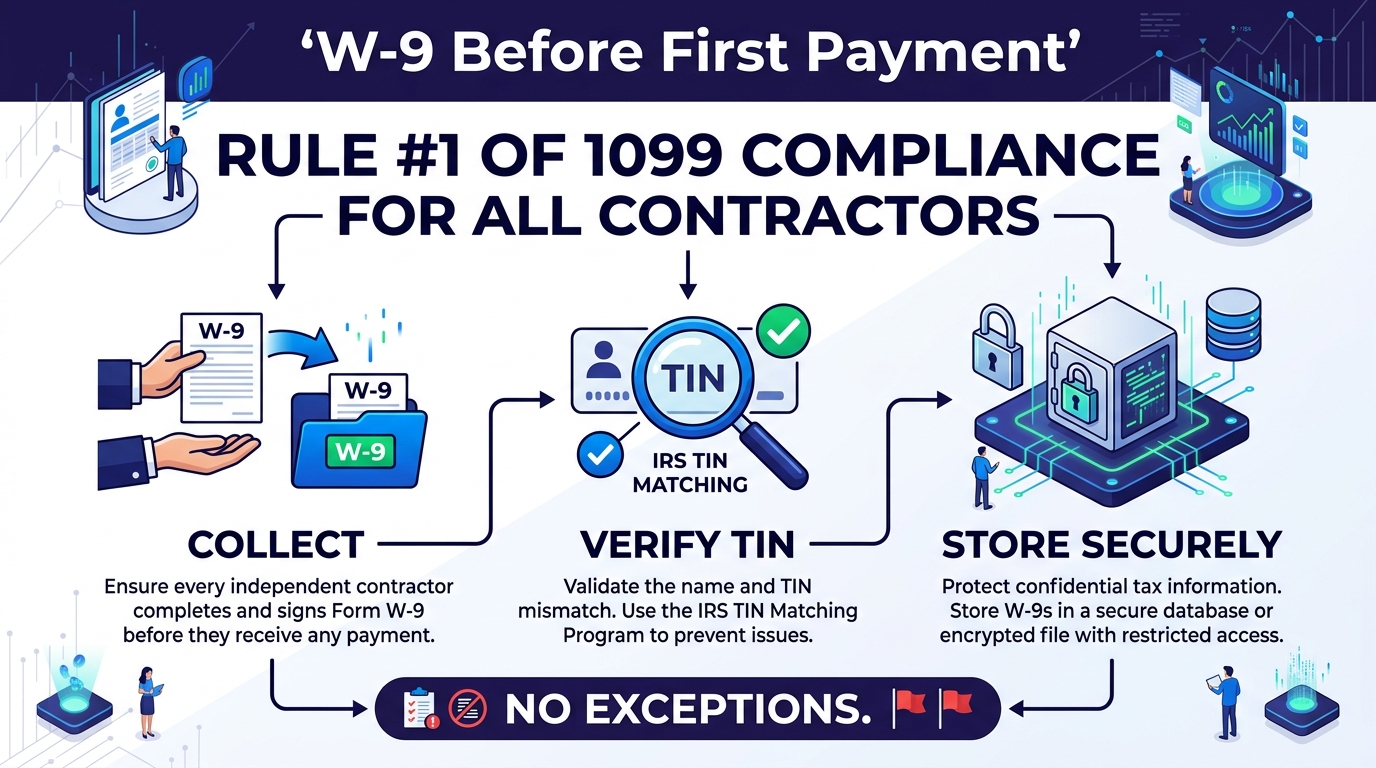
The single most important compliance step happens before you write the first check. Require a completed W-9 from every subcontractor before the first payment. Not after the job. Not at year end when you are scrambling. Before.
1. Request the W-9 at engagement. When you agree to bring on a sub for a project, send the W-9 request as part of your subcontractor agreement package. Make it a gating requirement — no W-9, no purchase order, no payment.
2. Verify the TIN. The IRS TIN Matching program lets you verify that the name and Taxpayer Identification Number on a W-9 actually match IRS records. A mismatched TIN triggers a B-Notice from the IRS and can result in backup withholding at 24% — meaning you are required to withhold 24% of every payment to that sub and remit it to the IRS until the mismatch is resolved.
3. Store W-9s securely. These forms contain Social Security numbers or EINs. Store them in an encrypted digital folder with access controls — not in an unlocked filing cabinet, not in an open shared drive. Retention requirement: four years after the tax year the form covers.
4. Re-collect W-9s when information changes. If a sub incorporates, changes their business name, or gets a new EIN, you need an updated W-9 before the next payment.
Pro Tip: Build a new-sub onboarding checklist: W-9, certificate of insurance, subcontractor agreement, and lien waiver template. Do not issue a purchase order until all four are on file. This one process eliminates 90% of year-end 1099 headaches.
Every nonemployee you paid $600 or more during the calendar year gets a 1099-NEC. This applies to individuals, partnerships, and LLCs taxed as sole proprietors or partnerships. It does not apply to payments made to corporations (S-corps and C-corps) — which is exactly why the W-9 matters, because it tells you the entity type.
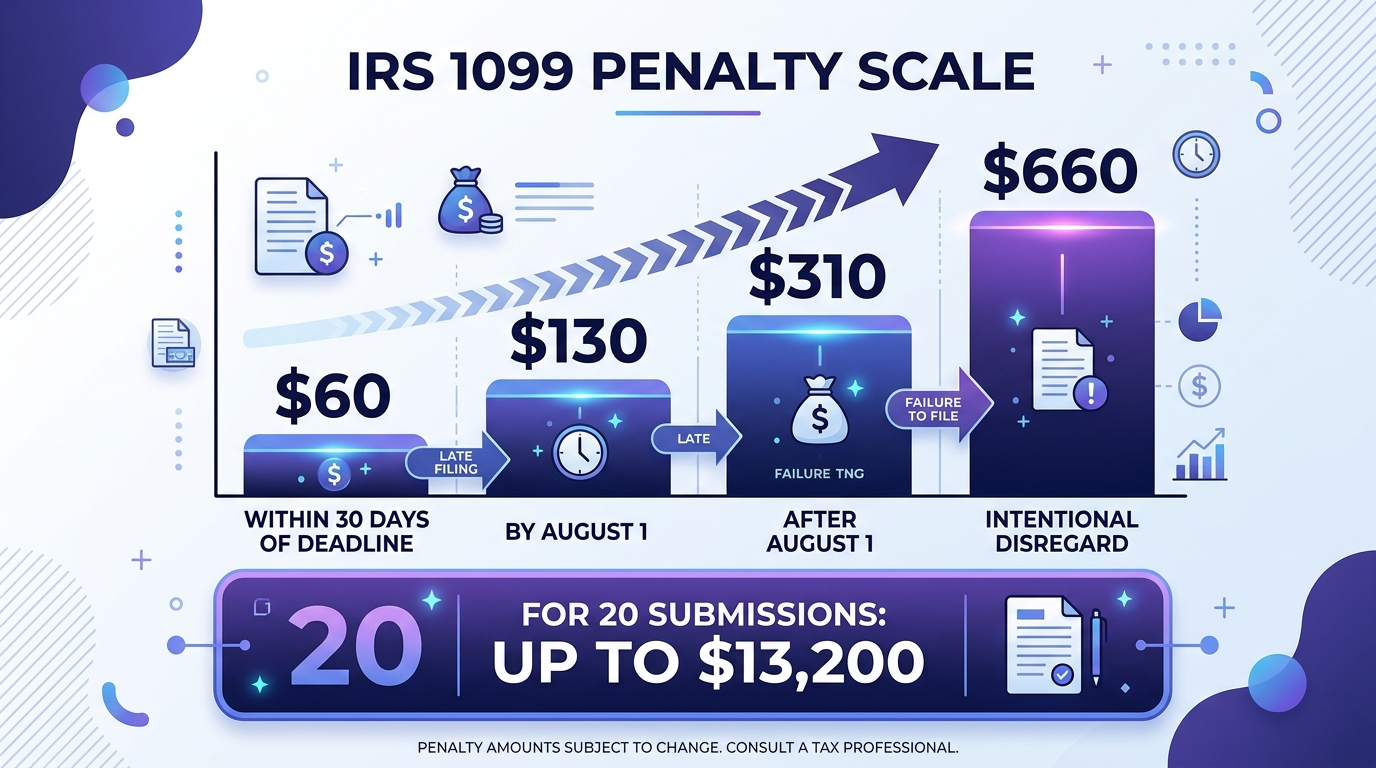
Miss the deadline and penalties escalate based on how late you file:
| Filing Status | Penalty Per Form | Example: 20 Subs |
|---|---|---|
| Filed within 30 days of deadline | $60 | $1,200 |
| Filed by August 1 | $130 | $2,600 |
| Filed after August 1 or not at all | $310 | $6,200 |
| Intentional disregard | $660 | $13,200 |
These penalties apply per form. A general contractor with 20 active subcontractors who misses the January 31 deadline and does not file until September is looking at $6,200 in penalties — for paperwork, not fraud. And if the IRS determines you showed intentional disregard — meaning you knew the requirement and ignored it — the penalty jumps to $13,200 for those same 20 forms.
Real scenario: A GC we onboarded had 20 active subs. Five were missing W-9s entirely. Without the W-9, you cannot file the 1099 on time — which means at minimum $60 per form if you correct within 30 days, or $310 each if you do not track them down until after August 1. Those five missing W-9s represented $1,550 in potential penalties just for late filing — before any TIN mismatch or backup withholding issues entered the picture.
Worker misclassification — treating someone who functions as an employee as a 1099 subcontractor — is the highest-risk compliance issue in the trades. Contracting companies are particularly vulnerable because the line between “sub” and “employee” gets blurry in field operations.
The IRS uses a three-factor test grouped into behavioral control, financial control, and relationship type:
Behavioral control: Do you tell the worker when to show up, how to do the work, and what tools to use? If yes, they are likely an employee. A true sub sets their own schedule, uses their own equipment, and controls their own methods.
Financial control: Does the worker have a significant investment in their own tools and equipment? Do they serve multiple clients? Can they profit or lose money on a job? Legitimate subs carry their own insurance, own their equipment, and market their services to other contractors.
Relationship type: Is the work ongoing and integral to your business, or project-based and specialized? A worker who shows up exclusively for you, 40 hours a week, on your jobsite, using your tools is an employee — regardless of what your contract says.
If the IRS or your state determines you misclassified employees as independent contractors, the financial exposure is severe:
Every trade uses subs differently. Here is where 1099 for subcontractors contractors need to manage across the major trades:
HVAC contractors routinely sub out duct fabrication and installation, refrigerant recovery specialists, controls and BAS (building automation) programmers, sheet metal work, and crane services for rooftop unit placement. A mid-size HVAC company with $3M in revenue might have 8-15 active subs in any given year.
Plumbing contractors use gas line specialists, drain camera and CCTV inspection operators, trenching and excavation crews, backflow prevention testers, and fire suppression contractors. See our plumbing 1099 subcontractor guide for a deep dive on plumbing-specific compliance. A plumbing operation running $2M-$5M can easily have 10-20 subs on the books.
Electrical contractors frequently sub low-voltage and data cabling work, fire alarm installation and testing, generator installation, solar panel mounting, and traffic signal specialists. The licensing requirements vary by state, which makes the employee-vs-sub classification even more critical — if your state requires the sub to hold their own electrical license, that supports independent contractor status.
General contractors use the most subcontractors of any trade. Every specialty — framing, drywall, painting, flooring, roofing, concrete, masonry, steel, glazing — is typically subbed out. A GC running $5M-$10M in revenue can easily file 30-50 1099-NECs per year.
Landscaping companies sub out irrigation system design and installation, tree removal and arborist work, hardscaping (pavers, retaining walls, outdoor kitchens), and seasonal snow removal crews. The seasonal nature of landscaping means sub relationships start and stop frequently, making W-9 tracking even more important.
The IRS requires you to keep employment tax records for four years after the due date of the return or the date the tax was paid — whichever is later. For 1099 purposes, this means:
Store everything digitally with dated backups. If you use QuickBooks Online, your transaction data is retained automatically — but the W-9s and subcontractor agreements need a separate, organized storage system.
Accurate 1099 reporting starts with how you set up vendors and categorize payments in QBO. Get this right and year-end filing takes 20 minutes. Get it wrong and you are pulling bank statements in January trying to reconstruct a year of sub payments.
1. Create each sub as a vendor. Go to Expenses > Vendors > New Vendor. Enter the legal name exactly as it appears on the W-9 — not nicknames, not DBA names unless the W-9 specifies.
2. Enable 1099 tracking. On the vendor record, check “Track payments for 1099.” This is the step most contractors miss. Without this flag, the vendor’s payments will not appear in your 1099 report.
3. Enter the TIN. Input the EIN or SSN from the W-9 into the Tax ID field. QBO uses this to populate the 1099-NEC forms at filing time.
4. Categorize payments correctly. Map sub payments to a dedicated COGS account — typically 5070 Subcontractor Costs or 5300 Subcontractor Costs depending on your chart of accounts. Do not dump sub payments into a generic “Contract Labor” or “Outside Services” expense account. This keeps your job costing clean and your bookkeeping audit-ready.
5. Run the 1099 report quarterly. Go to Reports > 1099 Transaction Detail and run it every quarter — not just at year end. Catch missing vendors and miscategorized payments while you can still fix them without panic.
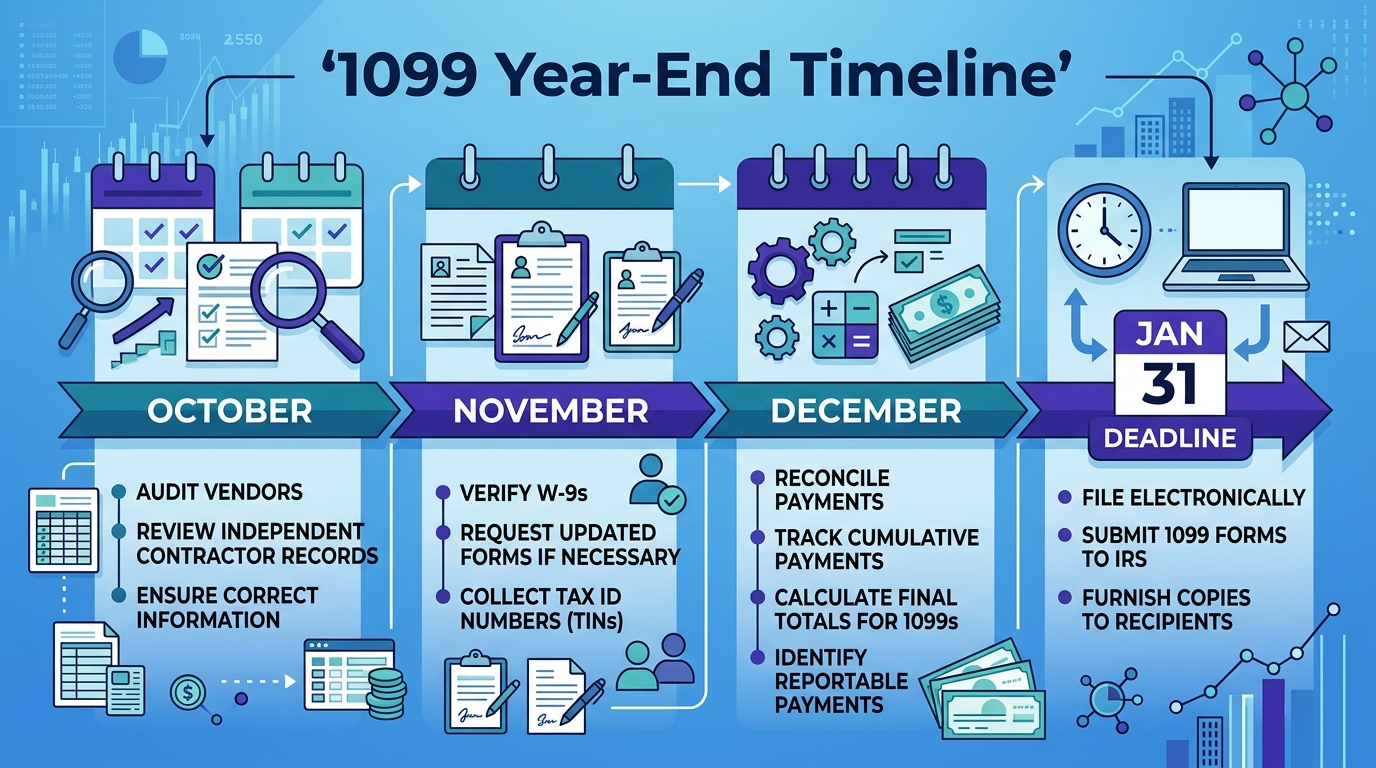
Do not wait until January. The contractors who file cleanly every year follow a timeline that starts in October.
Stop chasing W-9s in January. Steph’s Books handles 1099 subcontractor tracking, W-9 management, and year-end filing for trade contractors across every specialty — HVAC, plumbing, electrical, general contracting, and landscaping. We keep your vendor records clean, your payments categorized correctly, and your 1099-NECs filed on time. Get an instant quote or schedule a free consultation to lock down your subcontractor compliance.
Answer a few quick questions for an instant, no-obligation quote — no sales call required. See how Steph's Books saves you 40-60% vs. hiring in-house.