
Most business owners compare a bookkeeper’s salary against a monthly outsourcing fee and call it a day. That comparison misses roughly 60% of the actual cost of keeping bookkeeping in-house.
The salary is the smallest line item in the equation. Benefits, payroll taxes, software, training, turnover, management time, and the cost of errors — these are the numbers that turn a $55K hire into a $90K commitment. And they’re the numbers nobody puts on the job posting.
This is the full breakdown. No spin, no cherry-picked scenarios. If in-house is the right call for your firm, you’ll know by the end. If it’s not, you’ll know that too.
The True Cost of In-House Bookkeeping

Here’s what actually shows up on your P&L (and what doesn’t) when you hire a full-time bookkeeper.
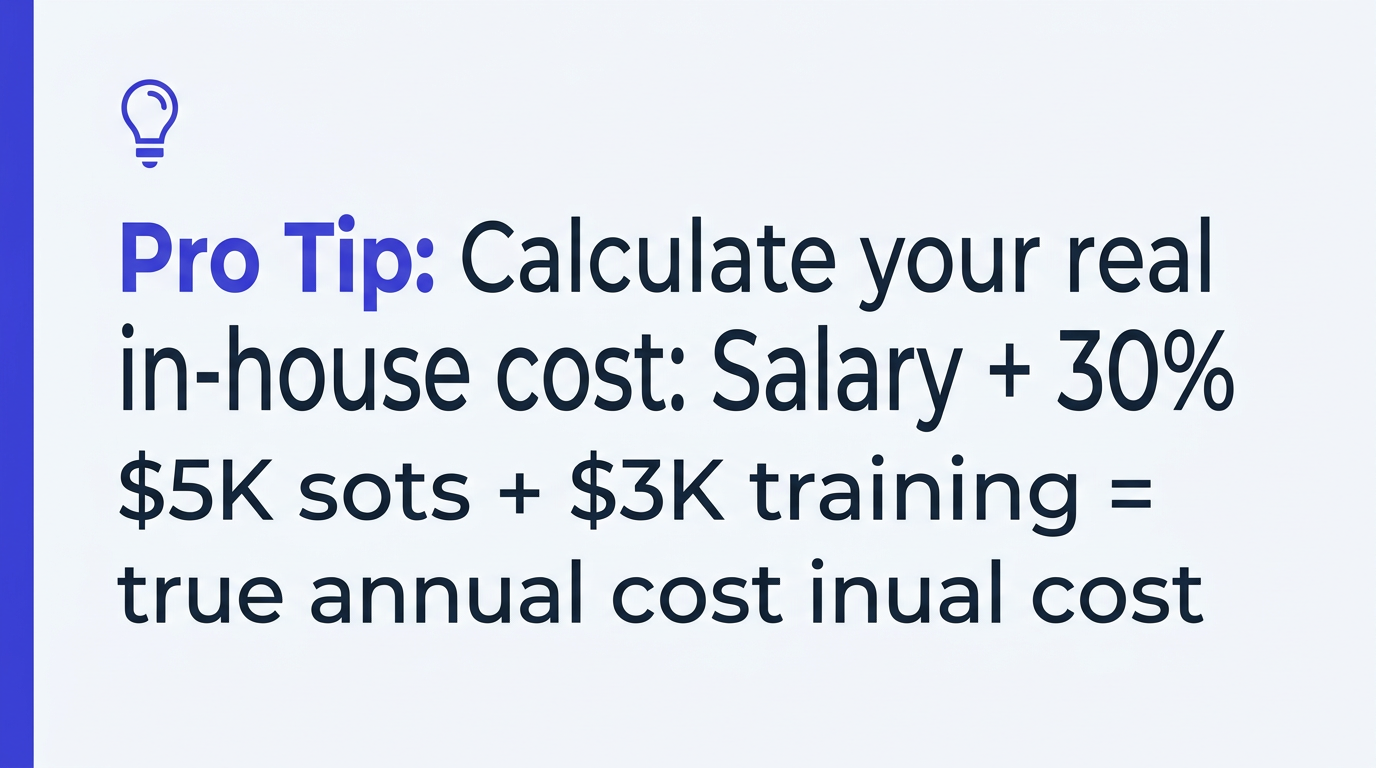
Salary: $45,000–$65,000
A qualified bookkeeper — someone who can handle accrual-basis accounting, monthly closes, and multi-entity reconciliation — commands $45K–$65K in 2026. That range depends on metro area, industry experience, and whether they’ve worked with your specific tech stack. If you need someone fluent in Clio or Procore on top of QuickBooks, you’re looking at the upper end.
Entry-level hires at $38K–$42K exist, but you’ll spend the first six months fixing their work. That’s not a savings — it’s a deferred cost with interest.
Benefits: Add 25–35% to Salary
Health insurance alone runs $7,200–$14,400/year for employer contributions on a single employee. Add PTO (average 15 days, worth $2,600–$3,750 in paid non-working time), retirement matching at 3–6% of salary, and disability/life insurance.
For a $55K bookkeeper, benefits add $13,750–$19,250 to your annual cost.
Payroll Taxes: 7.65% FICA + State
The employer share of Social Security and Medicare is 7.65% on every dollar of salary. On a $55K salary, that’s $4,208/year. Add state unemployment insurance (SUTA), which varies but typically runs $200–$1,500/year depending on your state and experience rating.
Software Licenses: $200–$500/month
Your in-house bookkeeper still needs tools. QuickBooks Online Advanced runs $235/month. Payroll processing adds $75–$150/month. Bill.com or similar AP automation is $79–$199/month. Expense management, receipt capture, reporting dashboards — each one adds to the stack.
Annual software cost: $2,400–$6,000. And you’re paying these whether your bookkeeper is productive that month or not.
Training and Turnover: The Hidden Multiplier
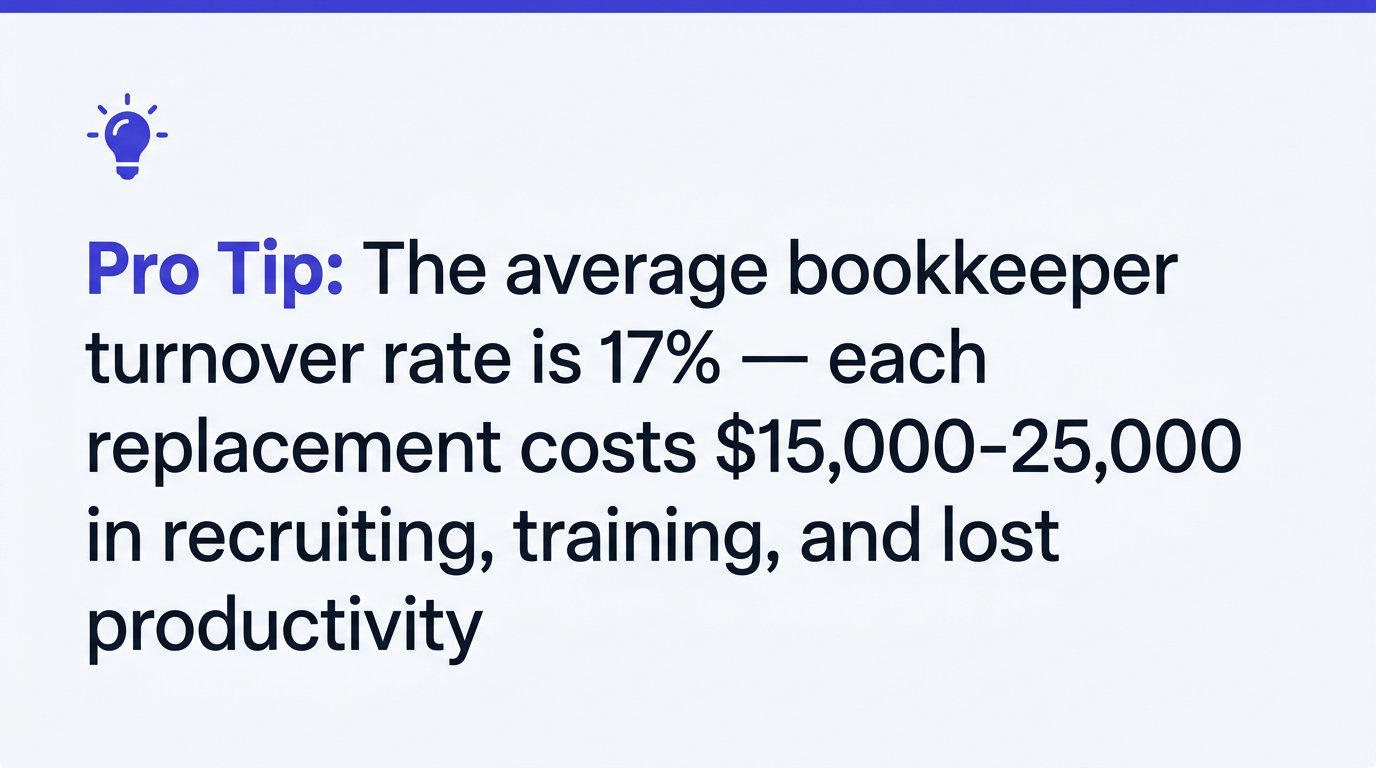
The average bookkeeper tenure is 2.3 years. That means every 2–3 years, you’re absorbing:
- Recruiting costs: Job postings, screening, interviews — $3,000–$8,000 per hire cycle
- Ramp-up time: A new bookkeeper needs 2–4 months to learn your chart of accounts, vendor relationships, and reporting preferences
- Lost productivity: During the transition, month-end closes slip. Reports arrive late. Errors spike.
- Knowledge loss: The institutional knowledge about why that one client’s retainer is structured differently walks out the door
Amortized over that 2.3-year tenure, turnover adds $2,500–$5,000/year to the real cost.
Management Overhead: Your Time Has a Price
Someone has to review the bookkeeper’s work, answer their questions, approve journal entries, and handle performance management. For most firms in the $1MM–$10MM range, that someone is the managing partner or ops director — people whose billable time is worth $150–$400/hour.
Even at just 3–5 hours per month of oversight, that’s $5,400–$24,000/year in opportunity cost. It doesn’t show up on a P&L, but it shows up in your calendar.
Error Risk and Coverage Gaps
A single bookkeeper is a single point of failure. When they’re on PTO, out sick, or (more common than anyone admits) quietly job-hunting for the last three months of their tenure, your books stall.
Sick days and PTO alone create 20–25 business days per year with no coverage. Some firms hire temp bookkeepers to fill gaps — at $35–$50/hour, that’s another $2,000–$5,000/year for coverage you hope you won’t need.
Then there’s the cost of errors that go unreviewed because there’s no second set of eyes. A misclassified expense category might not cost you today, but it costs you at tax time or during a bank audit.
Total Fully Loaded Cost: $65,000–$95,000/Year
| Cost Component | Low Estimate | High Estimate |
|---|---|---|
| Salary | $45,000 | $65,000 |
| Benefits (25–35%) | $11,250 | $22,750 |
| Payroll taxes (FICA + SUTA) | $4,400 | $6,500 |
| Software licenses | $2,400 | $6,000 |
| Turnover (amortized) | $2,500 | $5,000 |
| Management overhead | $5,400 | $12,000 |
| Coverage/error risk | $2,000 | $5,000 |
| Total | $72,950 | $122,250 |
The low end assumes a junior-mid bookkeeper in a low-cost market with minimal oversight. The high end reflects a qualified bookkeeper in a competitive metro with full benefits. Most professional services firms land in the $75K–$95K range once everything is counted.
What Outsourced Bookkeeping Actually Costs
For firms in the $1MM–$10MM revenue range, outsourced bookkeeping typically runs $1,500–$5,000/month. The range depends on transaction volume, number of entities, payroll complexity, and reporting requirements.
Here’s what that fee typically includes:
- Bank and credit card reconciliation — monthly, across all accounts
- Accounts payable and receivable management — vendor payments, client invoicing, collections follow-up
- Monthly financial statements — P&L, balance sheet, and cash flow statement delivered by the 15th (not the 45th)
- Payroll processing — pay runs, tax filings, W-2/1099 prep
- Year-end tax packages — clean books handed to your CPA, ready for filing
- Software included — most outsourced firms cover QBO, payroll platforms, and AP tools in their fee
What’s not in the fee: benefits, PTO, retirement matching, FICA, recruiting, training, or management overhead. Those costs are zero on your end — they’re the outsourcing firm’s problem.
Team Coverage vs. Single Point of Failure
An outsourced firm assigns a team, not a person. If your primary bookkeeper is out, someone else on the team picks up the work. There’s no scrambling for a temp, no two-week backlog when someone takes vacation, and no knowledge loss when someone leaves.
This alone is worth the premium for any firm that’s been burned by a bookkeeper quitting mid-year-end-close.
Annual Cost: $18,000–$60,000
At $1,500/month, a firm with straightforward books pays $18,000/year. A more complex firm at $5,000/month pays $60,000/year. The median for a $3MM–$5MM professional services firm with standard complexity is around $2,500–$3,500/month — or $30,000–$42,000/year.
Side-by-Side Comparison
| Factor | In-House Bookkeeper | Outsourced Bookkeeping |
|---|---|---|
| Annual cost | $75,000–$95,000 (fully loaded) | $18,000–$60,000 |
| Benefits/PTO/taxes | You pay them (25–35% adder) | Included in provider’s overhead |
| Coverage/backup | Single person; you cover gaps | Team-based; built-in redundancy |
| Software included | You buy and manage licenses | Typically included in fee |
| Month-end close speed | 30–45 days (common) | 10–15 days (standard SLA) |
| Error review process | Self-reviewed or partner-reviewed | Multi-level review built into workflow |
| Scalability | Hire another person | Adjust scope and fee |
| Management time required | 3–5+ hours/month | 1–2 hours/month (review meetings) |
| Turnover risk | Every 2.3 years on average | Provider’s retention problem, not yours |
| Ramp-up after turnover | 2–4 months | Zero (team already knows your books) |
When In-House Makes Sense
Outsourcing isn’t universally better. In-house bookkeeping is the right call when:
- You have 100+ employees with complex daily payroll operations (multi-state, union, prevailing wage) that require someone physically present or on-call for same-day issues
- Your industry requires on-site financial staff — some government contracts and regulated industries mandate in-house finance roles for compliance
- You need a full-time controller, not a bookkeeper — if you need someone doing cash flow forecasting, budgeting, financial modeling, and strategic analysis 40 hours a week, that’s a different hire. Outsourced bookkeeping covers the data engine, not the strategic layer (though many firms offer fractional CFO services as an add-on)
- Your transaction volume is extreme — 1,000+ transactions per month with heavy job costing, inventory management, or intercompany eliminations can push outsourced fees above in-house costs
Be honest with yourself about whether you actually need in-house or whether you’ve just never considered the alternative.
When Outsourcing Wins
The sweet spot for outsourced bookkeeping is clear:
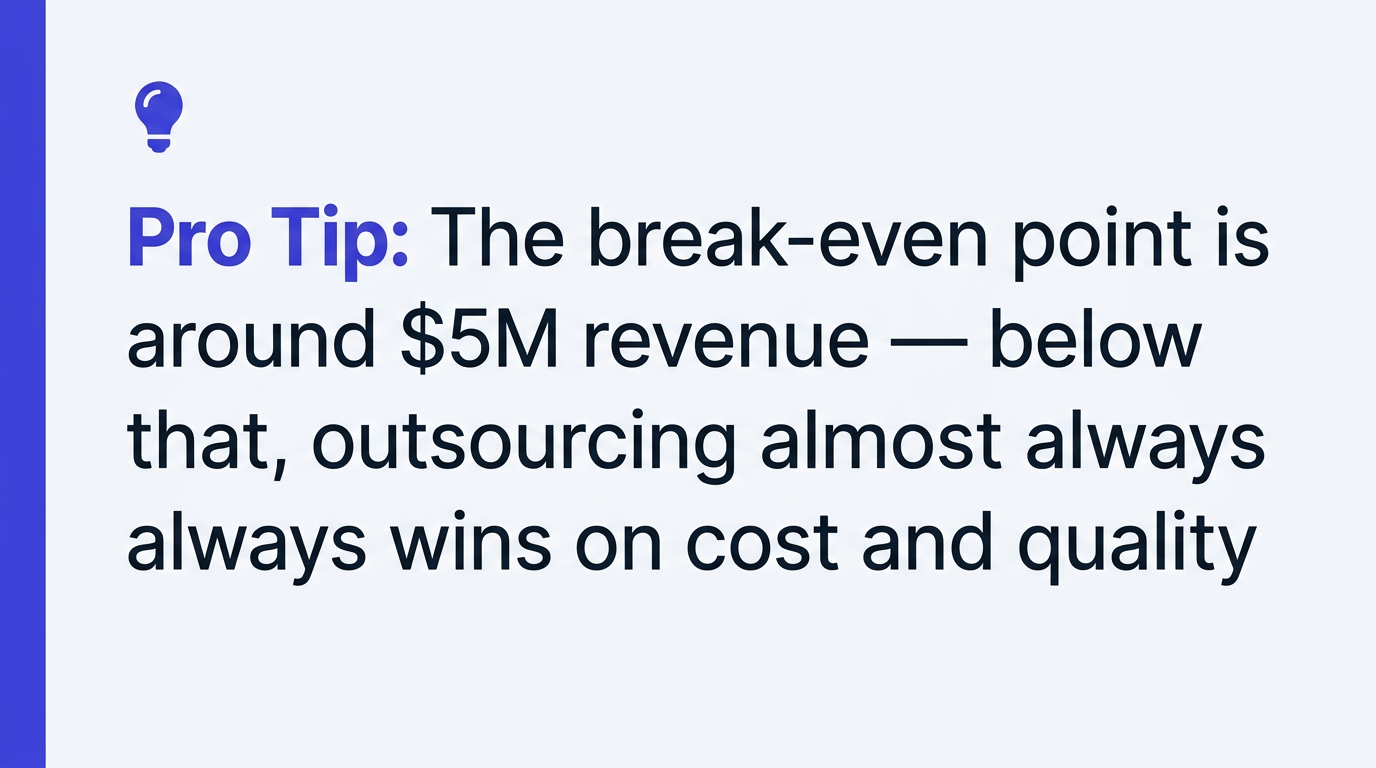
- $1MM–$10MM revenue — large enough to need professional-grade books, not large enough to justify a full finance department
- Professional services firms — law, consulting, medical, architecture, property management, agencies. Your books follow predictable patterns (retainers, project billing, time-based revenue) that outsourced teams handle every day
- You want books closed by the 15th, not the 45th — if your current process involves chasing down receipts and reconciling for six weeks after month-end, an outsourced team with defined SLAs will cut that cycle time in half or more
- You’re growing and don’t want to hire — scaling from $2MM to $5MM shouldn’t require three sequential bookkeeper hires. An outsourced team scales with you by adjusting scope, not headcount
- You’ve been burned by turnover — if you’ve lost a bookkeeper mid-close or discovered months of errors after someone left, team-based coverage eliminates that risk permanently
See How Your Numbers Compare
The math is different for every firm. Transaction volume, entity structure, payroll complexity, and reporting needs all shift the calculation. Some $8MM firms are better off in-house. Some $1.5MM firms are dramatically overpaying for a mediocre internal bookkeeper.
The only way to know is to run the numbers on your specific situation.
Take our free financial operations assessment — it takes 5 minutes, and you’ll see exactly where your firm’s bookkeeping costs stack up against the benchmarks. No sales call required.