Steph's Books
Services
Industries
Pricing
About
Tools
Contact Us
Get a Quote
Steph's Books

Expert outsourced bookkeeping for professional services firms with $1MM-$10MM revenue.

Stay in the loop

Bookkeeping tips and fraud prevention insights. No spam.

Services

  • Bookkeeping
  • Payroll
  • AR/AP Services
  • Bank Reconciliation
  • Tax Prep
  • Catch-Up Bookkeeping
  • QuickBooks Training

Company

  • Home
  • All Services
  • Industries Served
  • Pricing
  • Meet the Team
  • Blog
  • Contact Us
  • Get Started

Areas Served

ChicagoNapervilleSchaumburgArlington HeightsBarringtonBuffalo GroveVernon HillsLake ZurichWaukeganElginMcHenryWoodstockMarengoLake ForestWaucondaFox LakeLakemoorGreen Oaks

Contact

  • (815) 271-5646
  • steph@stephsbooks.com
  • 4318 W Crystal Lake Rd
    Suite J
    McHenry, IL 60050

Mon – Fri: 9am – 5pm CST

© 2026 Steph's Books. All rights reserved.

Privacy PolicyTerms of ServiceEULA
Back to Blog

IOLTA Trust Account Reconciliation: Step-by-Step Guide for Law Firms

March 15, 2026

If your firm handles client funds, IOLTA trust account reconciliation is not optional — it is your most critical compliance obligation. A single misstep can trigger state bar investigations, malpractice claims, and even disbarment. Yet many managing partners treat trust accounting as an afterthought, delegating it to staff without clear processes or oversight.

This guide walks through exactly how three-way IOLTA trust account reconciliation works, the violations that get firms in trouble, and the systems that keep you compliant without burning hours every month.

What IOLTA Accounts Are (and Why They Exist)

An IOLTA (Interest on Lawyers’ Trust Accounts) account holds client funds that are either too small or held too briefly to earn net interest for the individual client. Instead of sitting idle, the pooled interest funds legal aid programs in your state.

Every state bar requires lawyers to maintain IOLTA accounts separate from operating funds. The core rule is simple: client money never touches your operating account. Retainers, settlement proceeds, escrow deposits, and prepaid costs all go into the trust account until earned or disbursed.

The distinction matters because commingling — even accidentally — is one of the most frequently disciplined ethics violations in legal practice. According to the American Bar Association, trust account mismanagement is a leading cause of attorney discipline nationwide.

Why this matters for your bottom line: Trust account errors do not just create compliance risk. They signal operational dysfunction that bleeds into billing accuracy, collections, and client confidence. Firms with clean trust accounting consistently report stronger financial KPIs across the board.

The Three-Way Reconciliation Process

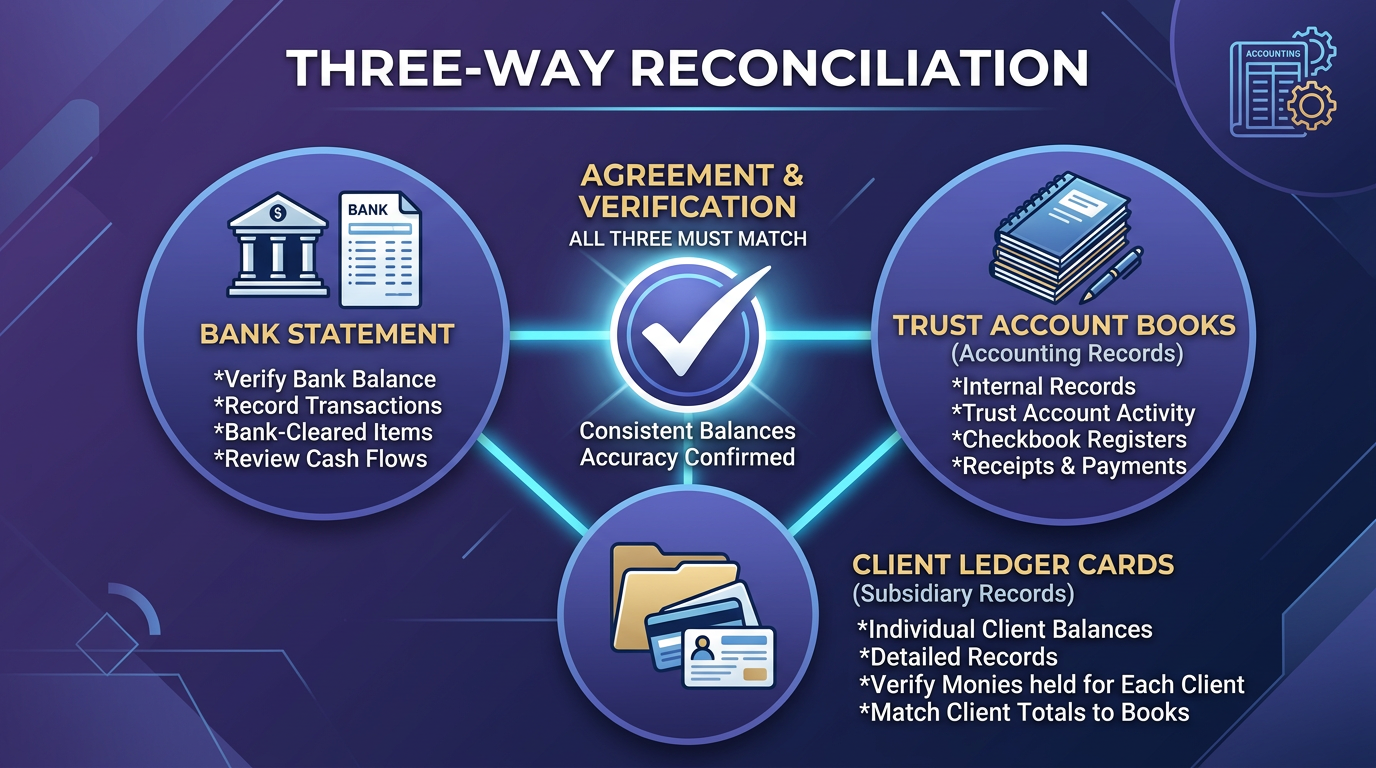
Three-way reconciliation is the gold standard for IOLTA trust account reconciliation. It cross-checks three independent records to ensure every dollar is accounted for:

  1. Bank statement balance — what the bank says you have
  2. Trust ledger (book balance) — your firm’s internal record of all trust transactions
  3. Client ledger total — the sum of individual client sub-ledgers

When all three match, your trust account is reconciled. When they do not, you have a problem that needs immediate attention.

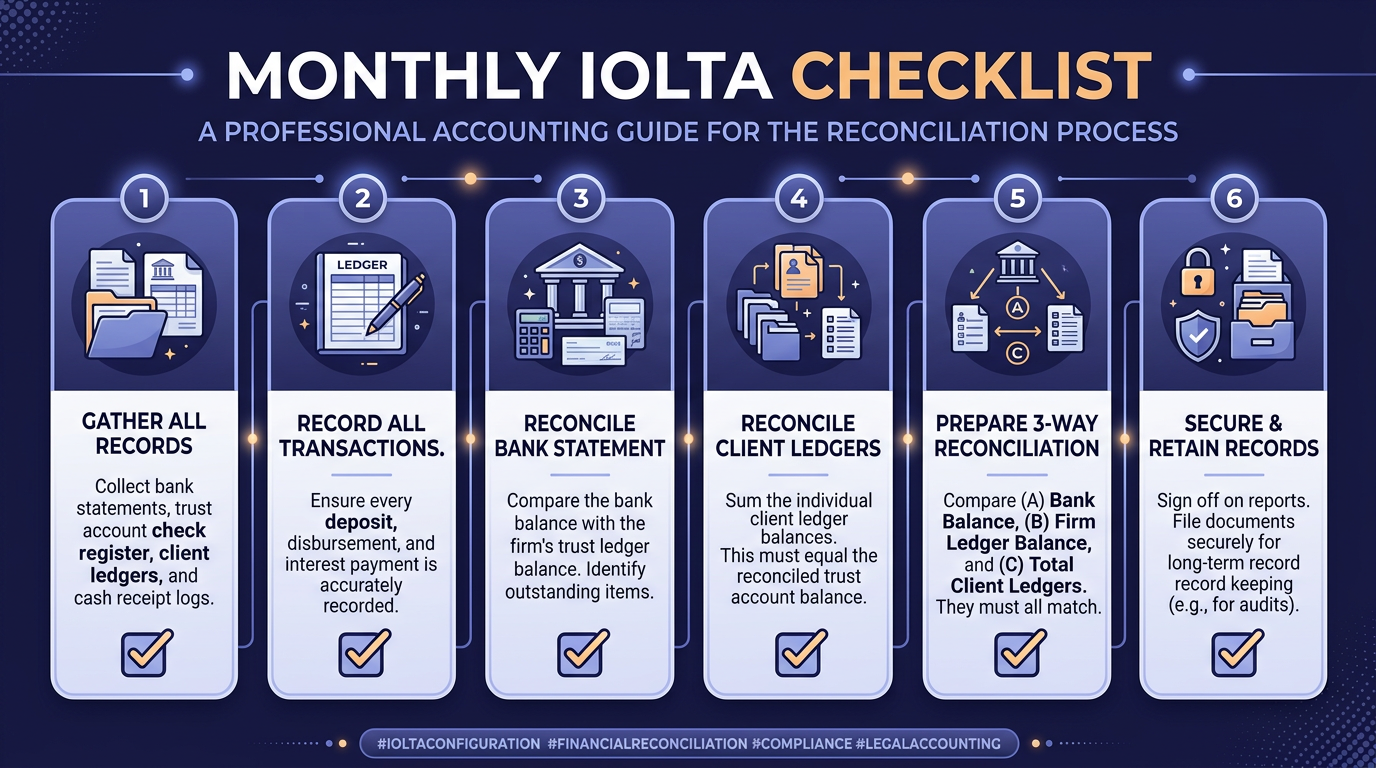
Step 1: Gather Your Records

Before you start, pull together:

  • The bank statement for the reconciliation period (monthly, at minimum)
  • Your trust account checkbook register or general ledger showing all deposits and disbursements
  • Individual client ledger cards for every client with funds in trust
  • Outstanding check list from the prior month’s reconciliation
  • Any deposit slips or wire transfer confirmations for the period

Step 2: Reconcile the Bank Statement to the Book Balance

Start with the ending bank statement balance and adjust for timing differences:

  1. Add deposits in transit — funds you recorded but the bank has not yet posted
  2. Subtract outstanding checks — checks you issued that have not yet cleared
  3. Investigate bank charges — trust accounts should have zero fees charged against client funds (pay bank fees from your operating account)
  4. Compare the result to your trust ledger ending balance

If the adjusted bank balance matches your book balance, you have completed the first leg of the reconciliation.
Pro tip: Three-Way Reconciliation
Three-Way Reconciliation

Step 3: Reconcile Client Ledgers to the Book Balance

This is where most firms fall short. Pull every individual client ledger and sum the balances:

  1. List every client with a balance in trust, along with their individual balance
  2. Total all client balances — this sum must equal your trust ledger (book) balance
  3. Flag negative balances — a negative client ledger means you disbursed more than was deposited for that client. This is effectively using one client’s money for another, which is an ethics violation
  4. Flag stale balances — client matters closed months ago with remaining funds signal unclaimed property obligations

Critical: If your client ledger total does not match your book balance, stop and investigate immediately. The discrepancy means either a transaction was recorded to the wrong client, a transaction was missed entirely, or there is an unauthorized disbursement. Never adjust a client ledger to force a match.

Step 4: Complete the Three-Way Match

With all three figures in hand, confirm:

  • Adjusted bank balance = Trust ledger balance = Total of all client ledger balances

If all three agree, document the reconciliation with:

  • Date of reconciliation
  • Name of person who performed it
  • Name of person who reviewed it (should be a different person — ideally a partner)
  • Copies of the bank statement, reconciliation worksheet, and client ledger listing
  • Explanations for any reconciling items

Step 5: Investigate and Resolve Discrepancies

Common causes of discrepancies include:

  • Data entry errors — transposed digits, wrong client matter number
  • Unrecorded bank fees — some banks charge analysis fees or per-item charges
  • Duplicate entries — the same deposit or check recorded twice
  • Timing differences — end-of-month transactions hitting different periods
  • Unauthorized transactions — requires immediate investigation and reporting

Resolve every discrepancy before closing the month. Carrying forward unresolved items compounds the problem and makes future reconciliations exponentially harder.
Pro tip: Common IOLTA Violations
Common IOLTA Violations

Common IOLTA Violations and Penalties

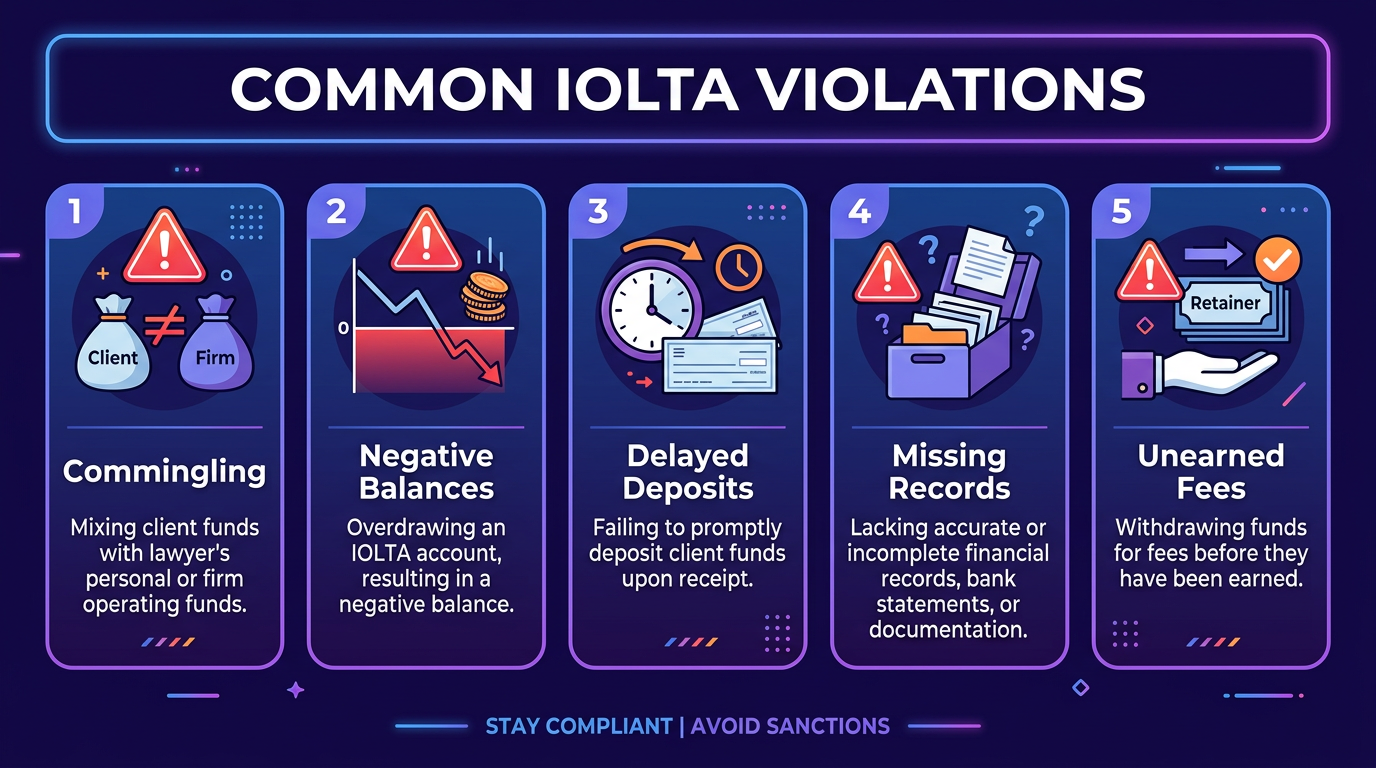
Trust account violations carry severe consequences. Here are the issues state bars see most frequently:

Violation Description Typical Penalty
Commingling Mixing personal or firm operating funds with client funds Suspension (6 months to 3 years)
Misappropriation Using client funds for firm expenses or personal use Disbarment
Failure to reconcile Not performing monthly three-way reconciliation Public reprimand or suspension
Negative client balance Disbursing more than a client has in trust Suspension + restitution
Failure to maintain records Incomplete or missing trust account records Private or public reprimand
Delayed disbursement Holding earned fees in trust beyond a reasonable time Reprimand + fee dispute
Overdraft notification Bank reports an overdraft to the state bar (automatic in most states) Triggered investigation
Failure to return funds Not returning unearned retainer or unused cost deposits Suspension + restitution

Most state bars have automatic overdraft notification agreements with banks. If your IOLTA account goes negative — even for a single day due to a timing issue — the bank notifies your state bar, and you receive an inquiry letter. The presumption is against you until you prove it was a clerical error.

Real talk: The managing partners we work with at law firms are not misappropriating funds. They are getting caught by sloppy processes — skipped reconciliations, no secondary review, deposits applied to the wrong client. The penalties are the same regardless of intent.
Pro tip: Monthly IOLTA Checklist
Monthly IOLTA Checklist

State Bar Reporting Requirements

Every state has its own trust account rules, but the common requirements include:

  • Monthly reconciliation — most states require reconciliation within 30–45 days of the bank statement date
  • Record retention — typically 5–7 years after the matter closes (California and New York require 7 years; check your state bar’s specific requirements)
  • Annual certification — many states require lawyers to certify annually that their trust accounts are properly maintained
  • Overdraft reporting — banks must report overdrafts directly to the state bar in most jurisdictions
  • Random audits — approximately 20 states conduct random trust account audits, and the trend is expanding

Some states have moved to proactive management-based regulation, where firms must demonstrate compliance systems rather than just responding to complaints. If your state adopts this model, having documented reconciliation procedures and strong financial controls becomes essential evidence of compliance.

What Auditors Look For

When a state bar auditor reviews your trust account, they typically examine:

  • Reconciliation timeliness — are you doing it monthly, and is it done within 30 days?
  • Three-way match — do all three balances agree for every month under review?
  • Supporting documentation — can you produce bank statements, client ledgers, and reconciliation worksheets?
  • Segregation of duties — is someone other than the person writing checks reviewing the reconciliation?
  • Negative balances — have any client ledgers gone negative at any point?
  • Stale balances — are there funds sitting in trust for closed matters?

Software for Trust Account Reconciliation

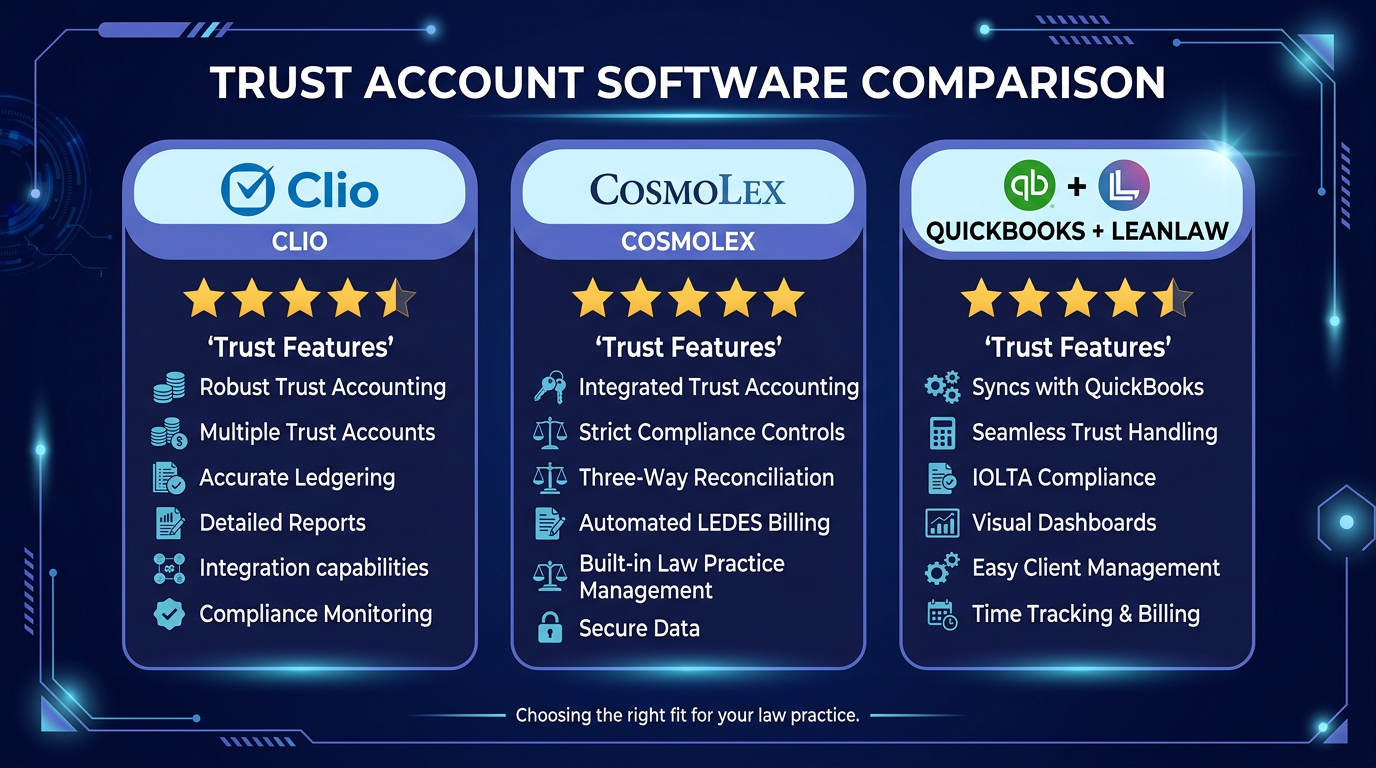
Manual trust accounting with spreadsheets is a compliance risk in itself. Purpose-built law firm bookkeeping software automates the three-way reconciliation and flags issues before they become violations.

Legal-Specific Trust Accounting Tools

  • Clio Manage — built-in trust accounting with three-way reconciliation reports, automatic overdraft alerts, and client ledger tracking. Integrates with QuickBooks Online for operating account bookkeeping.
  • CosmoLex — combined practice management and accounting platform with native trust accounting. Eliminates the need for a separate accounting system.
  • PracticePanther — trust account management with automated reconciliation workflows and compliance reporting.
  • LEAP — includes trust ledgers with real-time balance tracking and automated bank feed reconciliation.

Integration With Your Accounting System

Your trust accounting software should integrate with QuickBooks Online or your general ledger system so that:

  • Trust account bank feeds flow into both systems
  • Operating account transfers (earned fees moved from trust to operating) are recorded in both places
  • You can generate the three-way reconciliation report with one click, not a manual spreadsheet exercise

The right software does not replace the need for someone who understands trust accounting rules — it just makes the mechanical process faster and less error-prone.
Pro tip: Trust Account Software Comparison
Trust Account Software Comparison

When to Get Professional Help

Trust accounting is one area where the cost of getting it wrong dwarfs the cost of getting help. Consider bringing in a specialized law firm bookkeeper if:

  • You are behind on reconciliations — catching up on months of unreconciled trust activity requires forensic attention to detail. Every month you skip makes the next one harder.
  • You have had an overdraft notification — a state bar inquiry is not the time to learn trust accounting. You need clean records and a clear narrative, fast.
  • Your firm is growing — adding attorneys, matters, and client funds multiplies the complexity. What worked for a solo practice does not scale to a 10-attorney firm without dedicated processes.
  • You are switching software — migrating trust account data between systems is high-risk. A single missed transaction during conversion can cascade into months of reconciliation errors.
  • You cannot explain your trust balance — if you cannot tell a partner exactly whose money is in trust and why, you have a problem that needs expert attention before it becomes a bar complaint.

The Cost of Neglect vs. the Cost of Compliance

Firms that invest in proper trust accounting — whether in-house or outsourced — typically spend $500–$1,500/month on the function. Firms that face state bar discipline spend $10,000–$50,000+ on defense costs alone, not counting the reputational damage, lost clients, and potential malpractice insurance premium increases.

The math is straightforward: proactive compliance costs a fraction of reactive damage control.

Building a Sustainable Trust Accounting Process

The firms that never have trust account problems share three habits:

  1. Reconcile on a fixed schedule — same person, same week every month, no exceptions
  2. Separate the duties — the person who disburses funds should not be the person who reconciles the account
  3. Review at the partner level — a named partner signs off on every reconciliation, every month

These are not complex systems. They are disciplines. And they protect your license, your firm, and your clients.


Related Reading

  • The Complete Law Firm Bookkeeping Guide — comprehensive overview of financial management for legal practices
  • Best Software for Law Firm Bookkeeping — detailed comparison of accounting tools built for law firms
  • Law Firm Financial KPIs That Matter — the metrics managing partners should track monthly

Ready to get your trust accounting under control? Steph’s Books provides dedicated bookkeeping for law firms, including IOLTA trust account reconciliation, three-way matching, and state bar compliance support. Schedule a free consultation and let us handle the numbers so you can focus on your practice.

Need help with your bookkeeping?

Get a free quote and see how Steph's Books can save you 40-60% vs hiring in-house.

Get a Free QuoteCall (815) 271-5646