
Ask five bookkeeping firms what they charge and you’ll get five different answers structured five different ways. One quotes hourly, another quotes monthly, a third wants to “scope a custom engagement” before giving you a number. The opacity is intentional — it keeps you from comparison shopping.
This post fixes that. Below you’ll find real pricing ranges based on business size, the five factors that move your quote up or down, and the red flags that separate competent firms from ones that will cost you more in cleanup than you save on fees.
Outsourced Bookkeeping Pricing Models
Before comparing numbers, understand how firms structure their fees. The model matters as much as the dollar amount — it determines whether you can predict your costs or whether they creep up quarterly.
Fixed Monthly Fee
The most common model for ongoing outsourced bookkeeping. You pay a flat rate — typically $500 to $5,000/month depending on complexity — and the firm handles a defined scope of work.
Why it works: Predictable cash flow, clear deliverables, no incentive for the firm to drag out hours. The firm absorbs the variance — if January has 400 transactions and February has 600, your bill stays the same.
Watch for: Firms that quote a low monthly fee but charge overages for “out of scope” work. Get the scope in writing before you sign.
Hourly Rate

Less common for ongoing engagements, more common for project work (cleanup, catch-up, system migrations). Expect $40–$80/hour for a qualified staff bookkeeper and $100–$150/hour for controller-level oversight or advisory work.
Why it’s risky for ongoing work: A bookkeeper billing hourly has zero incentive to build efficient systems. If your chart of accounts is a mess, fixing it means fewer billable hours next month. That misalignment compounds over time.
When it makes sense: One-time cleanups, back-filing, or transitional work where the scope genuinely can’t be defined upfront.
Per-Transaction Pricing
Some firms charge $0.50–$2.00 per transaction, which sounds precise but rarely works in practice. A $2MM construction firm processing 800 transactions per month faces wildly different costs than a consulting firm with the same revenue but 150 transactions.
Best for: High-volume, low-complexity businesses (e-commerce, retail) where transactions are repetitive and categorization is straightforward. For professional services firms with project-based billing, retainers, and trust accounts, per-transaction pricing usually misses the complexity.
What Drives the Price?
Five factors explain 90% of the variance between quotes. If two firms give you numbers that are $2,000/month apart, at least one of these is the reason.
1. Monthly Transaction Volume
The single biggest cost driver. A firm processing 100 transactions per month requires fundamentally different staffing than one processing 1,000+. Every transaction needs categorization, review, and reconciliation. Volume is volume — there’s no shortcut.
Rule of thumb: Expect a meaningful price jump at the 300-transaction and 800-transaction thresholds. That’s typically where firms add a second set of eyes or move you to a senior bookkeeper.
2. Revenue Complexity
A consulting firm with one revenue stream invoicing monthly is straightforward. A law firm with retainer income, contingency fees, IOLTA pass-throughs, and cost advances is not. Neither is a construction company with progress billing, retention holdbacks, and change orders.
Multiple revenue streams mean multiple reconciliation points. Each one adds time.
3. Industry-Specific Requirements
This is where generic bookkeeping firms break down. Specific industries require specific knowledge:
- Law firms: IOLTA compliance, trust accounting, three-way reconciliation, matter-level tracking
- Construction: Job costing, WIP schedules, progress billing, subcontractor 1099 management
- Medical practices: Insurance reconciliation, patient payment posting, provider-level P&L
- Property management: Per-property accounting, CAM reconciliation, security deposit tracking, owner disbursements
A bookkeeper who doesn’t understand your industry’s compliance requirements isn’t cheaper — they’re a liability. Expect to pay 15–25% more for genuine industry expertise, and consider it money well spent.
4. Software Stack
Most outsourced bookkeeping firms standardize on QuickBooks Online or Xero. If you’re already on one of those, onboarding is straightforward.
Running industry-specific software — Clio, Sage 300, Yardi, Procore, or an ERP — adds complexity. The firm either needs experience with your platform or needs to build a workflow around it. Either way, expect it to show up in the quote.
5. Scope of Services
The gap between “basic bookkeeping” and “full-service financial operations” is enormous:
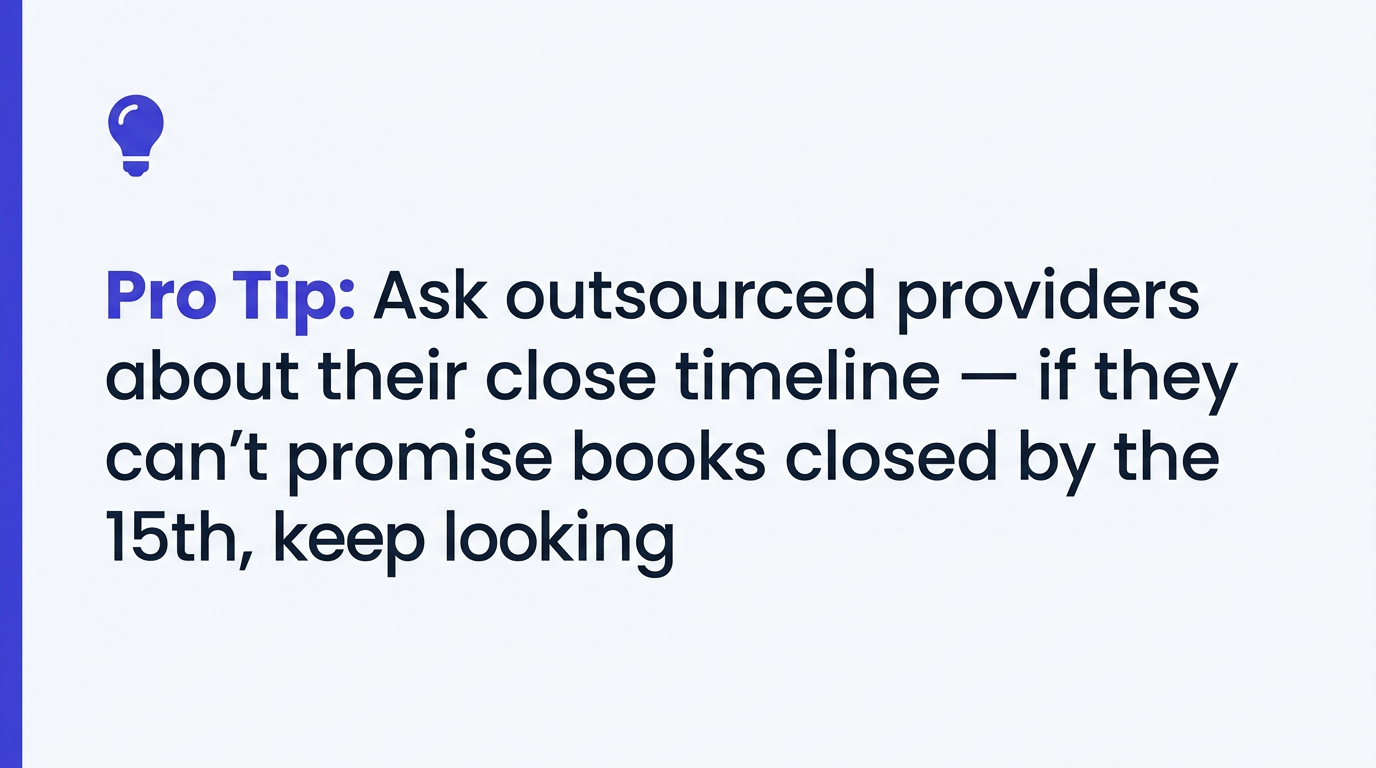
- Basic bookkeeping: Transaction categorization, bank reconciliation, monthly statements. This is the $500–$1,500/month tier for most small businesses.
- Full-service: Add accounts payable, accounts receivable, payroll processing, bill pay, vendor management, and a monthly financial reporting package with variance analysis.
- Controller-level: Add cash flow forecasting, budget-to-actual reporting, KPI dashboards, and strategic advisory. This pushes into the $3,000–$5,000+/month range.
Know what tier you actually need before requesting quotes. Overpaying for services you don’t use is just as wasteful as underpaying for services you need.
Pricing by Business Size
This is the table most people are looking for. These ranges reflect 2026 market rates for US-based outsourced bookkeeping firms serving professional services businesses. Offshore-only firms will quote lower; the trade-offs are covered in the red flags section below.
| Business Size | Revenue Range | Monthly Cost Range | What’s Typically Included |
|---|---|---|---|
| Freelancer / Solopreneur | Under $250K | $200–$500/mo | Transaction categorization, bank reconciliation, quarterly tax estimates |
| Small Business | $250K–$1MM | $500–$1,500/mo | Bank reconciliation, monthly P&L and balance sheet, basic AP/AR |
| Growing Business | $1MM–$3MM | $1,500–$3,000/mo | Full monthly close, AP/AR management, payroll, financial reporting package |
| Mid-Market | $3MM–$10MM | $3,000–$5,000/mo | Full-service bookkeeping, department/project tracking, controller-level oversight |
| Enterprise | $10MM+ | $5,000–$10,000+/mo | Multi-entity consolidation, CFO advisory, custom reporting, board-ready financials |
Context check: Compare these numbers to an in-house hire. According to the Bureau of Labor Statistics, a full-time bookkeeper costs $45,000–$65,000/year in salary alone — add benefits, payroll taxes, software licenses, and management overhead and you’re at $60,000–$85,000/year. That’s $5,000–$7,000/month before accounting for turnover, training, and coverage gaps. For most businesses under $5MM in revenue, outsourcing is the better economic decision.
What Should Be Included at Every Price Point
Regardless of whether you’re paying $500/month or $5,000/month, your bookkeeping provider should deliver all of the following. If any of these are missing or listed as add-ons, ask why.
- Bank and credit card reconciliation — every account, every month, no exceptions
- Monthly financial statements — Profit & Loss, Balance Sheet, and Cash Flow Statement delivered on a consistent schedule
- Year-end package for your CPA — a clean, organized file that lets your tax preparer start work immediately, not a shoebox of questions
- Dedicated point of contact — a named person who knows your business, not a rotating ticket queue
- Cloud-based access to your books — you should be able to log into your accounting software and see current data at any time, not wait for a monthly email
These aren’t premium features. They’re table stakes. A firm that charges $1,500/month and doesn’t provide a cash flow statement is selling an incomplete service.
Red Flags in Bookkeeping Pricing
Cheap bookkeeping is almost never cheap. Here’s what to watch for when evaluating quotes.
Prices that defy gravity. If a firm quotes $200/month for a $3MM business, they’re either cutting corners, offshoring everything without disclosure, or planning to upsell you aggressively. At that price point, they can’t afford to assign a qualified bookkeeper to your account. You’ll pay the difference later in cleanup costs.
No defined scope of work. If the engagement letter doesn’t specify exactly what’s included — number of accounts reconciled, deliverable list, close timeline — you have no basis for holding them accountable. Every “out of scope” conversation becomes a negotiation.
Hourly-only billing with no cap. For ongoing bookkeeping (not cleanup), hourly billing without a monthly cap is a red flag. It means the firm hasn’t underwritten the engagement — they don’t know how much work your books require, which means they haven’t assessed your books properly.
No mention of month-end close timeline. If a firm can’t tell you when you’ll receive your monthly financials, they don’t have a process. A competent firm commits to a specific business day — the 5th, 10th, or 15th of the following month. Anything past the 15th means you’re making decisions on stale data.
Offshore-only teams with no US oversight. Offshore bookkeepers can be perfectly competent, but a fully offshore engagement with no US-based review layer introduces risk — timezone gaps, communication friction, and reduced familiarity with US GAAP nuances. The issue isn’t where the work is done; it’s whether someone stateside is reviewing it.
How to Compare Quotes
When you have two or three proposals in hand, these four questions will separate the serious firms from the ones padding their pipeline.
Ask for the month-end close date. The difference between books closed on day 5 and books closed on day 45 is the difference between a firm with systems and a firm winging it. If they can’t commit to a date, move on.
Ask about team coverage. What happens when your bookkeeper is sick, on vacation, or leaves the firm? A one-person operation means your books stop when they stop. A firm with team-based coverage ensures continuity — someone else on the team already knows your account.
Ask what software is included vs. extra. Some firms include your QuickBooks Online subscription in their fee. Others expect you to maintain it separately. Neither is wrong, but the total cost needs to be apples-to-apples. Same for payroll platforms, bill-pay tools, and expense management software.
Ask for client references in your industry. A firm that does great work for e-commerce businesses may struggle with IOLTA reconciliation or job costing. Industry experience isn’t a nice-to-have — it’s the difference between a bookkeeper who asks smart questions and one who needs you to explain your business model every month.
Get a Quote Based on Your Business
Pricing guides are useful for ballparking, but your actual cost depends on your specific transaction volume, industry, and service needs. If you’re evaluating whether outsourced bookkeeping makes sense for your firm, we’ll give you a straight answer — no obligation, no 45-minute sales pitch.
Take our 2-minute financial assessment and we’ll follow up with a scoped proposal and clear pricing within 48 hours.
Frequently Asked Questions
How much does outsourced bookkeeping cost per month?
Most small businesses pay between $200 and $2,500 per month, depending on transaction volume, number of accounts, and how many services are bundled in. Solo operators and early-stage firms land near the low end; established professional services firms with payroll and multiple accounts sit in the middle; complex, multi-entity businesses can run $3,000+ per month.
Is outsourced bookkeeping cheaper than hiring in-house?
Almost always. A full-time in-house bookkeeper costs $45,000–$65,000 per year plus benefits, payroll taxes, software, and management time. Outsourced bookkeeping delivers the same work for roughly 40–60% less because you only pay for the hours your books actually require—with no hiring, training, or coverage gaps.
Do bookkeepers charge hourly or a flat monthly fee?
Reputable outsourced firms almost always quote a flat monthly fee so your cost is predictable and doesn’t balloon in busy months. Hourly billing ($25–$100/hour) is common only for one-time cleanup or catch-up work. If a provider wants to bill ongoing bookkeeping hourly, treat it as a red flag.
What drives the price up or down?
The biggest factors are monthly transaction volume, the number of bank and credit-card accounts to reconcile, payroll, whether you need accrual-basis accounting, and any cleanup of prior months. Add-ons like sales-tax filing, AP/AR management, and advisory reporting also move the price.
Are there hidden costs to watch for?
Ask specifically about one-time onboarding or setup fees, catch-up/cleanup fees for bringing old books current, per-transaction surcharges, and software subscriptions. A trustworthy provider gives you a clear, itemized quote with no surprises after you sign.