Steph's Books
Services
Industries
Pricing
About
Tools
Contact Us
Get a Quote
Steph's Books

Expert outsourced bookkeeping for professional services firms with $1MM-$10MM revenue.

Stay in the loop

Bookkeeping tips and fraud prevention insights. No spam.

Services

  • Bookkeeping
  • Payroll
  • AR/AP Services
  • Bank Reconciliation
  • Tax Prep
  • Catch-Up Bookkeeping
  • QuickBooks Training

Company

  • Home
  • All Services
  • Industries Served
  • Pricing
  • Meet the Team
  • Blog
  • Contact Us
  • Get Started

Areas Served

ChicagoNapervilleSchaumburgArlington HeightsBarringtonBuffalo GroveVernon HillsLake ZurichWaukeganElginMcHenryWoodstockMarengoLake ForestWaucondaFox LakeLakemoorGreen Oaks

Contact

  • (815) 271-5646
  • steph@stephsbooks.com
  • 4318 W Crystal Lake Rd
    Suite J
    McHenry, IL 60050

Mon – Fri: 9am – 5pm CST

© 2026 Steph's Books. All rights reserved.

Privacy PolicyTerms of ServiceEULA
Back to Blog

The Complete Guide to Outsourced Bookkeeping for Professional Services Firms (2026)

March 9, 2026

Your firm bills $175/hour. Your managing partner spent six hours last month reconciling QuickBooks because your office manager was on PTO. That’s $1,050 in lost billable time — on a task that an outsourced bookkeeping team handles for $500/month.

That math is why professional services firms between $1M and $10M in revenue are outsourcing their bookkeeping at record rates. Not because they can’t afford an in-house hire — but because the opportunity cost of financial admin is destroying their margins.

This guide breaks down everything you need to know about outsourced bookkeeping for professional services firms: what it actually costs, what’s included, how the transition works, and how to evaluate whether it’s the right move for your firm.

What Is Outsourced Bookkeeping (And What It Isn’t)

Outsourced bookkeeping means hiring an external team — not an employee — to handle your day-to-day financial record-keeping. For professional services firms, that typically includes:

  • Transaction categorization across all bank and credit card accounts
  • Monthly bank reconciliation (the non-negotiable foundation)
  • Accounts receivable tracking — who owes you, how much, and how late
  • Accounts payable management — vendor bills entered, scheduled, and tracked
  • Monthly financial statements — P&L, Balance Sheet, Cash Flow Statement
  • Payroll integration — reconciling payroll entries from Gusto, ADP, or similar
  • Year-end tax prep — clean books handed to your CPA on time

What it is not: tax filing, strategic financial advisory, or fractional CFO work. Those are separate services. An outsourced bookkeeper is the engine room — they keep the data clean so your CPA and advisors can do their job with accurate numbers.

Key distinction: If you’re comparing outsourced bookkeeping to a virtual CFO, you’re looking at different services. A bookkeeper handles data entry and reconciliation. A CFO interprets the data and makes strategic recommendations. Most firms need both, but the bookkeeper comes first. See our breakdown of in-house vs. outsourced bookkeeping for the full comparison.

Why Professional Services Firms Are Different

Generic bookkeeping — the kind designed for retail shops and restaurants — doesn’t work for professional services. Your firm has specific financial dynamics that require specialized handling:

Project-Based Revenue Recognition

You don’t sell widgets. You sell time, and time gets complicated. Between retainers, fixed-fee engagements, hourly billing, and progress invoicing, your revenue recognition needs to track:

  • Work in Progress (WIP) — hours logged but not yet billed
  • Unbilled receivables — work completed, invoice not sent
  • Deferred revenue — retainer payments received before work is performed
  • Effective billable rate — actual revenue per hour worked (not your rack rate). These are leading indicators that predict financial health before your P&L catches up

A bookkeeping partner who understands professional services knows how to set up your chart of accounts to separate these categories. A generalist bookkeeper dumps everything into “Revenue” and calls it a day.
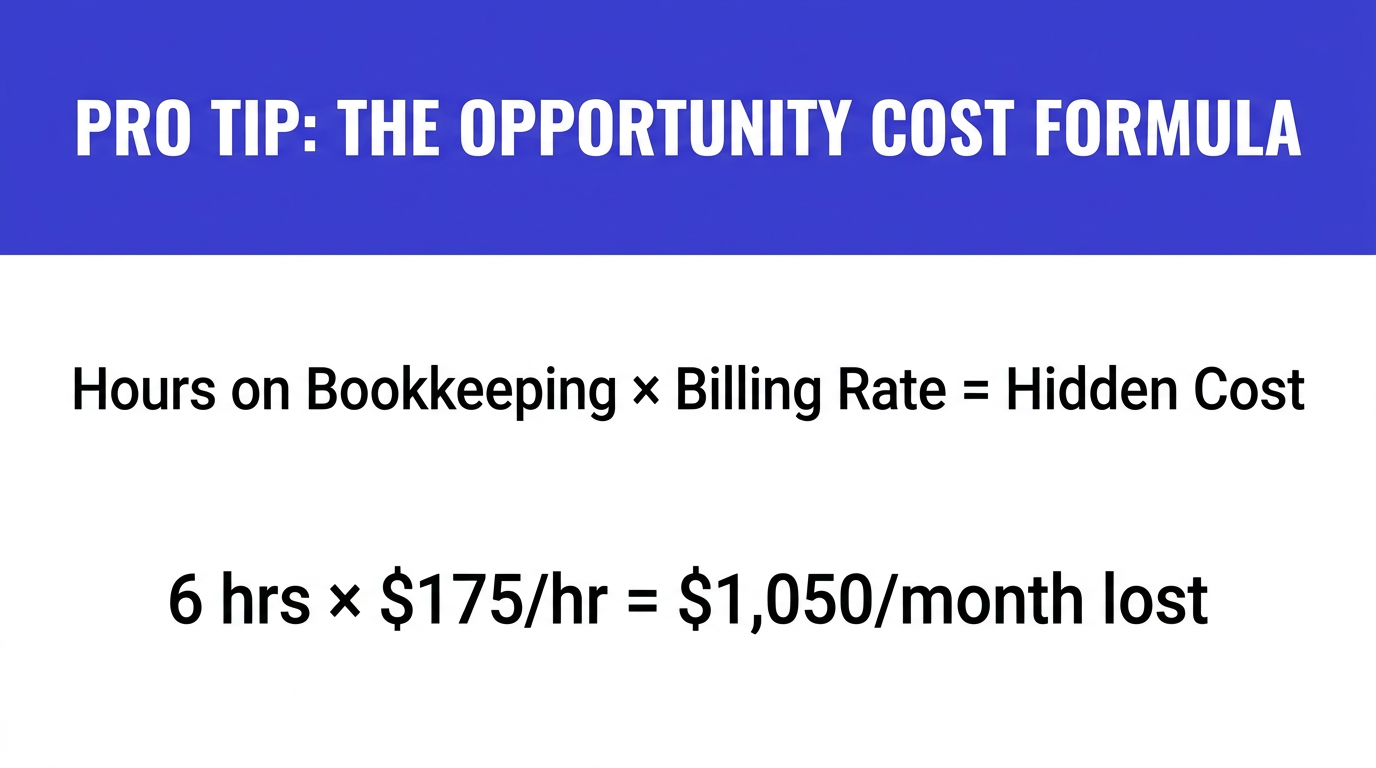
Pro tip: The opportunity cost formula
Every hour on bookkeeping has a measurable cost in lost billable revenue.

Labor as Your Primary Cost

In a law firm, architecture practice, or consulting firm, 55-75% of your expenses are people costs. Your bookkeeping needs to track:

  • Fully loaded labor costs — salary plus benefits, FICA, PTO liability, 401(k) match
  • Utilization rates — billable hours vs. total hours by team member
  • Project-level profitability — is the Henderson account actually making money?
  • Contractor vs. employee costs — with proper 1099 vs. W-2 classification

If your books don’t separate labor burden from base salary, you’re underpricing every fixed-fee project by 25-40%. That’s not a bookkeeping problem — it’s a pricing problem caused by bad bookkeeping.

Trust Accounts and Compliance

Law firms have IOLTA requirements. Property management companies have security deposit escrow rules. Healthcare practices have insurance payment reconciliation. CPA firms increasingly use white label bookkeeping services to serve these specialized clients under their own brand. Each industry within professional services has compliance requirements that a generic bookkeeper will miss.

What Outsourced Bookkeeping Costs in 2026

Pricing varies by firm size, transaction volume, and complexity. Here’s the realistic range for professional services firms:

Firm Revenue Monthly Transactions Outsourced Cost/Month In-House Equivalent
$500K – $1M 100-200 $500 – $1,000 $3,500 – $4,500
$1M – $3M 200-500 $1,000 – $2,500 $4,500 – $6,000
$3M – $5M 500-1,000 $2,000 – $4,000 $5,500 – $7,500
$5M – $10M 1,000+ $3,500 – $6,000 $7,000 – $9,500

The “In-House Equivalent” column includes salary, benefits (add 30-40% to base), software licenses, training, management overhead, and backup coverage.

For a detailed breakdown by business size and service tier, see our complete outsourced bookkeeping cost analysis.

Pro Tip: When comparing costs, don’t forget the hidden expenses of in-house: turnover (average bookkeeper tenure is 2.3 years), training new hires, PTO coverage gaps, and the 2-4 week disruption when someone quits mid-month-end-close.

The ROI Case: More Than Just Cost Savings

Cost savings are the obvious benefit. The real ROI comes from three less obvious places:

1. Recovered Billable Time

Every hour your managing partner or office manager spends on bookkeeping tasks is an hour not spent on client work. At a $175-$300/hour billing rate, even 5 hours/month of recovered time generates $10,500-$18,000/year in additional capacity.
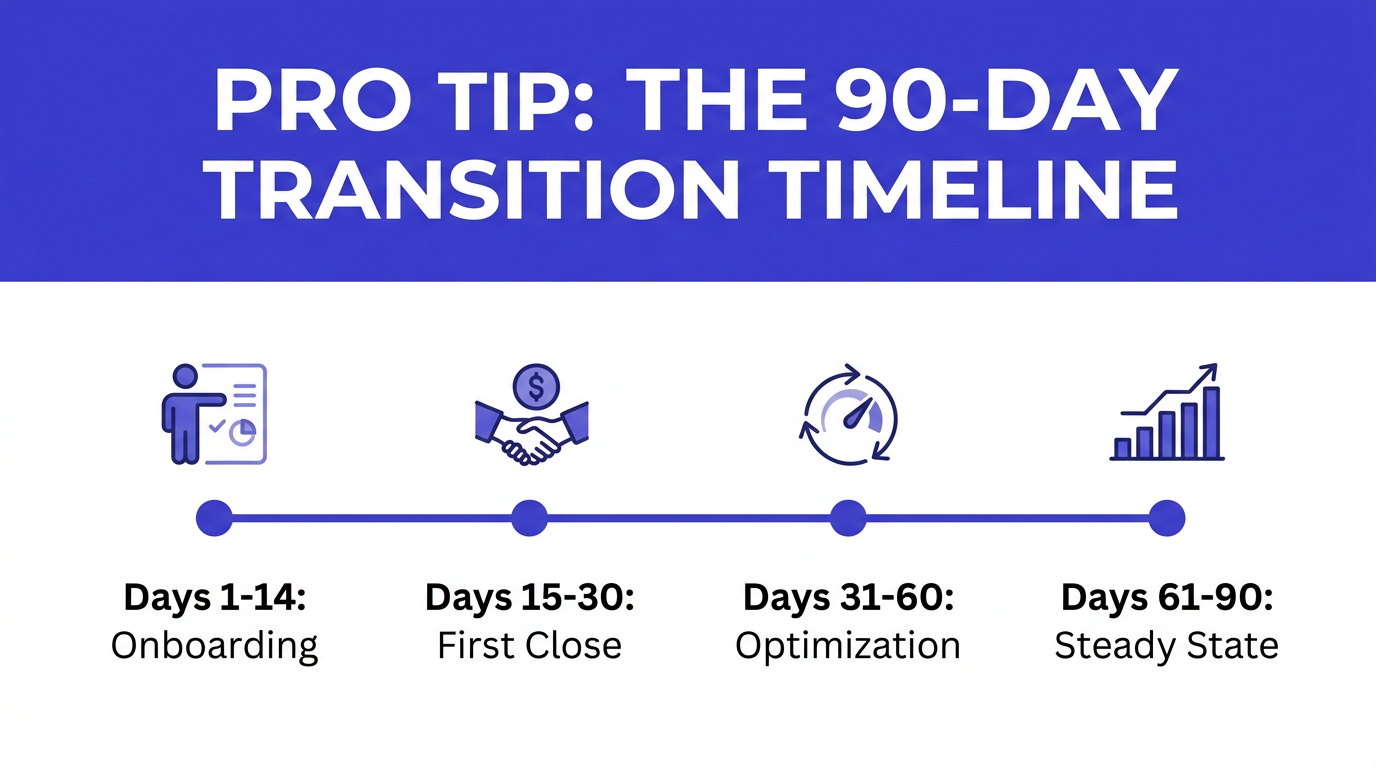
Pro tip: 90-day transition timeline
The first 90 days follow a predictable pattern.

2. Faster Financial Visibility

Most firms running their own books get financials 30-45 days after month-end. An outsourced team with defined SLAs delivers closed books by the 10th-15th of the following month. That 20-30 day improvement means you’re making decisions on data from this quarter, not last quarter.

3. Error Reduction and Audit Protection

DIY bookkeeping error rates run 5-12% on transaction categorization. For a firm processing $200K/month in transactions, that’s $10,000-$24,000/month in potentially miscategorized expenses. Those errors compound into:

  • Incorrect project profitability reports
  • Misguided hiring and pricing decisions
  • Tax filing amendments (which cost $2,000-$5,000 to fix)
  • IRS audit exposure from inconsistent classifications

What to Expect: The First 90 Days

The transition to outsourced bookkeeping follows a predictable timeline:

Days 1-14: Onboarding and Setup

  • Access provisioning — accountant-level access to QBO, bank feeds, payroll system
  • Chart of accounts review — restructuring if needed for project-level tracking
  • Historical catch-up — if your books are behind, this is where cleanup begins
  • Process documentation — how invoices get created, how bills get approved

Days 15-30: First Month-End Close

  • Full bank and credit card reconciliation
  • Transaction review and categorization
  • Payroll entry reconciliation
  • Draft financial statements delivered for your review

Days 31-60: Optimization

  • Process refinements based on month-one learnings
  • Integration tuning (practice management software ↔ QuickBooks)
  • Custom report setup (project P&L, department-level tracking)

Days 61-90: Steady State

  • Monthly close completed by the 10th-15th
  • Exception-only communication (you only hear about issues)
  • Quarterly review meeting for trends and process improvements
  • Your CPA gets clean books automatically

Reality check: Month one will feel slower than doing it yourself. That’s normal. You’re investing upfront time to build a system that runs without you. By month three, you should be spending less than 1 hour/month reviewing financials instead of 10-15 hours doing them.

How to Choose the Right Outsourced Bookkeeping Partner

Industry Specialization

A firm that specializes in professional services will understand your chart of accounts needs, your practice management software integrations, and your compliance requirements out of the box. Generalist providers will learn on your dime.

Ask this question: “How many law firms / consulting firms / PM companies do you currently serve?” If the answer is zero, keep looking.

Technology Stack Compatibility

Your bookkeeping partner needs to work with your existing tools:

  • Accounting software: QuickBooks Online, Xero, or FreshBooks
  • Practice management: Clio (law), Harvest (consulting), Procore (construction), AppFolio/Buildium (PM)
  • Payroll: Gusto, ADP, Paychex
  • Expense management: Expensify, Brex, Ramp

See our QuickBooks Online setup guide for how this should look.
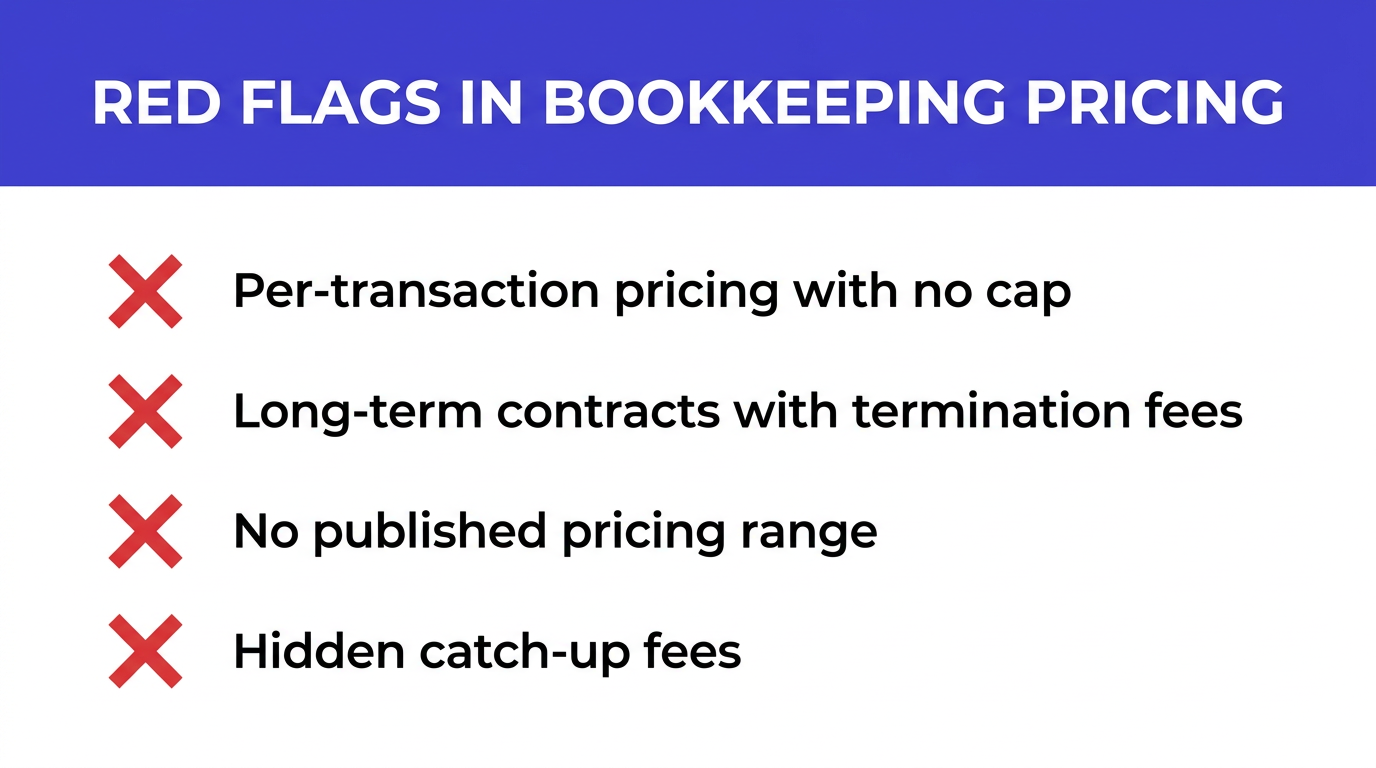
Red flags in bookkeeping pricing
Transparent pricing is a sign of a confident provider.

Communication and Reporting

Define expectations upfront:

  • Response time: Same-day acknowledgment, 24-48 hour resolution
  • Monthly deliverables: P&L, Balance Sheet, Cash Flow Statement, AR Aging, AP Aging
  • Meeting cadence: Monthly review calls (minimum), quarterly strategic reviews
  • Point of contact: Named team lead, not a rotating cast of associates

Pricing Transparency

Green flags:

  • Flat monthly fee based on transaction volume and complexity tier
  • Month-to-month terms or short-term agreements
  • Published pricing page with clear inclusions/exclusions
  • Separate onboarding fee with defined deliverables

For our approach to transparent pricing, visit our pricing page.

When Outsourcing Makes Sense (And When It Doesn’t)

Outsource when:

  • Your managing partner or office manager is spending 10+ hours/month on bookkeeping
  • Your books are consistently 30+ days behind
  • You’re growing past $1M and need project-level financial visibility
  • Your current bookkeeper is a single point of failure (vacation = books stop)
  • You need industry-specific expertise (IOLTA, WIP tracking, progress billing)

Keep in-house when:

  • You have a proven bookkeeper with 3+ years tenure and deep institutional knowledge
  • Your transaction volume is very low (under 50/month)
  • You need someone physically present for cash handling or check signing

The 5 Bookkeeping Gaps That Outsourcing Fixes

Professional services firms at the $1M-$10M level share common bookkeeping problems. Outsourcing addresses all five:
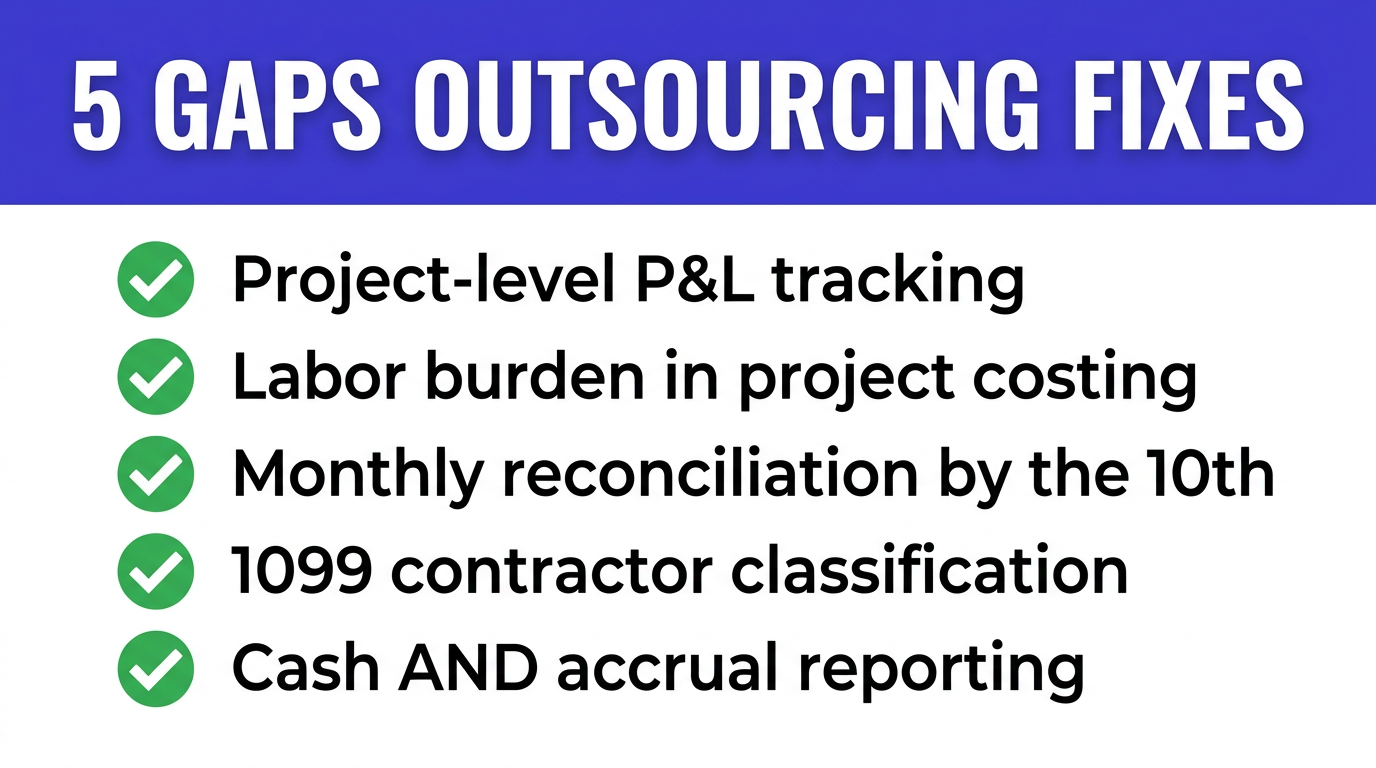
  1. No project-level P&L — an outsourced team sets up Classes/Tags in QBO to track profitability by project from day one
  2. Labor burden not in project costing — proper cost allocation means your fixed-fee quotes are based on real numbers
  3. Reconciliation lag — dedicated teams close books monthly by the 10th-15th
  4. Contractor classification exposure — proper 1099 tracking reduces IRS audit risk
  5. Cash vs. accrual blindness — you get both views: accrual for management, cash for liquidity
5 gaps outsourcing fixes
These five structural gaps are present in most $1M-$10M firms.

For a deep dive into each of these, read our analysis of the 5 bookkeeping mistakes costing professional services firms thousands.

Getting Started

The decision to outsource bookkeeping isn’t about whether you can do it yourself — it’s about whether you should. If your firm’s competitive advantage comes from billable expertise, every hour spent on financial admin is an hour stolen from growth.

  1. Assess your current state — how many hours/month do you spend on bookkeeping? How far behind are your books?
  2. Calculate the opportunity cost — multiply those hours by your billing rate.
  3. Talk to specialists — not generalists. Find a partner who speaks your industry’s language. For CPA firms looking to offer bookkeeping under their own brand, explore our CPA partner program.

Request a free bookkeeping diagnostic — we’ll review your current setup, identify the gaps, and show you exactly what outsourced bookkeeping looks like for your firm.

Related Reading

  • How Much Does Outsourced Bookkeeping Cost in 2026?
  • In-House vs. Outsourced Bookkeeping: The Real Cost Comparison
  • 5 Bookkeeping Mistakes That Cost Professional Services Firms Thousands
  • Professional Bookkeeping Services
  • Catch-Up Bookkeeping: What It Costs, How Long It Takes, and How to Get Started
  • White Label Bookkeeping for CPA Firms: Add Revenue Without Adding Staff

Need help with your bookkeeping?

Get a free quote and see how Steph's Books can save you 40-60% vs hiring in-house.

Get a Free QuoteCall (815) 271-5646