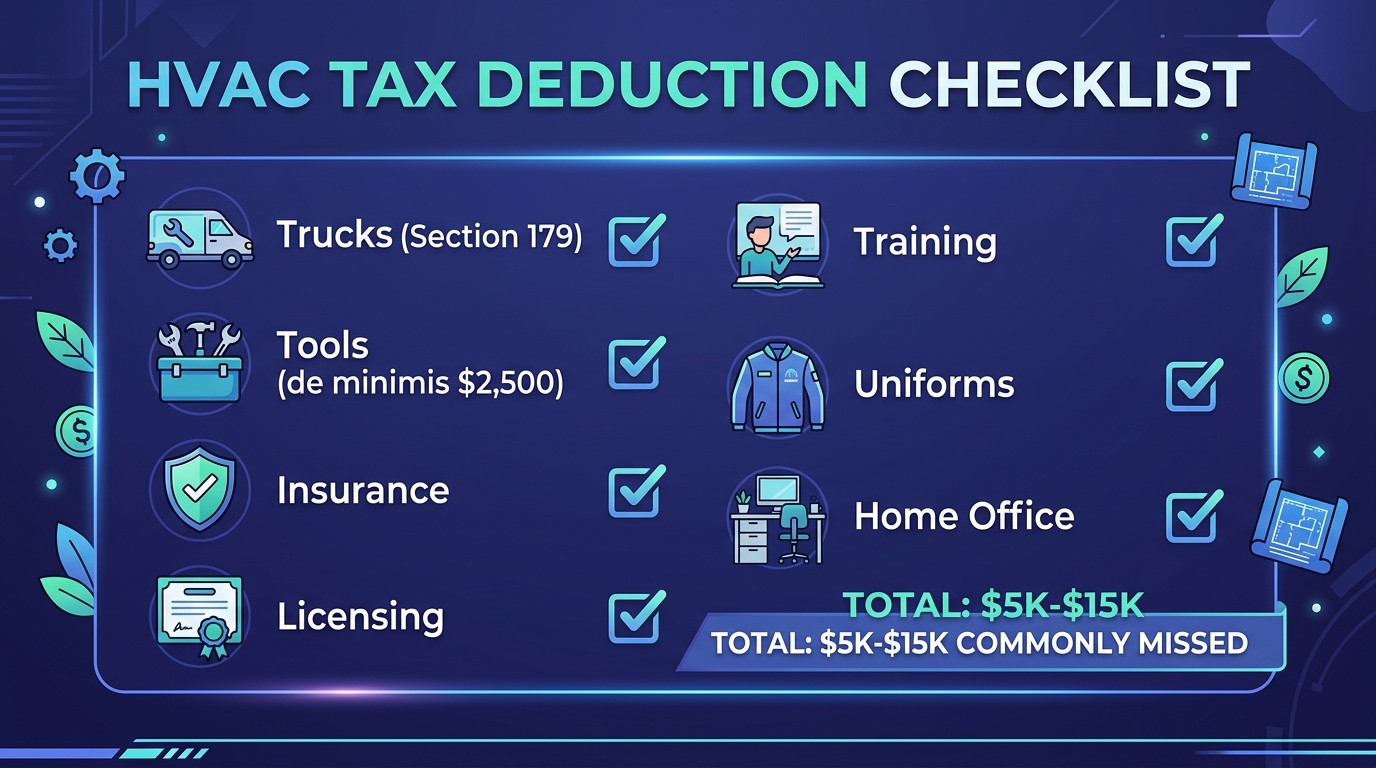
Most HVAC contractors pay more in taxes than they need to. Not because they’re doing anything wrong — but because their bookkeeper or CPA isn’t tracking every HVAC tax deduction available to trade businesses. The average contractor we work with leaves $5,000 to $15,000 on the table every year in missed deductions, miscategorized expenses, and depreciation strategies they never elected.
For the full picture of HVAC financial management, see our complete guide to HVAC bookkeeping.
This guide covers the specific HVAC tax deductions that contractors between $1M and $10M in revenue should be claiming in 2026 — including Section 179 expensing, vehicle deductions, the de minimis safe harbor for tools, and a handful of write-offs that get missed because nobody categorized them correctly in QuickBooks.
The Section 179 deduction lets you expense up to $2,560,000 in qualifying equipment purchases in the year you place them in service. Instead of depreciating a new service van over five years, you deduct the entire cost in year one.
For HVAC contractors, qualifying assets include service trucks and vans, diagnostic equipment (manifold gauges, combustion analyzers, leak detectors), recovery machines, vacuum pumps, brazing stations, sheet metal tools, and field service software.
This is where Section 179 gets interesting — and where most HVAC contractors either win big or leave money on the table.
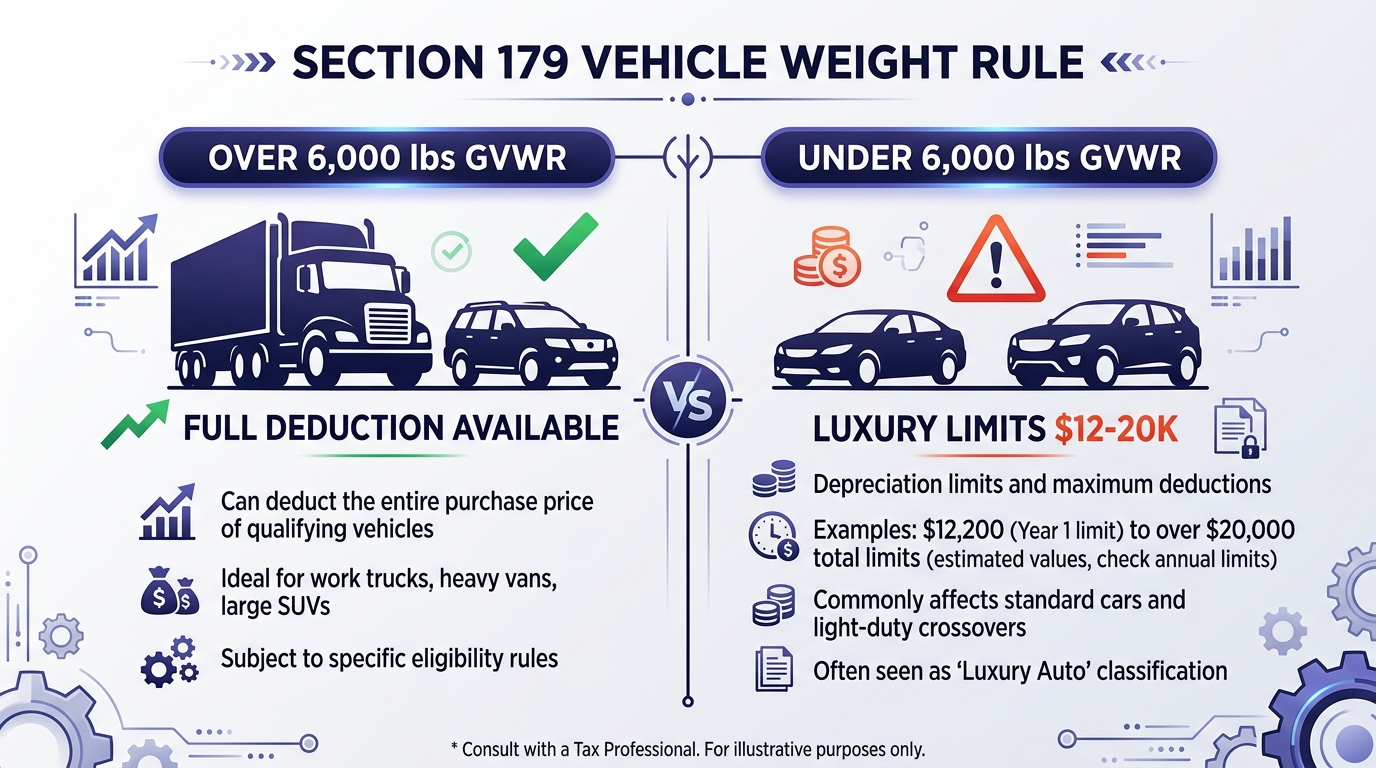
Vehicles over 6,000 lbs GVWR — Ford E-350 vans, Ram ProMaster 3500, Chevy Express 3500, most box trucks — qualify for the full Section 179 deduction. Buy a $55,000 service van that weighs over 6,000 lbs and you can deduct the entire $55,000 in year one.
Vehicles under 6,000 lbs GVWR — Transit Connect, small pickups, compact cargo vans — are subject to luxury automobile limits. That caps your first-year deduction at roughly $12,400 to $20,400 depending on whether you also claim bonus depreciation. On a $45,000 van, the difference between a full $45,000 write-off and a $20,400 first-year deduction is $24,600 in delayed tax benefit.
Check the GVWR on the driver’s side door sticker before you sign the purchase order. A Ford Transit 150 (low roof, short wheelbase) comes in under 6,000 lbs. A Ford Transit 250 or 350 typically clears the threshold. That weight difference can swing your year-one deduction by tens of thousands of dollars.
Pro Tip: If you’re buying two or three vans this year, the Section 179 election alone could save $15,000-$30,000 in federal tax. But you must elect Section 179 on your tax return for the year the asset is placed in service — you can’t go back and claim it retroactively.
After years of phasedown, 100% bonus depreciation has been restored for qualifying assets placed in service after January 19, 2025, following the passage of the OBBBA (One Big Beautiful Bill Act). This is a major development for HVAC contractors making large capital purchases.
Bonus depreciation works alongside Section 179 and covers new and used equipment. If your total equipment purchases exceed the Section 179 limit (unlikely for most HVAC contractors, but possible for large fleet purchases), bonus depreciation picks up the remainder. It also applies to assets that qualify for Section 179 but where you choose not to make the election — giving you flexibility in tax planning.
For a contractor buying $200,000 in trucks and equipment in 2026, the combination of Section 179 and restored bonus depreciation means you can potentially deduct the entire $200,000 in the current tax year. Compare that to the standard MACRS schedule, where you’d deduct roughly $40,000 in year one and spread the rest over four to six more years.
See IRS Publication 946 for the complete depreciation rules and asset class lives.
Every HVAC technician carries thousands of dollars in tools on their truck. Under the de minimis safe harbor election, you can expense any individual item costing $2,500 or less immediately — no depreciation schedule required.
This covers most hand tools, multimeters, refrigerant scales, torque wrenches, cordless drills, tube cutters, and portable equipment. Instead of capitalizing a $1,800 combustion analyzer and depreciating it over seven years, you write it off entirely in the year of purchase.
The catch: You must make the election on your tax return each year. And you need a written accounting policy stating that items under $2,500 are expensed rather than capitalized. Your bookkeeper should be categorizing these purchases into a dedicated “Tools & Small Equipment” expense account — not lumping them into a generic “Supplies” category where they get lost.
For an HVAC company running 6-8 trucks, tool purchases typically run $3,000 to $5,000 per year. Without the de minimis election, that’s $3,000-$5,000 tied up in depreciation schedules. With it, the entire amount hits your P&L in the current year.
HVAC contractors drive a lot. Between service calls, supply house runs, and job site visits, a single tech can log 25,000-35,000 miles per year. The IRS gives you two methods for deducting vehicle expenses, and the right choice depends on your fleet.
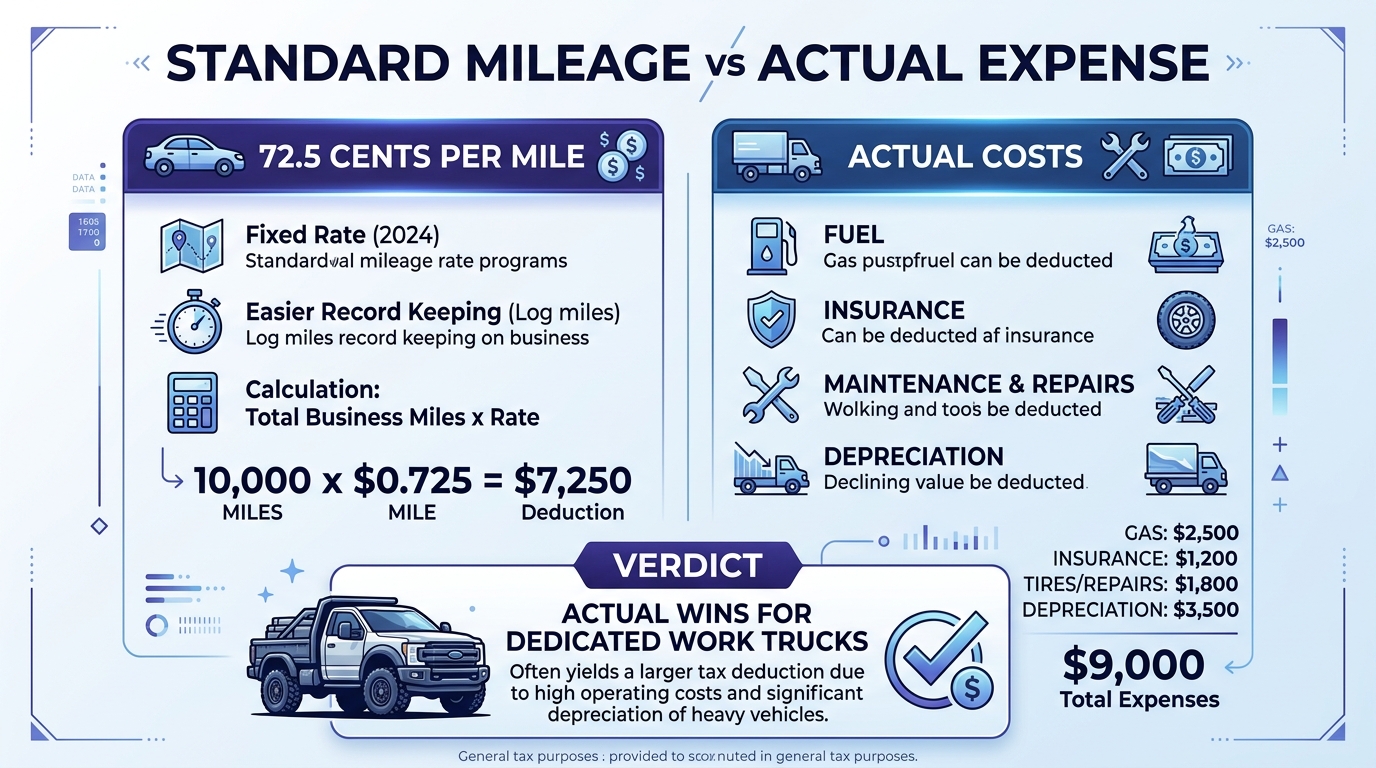
The 2026 standard mileage rate is 72.5 cents per mile. A technician driving 30,000 business miles generates a $21,750 deduction — no receipt tracking required beyond a mileage log.
Under the actual expense method, you deduct fuel, insurance, maintenance, repairs, registration, depreciation, and loan interest — the actual cost of running the vehicle. For a fully loaded HVAC service van, actual costs typically run $12,000-$18,000 per year including depreciation.
For most HVAC contractors, the actual expense method produces a larger deduction — especially in the year you buy the vehicle, when Section 179 or bonus depreciation creates a massive first-year write-off. A $50,000 van expensed under Section 179 plus $8,000 in operating costs gives you a $58,000 deduction in year one. Standard mileage on the same vehicle produces roughly $21,750.
Important: Once you use the actual expense method for a vehicle, you cannot switch to standard mileage for that vehicle in future years. And if you claim Section 179 on the vehicle, you’re locked into actual expense permanently. For company-owned service vans, this is almost always the right call. For employee-owned vehicles with a mileage reimbursement, the standard rate is simpler.
Beyond the big-ticket items — trucks, equipment, tools — there’s a layer of deductions that get missed because they’re small individually but add up to $3,000-$8,000 per year in aggregate.
If you dispatch technicians from a home office, manage scheduling, handle customer calls, or do administrative work from a dedicated space in your home, you qualify for the home office deduction. The simplified method gives you $5 per square foot up to 300 square feet ($1,500 maximum). The regular method — based on the percentage of your home used for business — can produce a larger deduction if your home office is substantial.
Many HVAC owners dismiss this because they have a shop or warehouse. But if you’re running the business from home during off-hours, early mornings, or weekends — which most HVAC contractors do — the deduction is legitimate.
These are ordinary and necessary business expenses, but they often get buried in generic expense categories where they’re hard to verify at tax time:
Company uniforms, steel-toe boots, safety glasses, hard hats, high-visibility vests, and gloves are deductible as long as they’re not suitable for everyday wear. For an HVAC company outfitting 8-10 techs, uniform and safety gear costs run $500 to $1,500 per year — a small but real deduction that many contractors never claim.
Here’s a summary of the deductions covered above, with typical annual amounts for a $2M-$3M HVAC contractor running 6-8 service vehicles:
| Deduction | Typical Annual Amount | Tax Treatment |
|---|---|---|
| Service van (over 6,000 lbs GVWR) | $45,000-$65,000 per vehicle | Section 179 — full expense in year one |
| Diagnostic equipment & recovery machines | $5,000-$15,000 | Section 179 or bonus depreciation |
| Tools & small equipment (under $2,500/item) | $3,000-$5,000 | De minimis safe harbor — immediate expense |
| Vehicle operating costs (fuel, maintenance) | $8,000-$18,000 per vehicle | Actual expense method |
| General liability & workers’ comp insurance | $15,000-$40,000 | Ordinary business expense |
| Licensing & EPA/NATE certifications | $200-$500 per tech | Ordinary business expense |
| Continuing education & safety training | $500-$2,000 | Ordinary business expense |
| Uniforms & safety gear | $500-$1,500 | Ordinary business expense |
| Home office (owner) | $500-$1,500 | Simplified or regular method |
| Trade association dues | $300-$800 | Ordinary business expense |
| Software (ServiceTitan, QBO, etc.) | $3,000-$8,000 | Ordinary business expense or Section 179 |
The gap isn’t about dishonesty or negligence. It’s structural. Most HVAC contractors use a general bookkeeper who categorizes expenses correctly for GAAP purposes but doesn’t optimize for tax deduction strategy. Specifically:
Tools get capitalized instead of expensed. Without the de minimis safe harbor election, every $800 multimeter and $1,200 refrigerant scale goes onto a depreciation schedule — giving you a $171/year deduction instead of the full $1,200 up front.
Vehicles land on the wrong side of the weight threshold. A bookkeeper who doesn’t know the 6,000 lb GVWR rule won’t flag the tax difference between a Transit 150 and a Transit 350 before you buy. That’s a $25,000 swing in year-one deductions.
Small deductions never get categorized. Licensing fees, certification renewals, trade association dues, and safety gear purchases end up in “Miscellaneous” or “Office Supplies” — categories that are easy to overlook at tax time and hard to defend in an audit.
No one coordinates the Section 179 election with the CPA. Your bookkeeper tracks the purchase. Your CPA files the return. But if nobody proactively discusses the Section 179 election before year-end, the CPA may default to standard depreciation — and you lose the accelerated deduction.
This is why HVAC-specific bookkeeping matters. A bookkeeper who understands the trade — one who tracks vehicle weights, makes the de minimis election, and flags Section 179 opportunities before year-end — recovers their fee in tax savings alone.
Bottom line: Tax deductions aren’t found at year-end. They’re built throughout the year by categorizing expenses correctly, timing purchases strategically, and coordinating between your bookkeeper and CPA before the deadline. If your books aren’t set up to capture these deductions automatically, you’re paying more than you should.
Stop leaving money on the table. Steph’s Books specializes in bookkeeping for HVAC contractors — including tax-optimized expense categorization and Section 179 planning. Get an instant quote or schedule a free consultation to see how much you could save.
Get a free quote and see how Steph's Books can save you 40-60% vs hiring in-house.