Your HVAC payroll is probably wrong. Not “off by a few cents” wrong — wrong in a way that creates wage-and-hour liability every single pay period. Most HVAC contractors between $1M and $10M are running payroll with the same process they used at $300K: a flat hourly rate, manual overtime at time-and-a-half, and spiffs tacked on as a separate line item. That approach violates federal overtime law the moment a technician earns a bonus in a week they work more than 40 hours.
For the full picture of HVAC financial management, see our complete guide to HVAC bookkeeping.
This guide covers the specific HVAC payroll challenges that trip up trade contractors: FLSA overtime requirements, spiff reallocation for overtime recalculation, commission tracking, fully loaded burden rates, workers’ comp classification, and prevailing wage compliance. If you’re running payroll for five or more technicians, at least one of these is costing you money right now.
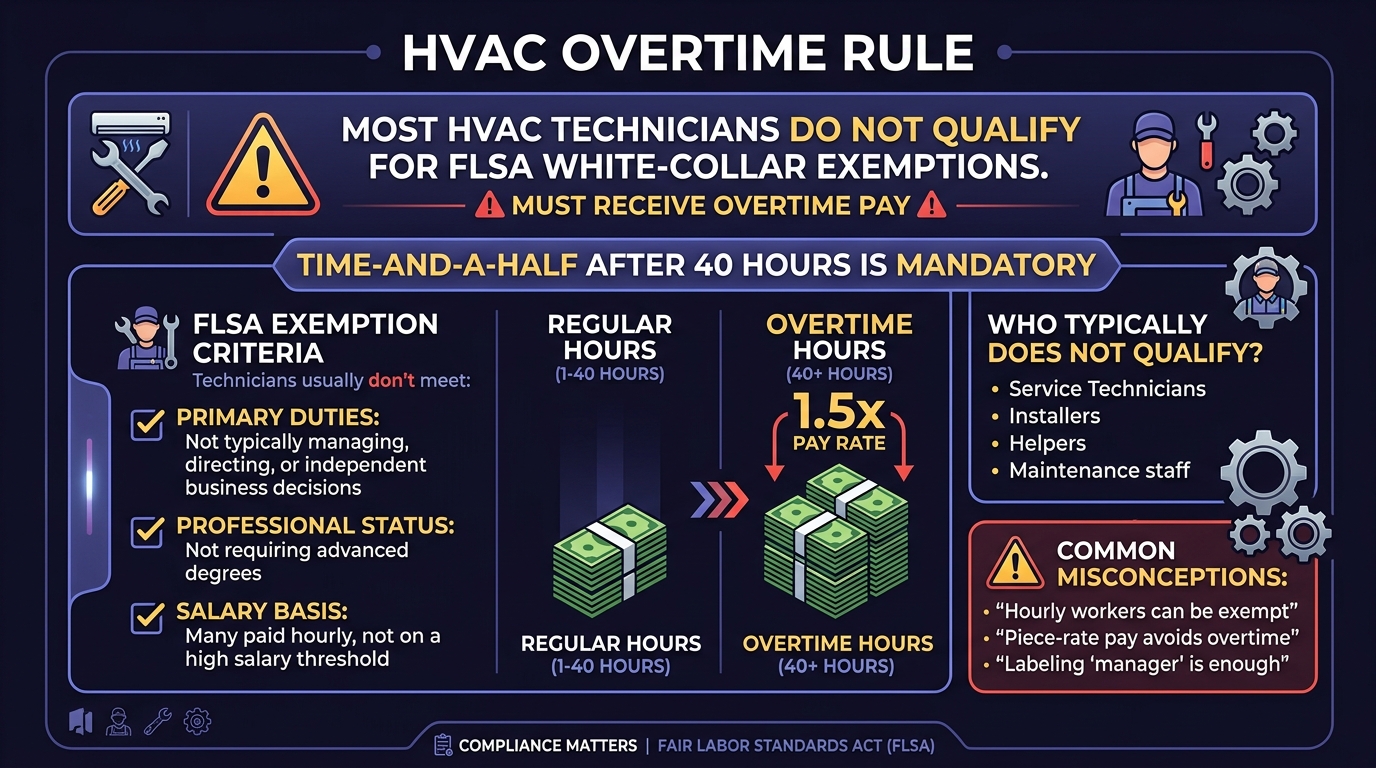
The Fair Labor Standards Act requires overtime pay at 1.5× the regular rate for all hours worked beyond 40 in a workweek. The question every HVAC contractor asks: “Are my techs exempt?”
Almost certainly not.
The DOL defines three main white-collar exemptions: executive, administrative, and professional. HVAC technicians fail all three:
The salary threshold ($58,656/year as of 2026) is also a factor, but even techs who earn above it still don’t meet the duties test for any exemption. The result: virtually all HVAC technicians are non-exempt and entitled to overtime.
If you’ve been treating senior techs or lead installers as exempt because they “make decisions in the field,” you have retroactive liability exposure. The statute of limitations is two years for unintentional violations and three years for willful violations.
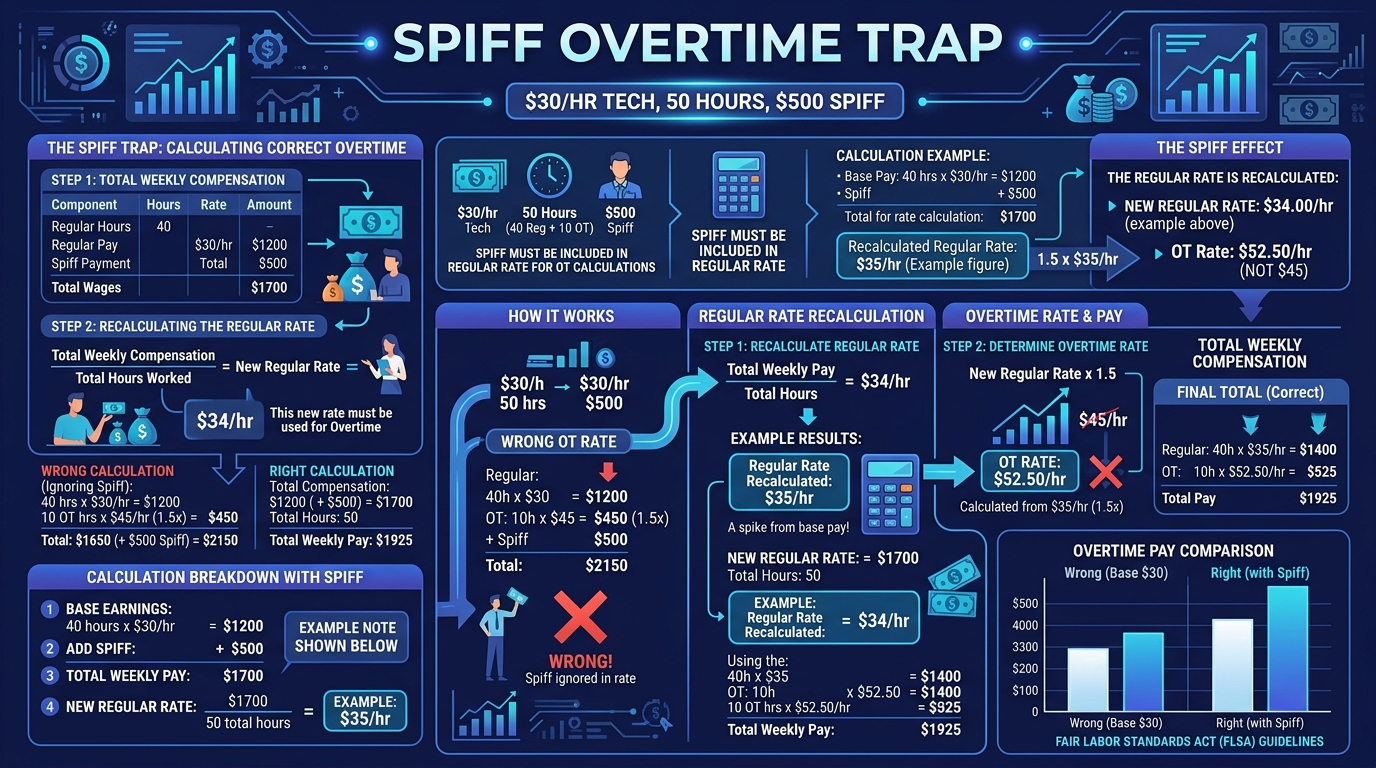
Here’s where most HVAC contractors get blindsided. The Air Conditioning Contractors of America (ACCA) and employment attorneys agree: spiffs and non-discretionary bonuses must be included in the regular rate of pay for overtime calculation.
This isn’t optional. Under FLSA §778.209, any bonus that is announced in advance to incentivize performance — a $50 spiff for selling a maintenance agreement, a $100 bonus for completing a retrofit under budget — is non-discretionary and must be factored into overtime.
Here’s a concrete example of how spiff reallocation works:
Without spiff (incorrect method most contractors use):
– Tech earns $30/hr, works 50 hours
– Straight time: 40 hrs × $30 = $1,200
– Overtime: 10 hrs × $45 (1.5 × $30) = $450
– Spiff earned that week: $500
– Total paid: $2,150
With spiff properly allocated (correct method):
– Total straight-time earnings: $1,200 + $500 spiff = $1,700
– Recalculated regular rate: $1,700 ÷ 50 hours = $35/hr
– Recalculated OT premium: 0.5 × $35 = $17.50/hr
– OT premium owed: 10 hrs × $17.50 = $175
– Total paid: $1,700 + $175 = $1,875
Wait — the correct total is actually lower? Yes, in this example. But here’s the catch: many contractors pay the spiff on top of already-calculated overtime, which means they’re paying $2,150. The recalculation yields $1,875. However, if the spiff is smaller or the overtime hours are higher, the recalculation can go the other direction and increase what you owe.
The real risk isn’t overpaying by $275 on one paycheck. It’s that you’re not documenting the allocation method at all — which means a DOL audit or wage claim forces you to defend a calculation you never performed. The ACCA recommends allocating each spiff back to the workweek in which it was earned and recalculating the regular rate for that week.
Pro Tip: Configure your payroll system to treat spiffs as “non-discretionary bonus” pay codes, not flat additions. QuickBooks Payroll, Gusto, and ADP all support bonus pay types that automatically trigger overtime recalculation — but only if you set them up correctly from the start.
Many HVAC companies pay technicians a commission on maintenance agreement sales, upsells, or equipment referrals. The tracking usually lives in a spreadsheet maintained by the service manager — completely disconnected from payroll.
This creates three problems:
The fix: commissions should flow from your field service platform (ServiceTitan, Housecall Pro, Jobber) into payroll as a coded earning type, tagged to the week the sale was completed — not the week the customer’s first payment processes.
Every HVAC contractor knows what they pay their techs per hour. Almost none know what their techs cost per hour. The gap between the two is your burden rate — and it’s the number you need for accurate job costing, bid pricing, and profitability analysis.
Here’s the fully loaded burden rate breakdown for a technician earning $30/hr:
| Burden Component | Cost per Hour | Notes |
|---|---|---|
| Base wage | $30.00 | Hourly rate |
| FICA (Social Security + Medicare) | $2.30 | 7.65% employer match |
| Federal unemployment (FUTA) | $0.04 | 0.6% on first $7,000 (amortized) |
| State unemployment (SUTA) | $0.30 | Varies by state; ~1% average |
| Workers’ comp insurance | $1.20 | ~$3.50–$5.00 per $100 payroll for HVAC (code 5183) |
| Health insurance | $3.50 | Employer share of group plan, amortized hourly |
| 401(k) match | $0.90 | 3% match on eligible wages |
| Tool allowance | $0.50 | Annual tool stipend amortized across hours |
| PTO / paid holidays | $2.30 | 10 days PTO + 6 holidays = 128 hrs paid non-productive |
| Training & certification | $0.75 | EPA 608, NATE renewals, manufacturer training |
| Fully loaded rate | $41.79 | ~39% burden on top of base wage |
Your actual burden rate will land between $42 and $45/hr on a $30/hr base wage depending on your state’s workers’ comp rates and the richness of your benefits package. That means every hour a tech spends on a job costs you 40-50% more than their hourly wage.
This number matters because it’s what you plug into job cost estimates and bid sheets. If you’re bidding a 16-hour install using $30/hr labor, you’re underpricing the job by $190. Do that across 200 installs per year and you’ve given away $38,000 in margin.
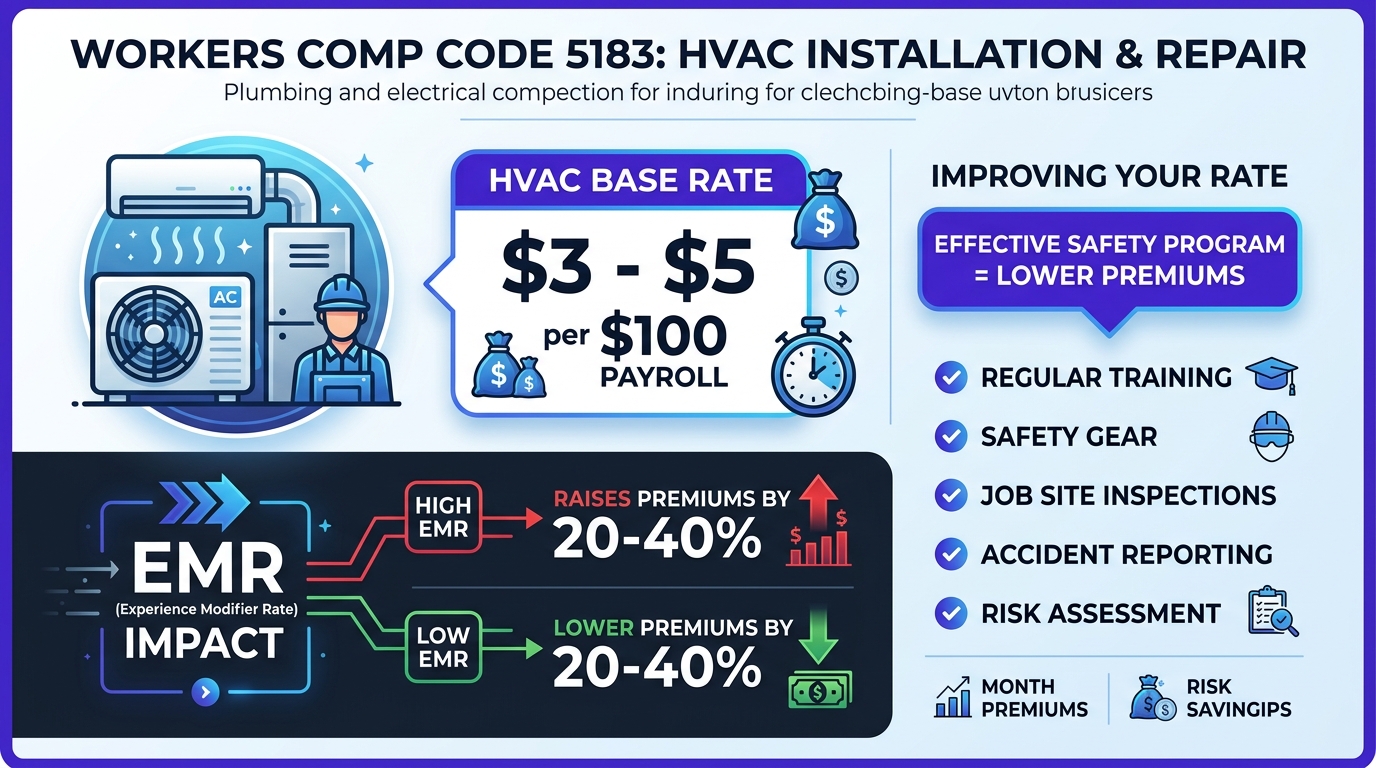
HVAC technicians are classified under NCCI workers’ compensation code 5183 — “Plumbing, Heating, Air Conditioning, and Ventilation” — in most states. This is a moderate-risk classification with rates typically ranging from $3.00 to $5.00 per $100 of payroll, depending on your state and experience modification rate (EMR).
Key considerations:
If your company bids on commercial projects funded with federal or state money, prevailing wage laws apply. The Davis-Bacon Act (federal) and state “Little Davis-Bacon” laws require contractors to pay at least the prevailing wage rate for the locality — which is typically the union scale.
When it applies:
What it requires:
Most HVAC contractors who take their first government job underestimate the payroll reporting burden. The certified payroll requirement alone demands per-project hour tracking, which means your field service software and payroll system must be configured to isolate prevailing wage jobs from standard work.
Whether you use QuickBooks Online Payroll, Gusto, or ADP, the setup principles are the same:
The payroll configuration is a one-time investment that pays for itself the first time a tech earns a spiff during an overtime week — because the system handles the recalculation automatically instead of creating a compliance gap you’ll discover during an audit.
Pro Tip: Review your payroll earning codes quarterly. As you add new incentive programs (seasonal bonuses, efficiency spiffs, referral commissions), each one needs its own non-discretionary bonus code. A single “miscellaneous” earning code is a compliance time bomb.
HVAC payroll errors don’t just create legal risk — they distort every downstream financial metric. If your burden rate is wrong by $3/hr, your job cost estimates are wrong. If your job costs are wrong, your profit margins are fictional. And if your margins are fictional, you’re making pricing, hiring, and growth decisions based on numbers that don’t reflect reality.
The contractors who get this right treat payroll as a financial system, not an administrative task. They configure earning codes correctly, allocate spiffs to the right weeks, track commissions in real time, and know their fully loaded burden rate down to the penny.
Is your HVAC payroll set up to handle spiffs, commissions, and overtime correctly? Steph’s Books provides trade-contractor-specific bookkeeping that catches the payroll errors most general bookkeepers miss. Get a free assessment →
Get a free quote and see how Steph's Books can save you 40-60% vs hiring in-house.