A $3M firm leaking 5% to fraud is a $150k/year problem.
Occupational fraud hits firms under 100 employees hardest. Monthly rec by someone who does not write the checks is the control those 10 cases skipped.
Instant QuoteThe biggest accounting fraud cases in history include Enron ($74 billion), WorldCom ($11 billion), Bernie Madoff ($65 billion), Wirecard ($2.1 billion), and Tyco ($600 million). Here’s what happened in each case and the bookkeeping red flags that should have caught them.
When we think of accounting fraud cases, we picture billion-dollar corporate collapses on the evening news. Enron. WorldCom. Bernie Madoff. These names belong to a hall of infamy that feels impossibly distant from the day-to-day reality of running a professional services firm — whether that is law firm bookkeeping with client trust accounts, property management bookkeeping with owner funds, or HVAC bookkeeping with seasonal cash.
But here is the uncomfortable truth: the exact same patterns that enabled those headline-grabbing frauds play out in small businesses every single day. The Association of Certified Fraud Examiners (ACFE) reports that organizations with fewer than 100 employees suffer the highest median fraud losses, and occupational fraud costs businesses an estimated 5% of annual revenue.
As a firm owner generating between $1 million and $10 million in revenue, you are squarely in the danger zone, not because you are dishonest, but because the controls that prevent fraud are often the last thing growing companies invest in. If the file is months behind, catch up bookkeeping is how you get a rec you can actually trust. What that help costs is in our outsourced bookkeeping cost guide.
This article breaks down 10 of the biggest accounting fraud cases in history, explains exactly how they happened, and, most importantly, distills the lessons you can apply to your own business starting today. For a deeper dive into the detection side, read our complete guide to forensic accounting and fraud detection.
Enron was America’s seventh-largest company, an energy trading giant celebrated on magazine covers and taught as a case study in business school innovation. Behind the glossy exterior, CFO Andrew Fastow had constructed a labyrinth of special purpose entities (SPEs), off-balance-sheet vehicles designed to hide billions of dollars in debt and inflate profits.
These SPEs were nominally independent but functionally controlled by Enron executives. They allowed the company to move losses off its books while recording illusory gains. The arrangement was so convoluted that even Enron’s board members later admitted they did not fully understand the structures they approved.
When the fraud unraveled, $74 billion in shareholder value evaporated in a matter of weeks. Over 20,000 employees lost their jobs and, in many cases, their retirement savings, which had been heavily invested in Enron stock.
Short seller Jim Chanos and Fortune reporter Bethany McLean began asking questions about Enron’s opaque financial statements in early 2001. Internal whistleblower Sherron Watkins also raised alarms. The SEC launched a formal investigation in October 2001, and Enron filed for bankruptcy by December.
Never allow financial complexity you do not understand. If your bookkeeper or CFO creates structures, accounts, or entities that they cannot explain in plain English, that is a red flag. Every transaction your business enters into should be transparent to at least two people. Consider having an independent bookkeeping team review your financials to provide an objective second set of eyes.
WorldCom, the second-largest long-distance phone company in the U.S., inflated its assets by approximately $11 billion through one of the simplest tricks in the accounting playbook: capitalizing ordinary operating expenses. Line costs that should have been expensed immediately were instead recorded as capital expenditures, spreading them across years and making the company appear far more profitable than it actually was.
CEO Bernie Ebbers pressured finance staff to “hit the numbers,” and CFO Scott Sullivan executed the scheme by directing journal entries that reclassified billions in expenses.
WorldCom’s internal audit team, led by Cynthia Cooper, discovered $3.8 billion in fraudulent entries during a routine review that Sullivan had tried to block. Cooper went around Sullivan to the board’s audit committee, triggering a full investigation.
Understand the difference between capital expenditures and operating expenses. If your P&L suddenly looks healthier because large expenses have shifted to the balance sheet, ask why. Regular bank reconciliations and independent reviews make it much harder to manipulate how expenses are classified.
Bernie Madoff ran the largest Ponzi scheme in history for nearly two decades. His investment firm reported consistently stellar returns by simply paying early investors with money from new investors. The scheme worked as long as new money kept flowing in.
What made Madoff’s fraud uniquely devastating was its longevity. Charitable foundations, pension funds, and individual investors trusted him implicitly. His auditor was a tiny, virtually unknown firm operating out of a strip mall, a firm with no capacity to audit an operation of that scale.
Financial analyst Harry Markopolos had been warning the SEC about Madoff since 1999, but his complaints were ignored for nearly a decade. The scheme finally collapsed in December 2008 when the financial crisis triggered a wave of investor redemptions that Madoff could not cover. He confessed to his sons, who reported him to the FBI.
Your auditor matters. An independent, qualified auditor (or bookkeeper) is your most important line of defense. If your financial reviews are conducted by someone without the proper credentials, bandwidth, or independence, you effectively have no review at all. This is why outsourcing your bookkeeping to a professional firm creates a natural layer of accountability.
Tyco CEO Dennis Kozlowski and CFO Mark Swartz looted $600 million from the company through unauthorized bonuses, fraudulent stock sales, and personal expenses disguised as business costs. Kozlowski famously used company funds to purchase a $6,000 shower curtain and throw a $2 million birthday party for his wife on the Italian island of Sardinia.
The fraud was enabled by a compliant board of directors and a culture of unchecked executive authority. Kozlowski treated the company treasury as a personal bank account.
A Manhattan District Attorney investigation into Kozlowski’s evasion of sales tax on art purchases led investigators to the much larger pattern of corporate theft. The SEC subsequently filed civil charges.
No one should have unchecked access to company funds, including you. Implement dual-signature requirements for large transactions, require board or partner approval for executive compensation changes, and ensure personal and business expenses are never commingled. Even founders need guardrails.
HealthSouth, the largest U.S. provider of rehabilitative healthcare, systematically inflated its earnings by $2.7 billion over six years. CEO Richard Scrushy instructed his accounting staff to insert fictitious entries to meet Wall Street earnings expectations each quarter. The company called these sessions “family meetings,” where senior accountants would determine exactly how much to inflate the numbers.
The SEC began investigating after Scrushy sold $75 million in stock shortly before HealthSouth reported a large loss. CFO William Owens cooperated with the FBI, wearing a wire to record conversations about the ongoing fraud.
Beware of pressure to “make the numbers.” When your financial reports are driven by targets rather than reality, you are one step away from fraud. If you find yourself, your bookkeeper, or your accountant adjusting entries to make things “look right” for a bank, an investor, or a partner, stop immediately. Accurate books are more valuable than impressive ones.
German fintech giant Wirecard claimed to process payments for merchants worldwide. In reality, $2 billion in cash balances that the company reported in Philippine bank accounts simply did not exist. A massive portion of Wirecard’s revenue came from third-party “partner companies” that turned out to be fabricated or shell entities generating fictitious transactions.
The fraud was remarkable because Wirecard was a DAX 30 company, one of the most valuable public companies in Germany, and it had been the subject of fraud allegations by investigative journalists for years before collapsing.
The Financial Times published a series of investigative reports starting in 2019. When auditor EY finally demanded to see evidence of the $2 billion in trust accounts, the Philippine banks confirmed the money was not there. CEO Markus Braun was arrested, and COO Jan Marsalek fled the country.
Verify balances independently, every single month. If someone tells you money is in an account, confirm it with the bank directly. Monthly bank reconciliations performed by someone other than the person managing the cash make fabricated balances nearly impossible to sustain.
Most fraud is caught by a recon, not an auditor.
Every case on this page ran because one person recorded, approved, and reconciled. On a $4M professional services firm, ACFE’s 5% median is $200,000 sitting in unreviewed QuickBooks Online — IOLTA, owner draws, or a vendor nobody has met.
Instant QuoteThis case hits closest to home for small businesses. Rita Crundwell served as the comptroller and treasurer of Dixon, Illinois, a town of just 15,000 people. Over 20 years, she embezzled $53 million from city funds, making it the largest municipal fraud in U.S. history.
Crundwell created a secret bank account labeled “RSCDA” (Reserve Sewer Capital Development Account) and funneled city money into it. She used the stolen funds to build one of the nation’s top quarter horse breeding operations. She was the only person who handled the city’s finances. No one reviewed her work. No one questioned the account. For two decades.
While Crundwell was on an extended vacation, a temporary replacement discovered the RSCDA account and reported it. The FBI investigation revealed 20 years of systematic theft.
This is the most important case on this list for small business owners. One person controlled all financial functions with zero oversight. She wrote checks, reconciled accounts, and prepared reports, all by herself. If a single employee or contractor handles your books without anyone reviewing their work, you are exposed to exactly this type of fraud. Forensic accountants consistently identify “lack of segregation of duties” as the number-one fraud risk factor in small organizations.
The Dixon, Illinois case is a textbook example of why every business, no matter how small, needs at least two people involved in the financial process. One person records transactions. A different person reviews them. This single control would have caught Rita Crundwell in year one, not year twenty.
Waste Management’s executives inflated earnings by $1.7 billion over five years through a combination of improper depreciation methods and inflated asset salvage values. The company extended the useful life of its garbage trucks and equipment far beyond reality, reducing depreciation expense and boosting reported profits.
They also failed to record expenses for declined asset values, manipulated interest rates on environmental liabilities, and improperly capitalized a variety of costs.
A new CEO, brought in to turn the company around, ordered a comprehensive financial review. The restatement revealed years of manipulated depreciation schedules. Arthur Andersen, the company’s auditor (the same firm that later audited Enron), paid $75 million to settle fraud charges related to its negligent audits.
Asset depreciation is not a “set it and forget it” calculation. If your fixed asset schedules have not been reviewed in years, or if asset useful lives seem unusually long, it is worth having an independent review. For service firms, this often applies to equipment, vehicles, and technology assets. Correct depreciation impacts your taxes, your financial ratios, and your ability to make informed capital decisions.
Satyam, one of India’s largest IT services companies, was dubbed “India’s Enron” when chairman Ramalinga Raju confessed that the company had fabricated $1 billion in bank balances and created 13,000 fictitious employee records to siphon off payroll funds. Revenue was inflated with fake invoices from nonexistent customers.
The scheme ran for years because Raju controlled the flow of information to the board and auditors. Forged bank statements were presented during audits, and the fictitious employees existed only on paper, their “salaries” diverted to accounts controlled by insiders.
Raju attempted a $1.6 billion acquisition of two companies owned by his family, which would have allowed him to fill the balance sheet hole with real assets. When the board blocked the deal, Raju confessed in a letter to the board, calling the fraud “a tiger I was riding and could not dismount.”
Ghost employees and fake invoices are not just a big-company problem. The ACFE reports that ghost payroll fraud is among the most common schemes in small businesses. If one person controls both payroll setup and payroll approval, ghost employees can be added without detection. Similarly, vendor payments should be verified against actual goods or services received. Run periodic headcount audits and match payroll records against HR files.
Theranos was not a traditional accounting fraud case, but it belongs on this list because it demonstrates how financial deception extends beyond the general ledger. Founder Elizabeth Holmes raised $700 million from investors by claiming her company had developed revolutionary blood-testing technology that could run hundreds of tests from a single drop of blood.
The technology did not work. Internal results were unreliable, and the company secretly used conventional machines from other manufacturers to run most of its tests. Financial projections presented to investors were based entirely on the assumption that the technology was functional.
Wall Street Journal reporter John Carreyrou, tipped off by former employees, published a devastating investigation in 2015. The SEC charged Holmes with massive fraud, and she was convicted on four counts of wire fraud in 2022.
Fraud is not always about the numbers on the page. It can live in the projections you show to a bank, the capabilities you promise a client, or the revenue forecasts you present to a potential partner. Integrity in financial reporting means representing your business honestly in every context, not just on the balance sheet. If something sounds too good to be true in a pitch deck, it probably is.
Despite spanning different industries, countries, and decades, every fraud on this list shares the same DNA. Understanding these patterns is what makes the difference between a cautionary tale and an actionable defense strategy.
In every case, the people committing the fraud either controlled the oversight process or operated in an environment where no meaningful oversight existed. Madoff chose an auditor that could not possibly scrutinize his operation. Crundwell was the only person who ever looked at the books. Enron’s board rubber-stamped structures they did not understand.
When one person or a small group controls recording, approving, and reconciling financial transactions, fraud becomes trivially easy. This is why segregation of duties is considered the cornerstone of internal controls by every major accounting body.
None of these frauds required sophisticated hacking or elaborate technology. They exploited basic control failures: no bank reconciliation by an independent party, no dual authorization for large payments, no periodic review of journal entries, no verification of vendor or employee existence.
From WorldCom’s pressure to “hit the numbers” to HealthSouth’s quarterly manipulation sessions, most large-scale frauds are driven by external performance expectations. In small businesses, this pressure often comes from loan covenants, investor expectations, or simply the desire to appear more successful than reality warrants.
Criminologists describe fraud as requiring three elements: opportunity (weak controls), pressure (financial or personal motivation), and rationalization (the ability to justify the act). You cannot control pressure or rationalization, but you can systematically eliminate opportunity through better processes and oversight.
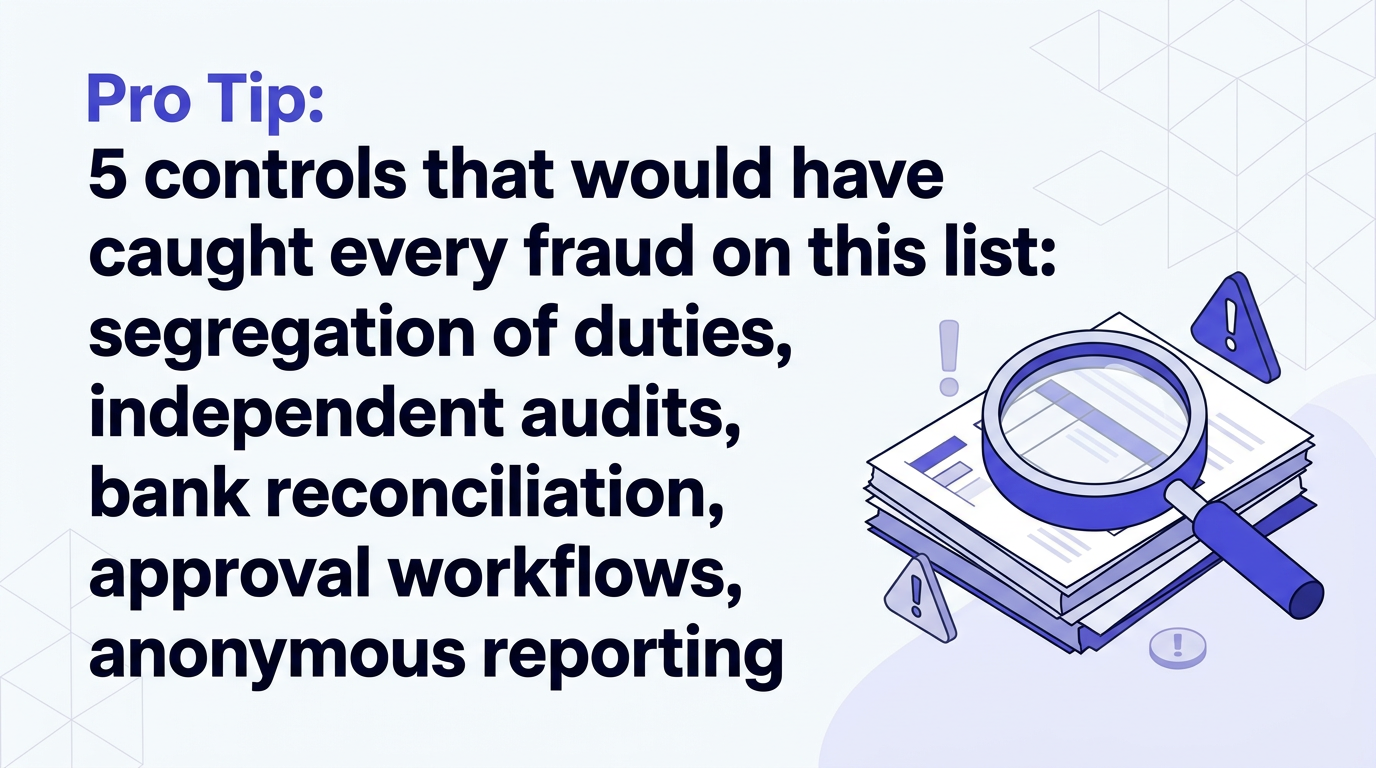
You do not need a Fortune 500 compliance department to protect your firm. These seven controls are practical, affordable, and directly inspired by the failures that enabled the frauds above.
| Case | Amount | How Discovered | Key Lesson |
|---|---|---|---|
| Enron | $74B market cap lost | Short sellers, journalist, SEC investigation | Never accept financial complexity you cannot explain |
| WorldCom | $11B fraud | Internal audit team found fraudulent entries | Understand CapEx vs. OpEx classification |
| Bernie Madoff | $65B Ponzi scheme | Financial crisis triggered redemptions; whistleblower ignored for years | Demand a qualified, independent auditor |
| Tyco International | $600M stolen | Tax evasion investigation uncovered larger theft | No one gets unchecked access to funds |
| HealthSouth | $2.7B inflated earnings | SEC investigation; CFO wore a wire | Never manipulate entries to “hit the numbers” |
| Wirecard | $2B fabricated | Investigative journalism; auditor verification of bank balances | Verify bank balances independently every month |
| Rita Crundwell / Dixon, IL | $53M embezzled | Temp worker found secret account during vacation coverage | Never let one person control all finances |
| Waste Management | $1.7B overstated | New CEO ordered comprehensive financial review | Review asset depreciation schedules regularly |
| Satyam | $1B fictitious assets | Chairman confessed after failed acquisition attempt | Audit payroll and vendor lists for ghost entries |
| Theranos | $700M raised fraudulently | Investigative journalism and whistleblowers | Financial integrity extends beyond the ledger |
The control is a second set of hands, not a new policy.
We enter and reconcile. You approve and pay. That split is what Crundwell, Satyam ghost payroll, and a partner-draw scheme cannot survive.
Instant QuoteInstant Quote for $1–10MM professional services firms. Monthly close, bank rec, and segregated duties — no sales call.