Steph's Books
Services
Industries
Pricing
About
Tools
Contact Us
Get a Quote
Steph's Books

Expert outsourced bookkeeping for professional services firms with $1MM-$10MM revenue.

Stay in the loop

Bookkeeping tips and fraud prevention insights. No spam.

Services

  • Bookkeeping
  • Payroll
  • AR/AP Services
  • Bank Reconciliation
  • Tax Prep
  • Catch-Up Bookkeeping
  • QuickBooks Training

Company

  • Home
  • All Services
  • Industries Served
  • Pricing
  • Meet the Team
  • Blog
  • Contact Us
  • Get Started

Areas Served

ChicagoNapervilleSchaumburgArlington HeightsBarringtonBuffalo GroveVernon HillsLake ZurichWaukeganElginMcHenryWoodstockMarengoLake ForestWaucondaFox LakeLakemoorGreen Oaks

Contact

  • (815) 271-5646
  • steph@stephsbooks.com
  • 4318 W Crystal Lake Rd
    Suite J
    McHenry, IL 60050

Mon – Fri: 9am – 5pm CST

© 2026 Steph's Books. All rights reserved.

Privacy PolicyTerms of ServiceEULA
Back to Blog

What to Expect in the First 90 Days of Outsourced Bookkeeping

March 16, 2026

You've made the decision to outsource your bookkeeping — now what? The first 90 days of outsourced bookkeeping set the tone for the entire relationship. This is when your new bookkeeping team learns your business, cleans up historical issues, establishes monthly processes, and proves they can deliver the financial clarity you've been missing. It's also when most failed engagements fall apart, usually because expectations weren't set properly upfront.

Whether you're switching from DIY bookkeeping, replacing an in-house hire, or moving from another outsourced provider, here's exactly what the first 90 days should look like — week by week — so you know what to expect, what to provide, and how to tell if things are on track.

Before Day 1: What to Prepare for Your Outsourced Bookkeeping Onboarding

The speed of your onboarding depends entirely on how quickly you can provide access and documentation. A prepared client can be fully onboarded in 5-7 business days. An unprepared one takes 3-4 weeks — and that delay pushes everything else back.

Access You'll Need to Provide

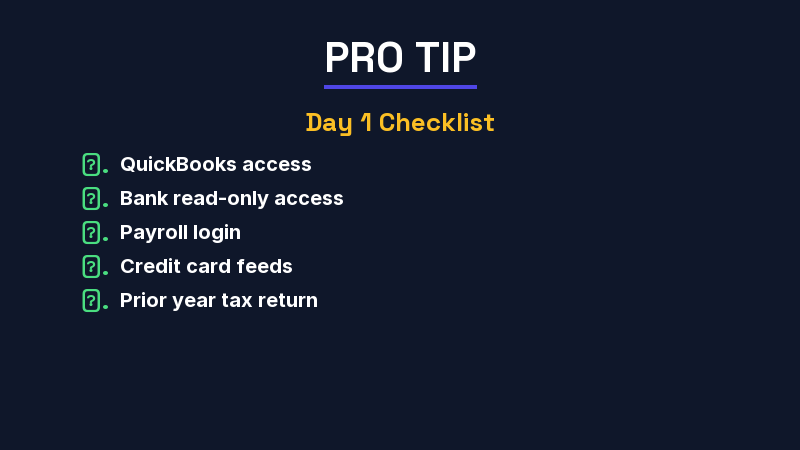
  • QuickBooks Online: Accountant-level or Admin-level access (not Standard user — they need full visibility)
  • Bank accounts: Read-only online banking access or agreement to connect bank feeds in QBO
  • Credit cards: Access to all business credit card portals for statement downloads
  • Payroll platform: Viewer access to Gusto, ADP, Paychex, or whichever provider you use
  • Bill payment platform: Access to Bill.com, Melio, or however you pay vendors
  • Practice management software: If relevant (Clio, PracticePanther, Harvest, Accelo) for revenue reconciliation

Documents to Have Ready

  • Last 2 years of tax returns (so they understand your entity structure and prior positions)
  • Most recent bank statements (all accounts)
  • Any outstanding invoices or bills (AP/AR aging)
  • Loan documents (for recording debt service correctly)
  • Payroll reports for the current year
  • Your current chart of accounts (they'll likely clean it up, but need to see the starting point)

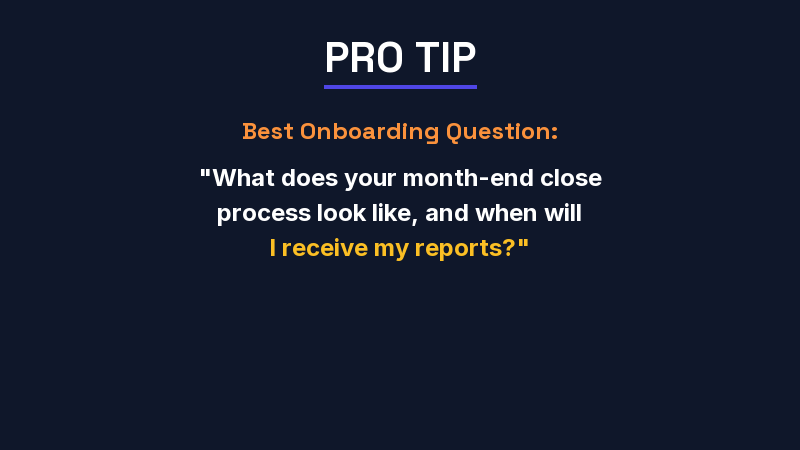
Pro Tip: Create a shared folder (Google Drive, Dropbox, or SharePoint) for your bookkeeping team from day one. This becomes the permanent document exchange — no more hunting through email threads for a bank statement from three months ago.
Pro tip: A prepared client onboards in 5-7 business days — an unprepared one takes 3-4 weeks
Having your access credentials and documents ready before kickoff is the single biggest factor in onboarding speed.

Days 1-14: Discovery and Assessment

The first two weeks are about your new bookkeeping team understanding the current state of your books and your business. Expect a lot of questions — that's a good sign.

Week 1: Kickoff and Access Setup

  • Kickoff call (60-90 minutes): Your bookkeeper learns your business — revenue model, billing cycle, number of employees, key vendors, and any pain points with your current books
  • Access configuration: They set up their QBO access, connect bank feeds, verify all integrations are pulling data correctly
  • Historical review: They pull your last 3-6 months of financials and identify obvious issues — unreconciled accounts, uncategorized transactions, missing entries, incorrect account classifications

Week 2: Assessment and Scope Definition

  • Assessment report: A good bookkeeping firm will deliver a written assessment of what they found — how far behind the books are, what needs cleanup, and an estimated timeline to get current
  • Chart of accounts review: They'll recommend simplifications, consolidations, or additions to make your chart of accounts work for your specific firm type
  • Process agreement: How will you communicate? Who approves vendor payments? How will you handle unclear transactions? These workflows get defined now
Week 1-2 Milestone Healthy Sign Red Flag
Kickoff call They ask detailed questions about your business model They jump straight into data entry without understanding your firm
Access setup Completed within 3 business days Still chasing access after 2 weeks
Assessment Written report with specific findings and timeline Vague verbal update: "Books look okay, we'll figure it out"
Communication Proactive questions via your preferred channel Radio silence — you have to chase them for updates

Days 15-45: Historical Cleanup and First Month-End Close

This is where the heavy lifting happens. If your books have been neglected, this phase can be intense — but it's also where you start seeing real value.

Weeks 3-4: Catch-Up Work

Depending on how far behind your books are, this phase includes:
  • Categorizing backlogged transactions: Every unreviewed bank feed item gets properly coded
  • Reconciling all accounts: Bank accounts, credit cards, loans, and payroll liabilities brought up to date
  • Cleaning up the chart of accounts: Merging redundant accounts, reclassifying transactions, removing unused categories
  • Recording missing entries: Journal entries for items the bank feed doesn't capture — payroll accruals, depreciation, prepaid expenses
  • Setting up bank rules: Automating categorization for your top 30-50 recurring vendors
Pro tip: The first month-end close takes the longest — expect 2-3x the time of a steady-state close
Don't judge your bookkeeper's long-term speed by the first close. Cleanup work front-loads the effort.

Weeks 4-6: First Month-End Close

The first month-end close your new bookkeeping team performs is the most important milestone in the 90-day window. This is where theory meets reality.

What a complete month-end close delivers:

  1. All bank accounts reconciled to the penny
  2. All credit cards reconciled with proper categorization
  3. Payroll entries recorded and balanced against payroll reports
  4. Accruals and deferrals posted (rent, insurance, retainers received but not yet earned)
  5. Financial statements prepared: P&L (Income Statement), Balance Sheet, and ideally a Cash Flow Statement
  6. Closing date locked to prevent accidental edits

Important: The first close will take longer than normal — often 2-3 weeks instead of the eventual 5-7 business days. This is expected. Your bookkeeper is still learning your vendor patterns, coding preferences, and business nuances. By the third close, the process should be dramatically faster.

Days 46-75: Second Close and Process Optimization

The second month-end close is where the outsourced bookkeeping relationship starts to hit its stride.

What Improves in Month 2

  • Bank rules handle 70-80% of transactions: The rules set up during cleanup now auto-categorize most recurring items
  • Fewer questions: Your bookkeeper has learned your vendor patterns and coding preferences
  • Faster close: Target is 7-10 business days after month-end (compared to 15-20 in month 1)
  • Cleaner statements: The P&L should look recognizable — you can see your actual cost structure reflected accurately for the first time

Your Role in Month 2

Review the financial statements they deliver. Not line by line (that's their job) — but at the summary level:

  • Does the revenue number match what you billed?
  • Do the major expense categories look right? (Payroll should be your largest; if software is #1, something's miscoded)
  • Is the net income in the ballpark of what you expected?
  • Are there any line items that don't make sense?

Flag anything that looks off. This feedback loop is how the bookkeeper fine-tunes their work to match your expectations.

Days 76-90: Steady State and Success Metrics

By day 90, your outsourced bookkeeping should be operating like a well-oiled machine. Here's what "success" looks like at the end of the first 90 days.

90-Day Success Metrics

Metric Target Why It Matters
Month-end close time 5-10 business days after statement date Timely financials enable timely decisions
Bank reconciliation accuracy $0 discrepancy, every account, every month The foundation of trustworthy books
Uncategorized transactions Zero at month-end Every dollar should be properly classified
Communication response time Same business day You shouldn't wait 3 days for an answer
Financial statements delivered P&L + Balance Sheet minimum, monthly The core deliverable you're paying for
Questions from your CPA Decreasing each quarter Clean books mean fewer tax-time headaches
Your time spent on bookkeeping < 1 hour/month (reviewing reports) The whole point of outsourcing
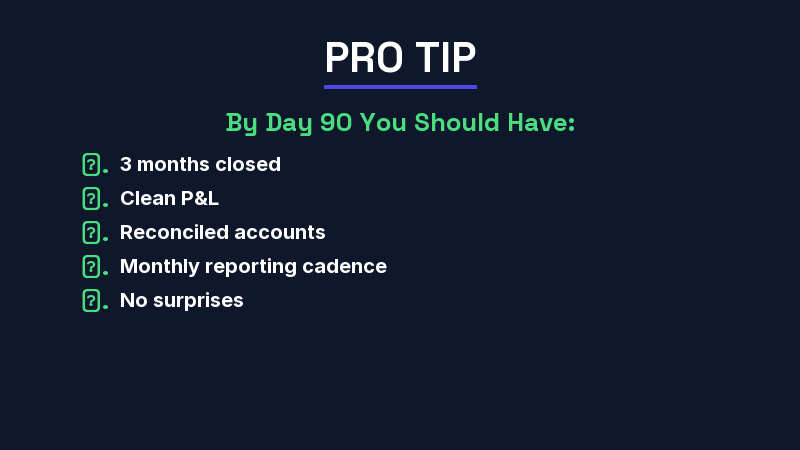
Pro tip: By day 90, your month-end close should take 5-10 business days and your time spent on bookkeeping should be under 1 hour/month
These benchmarks tell you whether the engagement is working. If you're not close to these targets by day 90, it's time for a candid conversation.

Red Flags: Signs Your First 90 Days Aren't Going Well

Not every outsourced bookkeeping engagement succeeds. Here are the warning signs that something is off — and what to do about them.

  • No assessment or onboarding plan: If your bookkeeper started entering transactions without first understanding your business, they're building on a shaky foundation
  • Radio silence: You haven't heard from them in 2+ weeks. A good bookkeeping team communicates proactively, especially during onboarding when they have the most questions
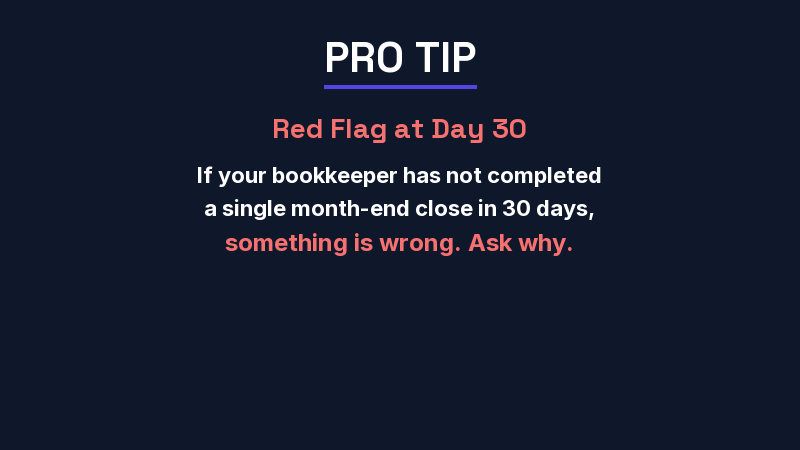
  • Still no financial statements by day 45: Unless your books required extensive historical cleanup (6+ months behind), you should have at least one complete month-end close by day 45
  • Asking you to categorize transactions: If they're sending you spreadsheets of transactions and asking "what is this?" for basic items (office supplies, software, meals), they may not have enough industry expertise to serve your firm well
  • Reconciliation discrepancies they can't explain: Small timing differences are normal; persistent unexplained gaps are not
  • Your chart of accounts looks the same: If they didn't touch the chart of accounts during onboarding, they either accepted a messy structure or didn't evaluate it properly

Pro Tip: Schedule a formal 30-day and 60-day check-in with your bookkeeping provider. These checkpoints give both sides a chance to address issues before they compound. If a provider resists scheduled check-ins, consider that a red flag in itself.

The 90-Day Timeline at a Glance

Phase Timeline Key Activities Your Time Commitment
Pre-onboarding Before Day 1 Gather access credentials, documents, and shared folder setup 2-4 hours (one-time)
Discovery Days 1-14 Kickoff call, access setup, historical review, assessment report 3-5 hours
Cleanup Days 15-30 Catch-up bookkeeping, reconciliation, chart of accounts cleanup 1-2 hours (answering questions)
First close Days 30-45 First full month-end close and financial statement delivery 1 hour (reviewing statements)
Optimization Days 46-75 Second close, process refinement, bank rule expansion 30-60 minutes
Steady state Days 76-90 Third close at target speed, success metric review 30 minutes/month ongoing
Pro tip: Your total time investment over 90 days is roughly 10-12 hours — after that, expect under 1 hour per month
The onboarding investment pays for itself quickly. Most firm owners get 10+ hours per month back after the first 90 days.

Setting Expectations for Long-Term Success

The first 90 days of outsourced bookkeeping are an investment — in onboarding time, in answering questions, and in building trust with a new team. Firms that approach it with realistic expectations and active participation in the first month see the fastest results.

After day 90, your role shifts from active participant to informed reviewer. You spend 30-60 minutes per month reviewing financial statements, flagging anything unusual, and making decisions based on data you can actually trust.

That shift — from spending Sundays in spreadsheets to spending 30 minutes reviewing a dashboard — is the entire point of outsourcing.

Ready to start your 90-day journey? Use our instant quote tool to see what outsourced bookkeeping would look like for your firm. Or schedule a free consultation with our team to walk through your specific situation. We specialize in professional services firms — law firms, consulting practices, agencies, and property management companies.

Related Reading

  • The Complete Guide to Outsourced Bookkeeping for Professional Services Firms
  • How to Evaluate an Outsourced Bookkeeping Firm
  • Get an Instant Bookkeeping Quote

Need help with your bookkeeping?

Get a free quote and see how Steph's Books can save you 40-60% vs hiring in-house.

Get a Free QuoteCall (815) 271-5646