Most law firm partnership disputes don't start over strategy. They don't start over hiring, or office leases, or whether to take on contingency work. They start over the compensation check. The partnership agreement said "profits will be distributed quarterly," but by Q3 the cash wasn't there, and now everyone has a different story about why — and a different read on what the agreement actually promised.
According to the American Bar Association's most recent research on law firm dissolutions, roughly 60% of partnership breakups cite compensation disputes as a primary driver. The irony is that most of these disputes are not really about greed. They're about confusion. Partners don't understand the mechanical and tax differences between guaranteed payments, draws, and distributions. The firm's bookkeeper treats them interchangeably. The partnership agreement was drafted by a transactional attorney who has never actually run a law firm. And when cash gets tight, those gaps become fault lines.
This article is the operational guide we wish every managing partner had before their first compensation conversation. It covers the four ways partners get paid, the tax treatment of each, how draws interact with K-1 allocations, and how to structure a compensation system that doesn't implode the first time a major receivable gets delayed. For the broader context on how all of this fits into running a financially sound law firm, see our Law Firm Bookkeeping Guide.
There are exactly four mechanisms by which a partner receives money from a law firm partnership. Confusing them is the single most common cause of tax surprises and partner disputes we see.
1. Guaranteed payments. These are fixed payments to a partner for services rendered or for use of capital, determined without regard to the firm's income. They are governed by IRC §707(c). Guaranteed payments are ordinary income to the receiving partner, subject to self-employment tax, and are deductible by the partnership as an ordinary business expense — meaning they reduce the profit pool before it gets distributed.
2. Draws. A draw is an advance against a partner's expected year-end profit distribution. Draws are not themselves taxable events. They are a cash transfer that reduces the partner's capital account. At year-end, the actual profit allocation per the partnership agreement is computed, and draws are reconciled against it.
3. Profit distributions. These are allocations of partnership income made according to the partnership agreement, reported on each partner's Schedule K-1 (Form 1065). The partner pays ordinary income tax and self-employment tax on their distributive share whether or not the cash is actually distributed — a critical point for tax planning, since "phantom income" is a real risk.
4. Return of capital. When a partner is repaid contributed capital (as opposed to profits), the payment is not taxable. It reduces the partner's basis in the partnership. If a partner's basis hits zero and they keep receiving distributions, those distributions become taxable gains.
| Mechanism | Nature | Tax Treatment to Partner | Self-Employment Tax? | On K-1? | Reduces Partnership Profit? |
|---|---|---|---|---|---|
| Guaranteed Payment | Fixed compensation for services/capital | Ordinary income | Yes | Yes (Line 4) | Yes (deductible above the line) |
| Draw | Advance on future distribution | Not taxable on receipt | N/A | No (reduces capital account) | No |
| Profit Distribution | Allocated share of partnership income | Ordinary income | Yes | Yes (Line 1/14) | No (it is the profit) |
| Return of Capital | Repayment of contributed capital | Not taxable (reduces basis) | No | Reflected in capital account | No |
The IRS's Partner's Instructions for Schedule K-1 (Form 1065) lays out exactly how each of these should be reported. If your firm's K-1s don't match the partnership agreement's allocation provisions, you have a problem — and it's a problem that compounds every year it goes unfixed.
Guaranteed payments are the most misunderstood compensation mechanism in law firm accounting. They exist because partnerships need a way to pay a partner for services without regard to the firm's profitability. A rainmaker who needs a $30,000 monthly floor regardless of whether the firm hits its numbers. A managing partner who takes on admin responsibilities and needs a stipend for that work. A capital partner whose contribution entitles them to a preferred return.
Under IRC §707(c), a guaranteed payment is treated, to the partnership, as if it were paid to a non-partner — meaning the firm deducts it as an ordinary expense. To the receiving partner, it is ordinary income reported on Schedule K-1, Line 4, subject to self-employment tax on Schedule SE.
When guaranteed payments make sense:
Common mistakes:
Tax warning: Guaranteed payments are taxable in the partner's tax year that includes the end of the partnership's tax year in which they were deducted — regardless of when the cash was actually paid. If your firm accrues a December guaranteed payment but doesn't pay it until February, the partner still owes tax on it for the prior year.
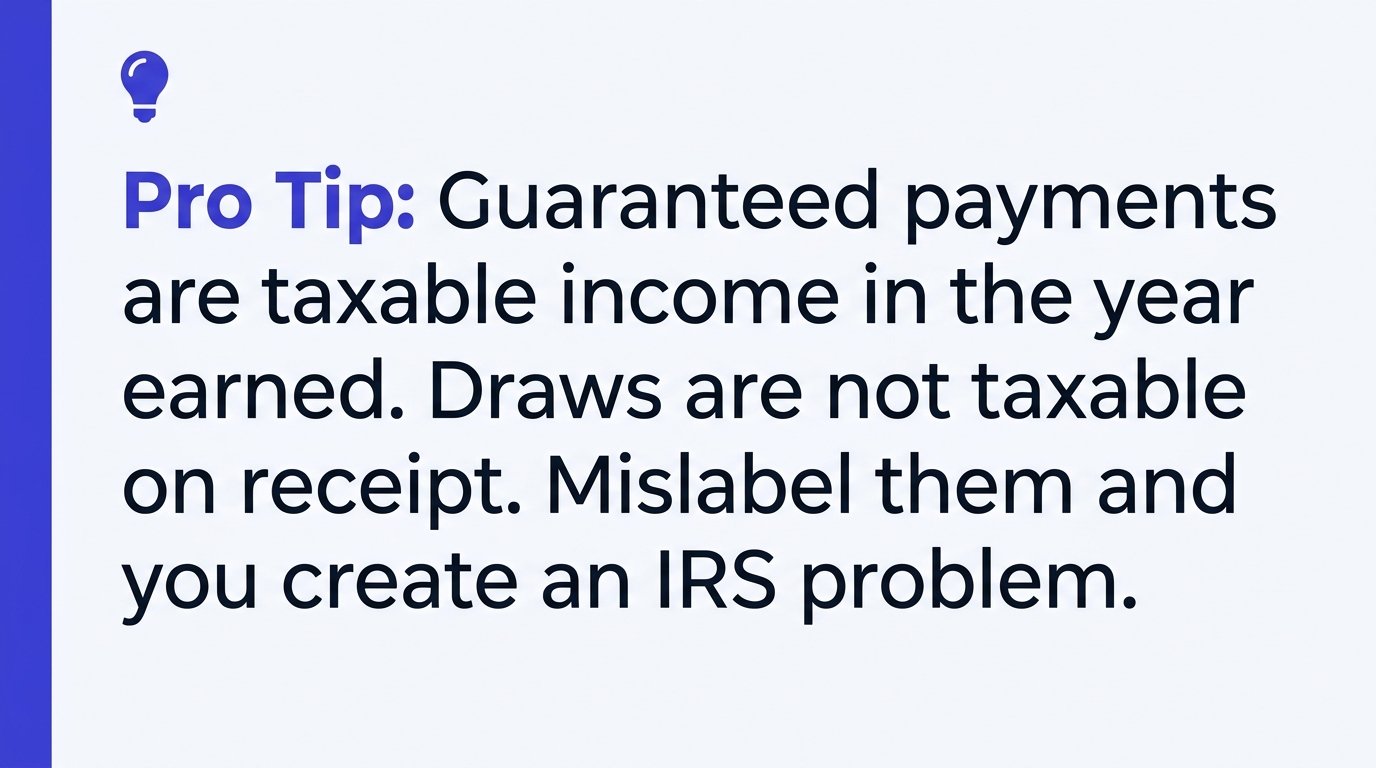
A draw is not a compensation event. It is a cash transfer. That distinction matters because every law firm that gets confused about its own draws eventually gets confused about its own taxes.
Here is how draws work mechanically. Each partner has a capital account on the partnership's books. When a partner takes a draw — say, $15,000 on the 15th of each month — the firm debits the partner's drawing account (a sub-account of their capital account) and credits cash. No income is recognized. No tax is owed on the draw itself.
At year-end, the firm computes each partner's actual distributive share of profit per the partnership agreement. That profit allocation flows onto the partner's K-1 and becomes taxable to them. The draws taken during the year are then netted against the actual profit allocation. If Partner A drew $180,000 and their K-1 profit share came to $220,000, they're entitled to an additional $40,000 distribution (if cash is available). If Partner A drew $180,000 but their K-1 profit share came to only $150,000, they have a $30,000 overdraw — and depending on the partnership agreement, they may owe the firm money back, or the overdraw may be carried forward against next year's allocation.
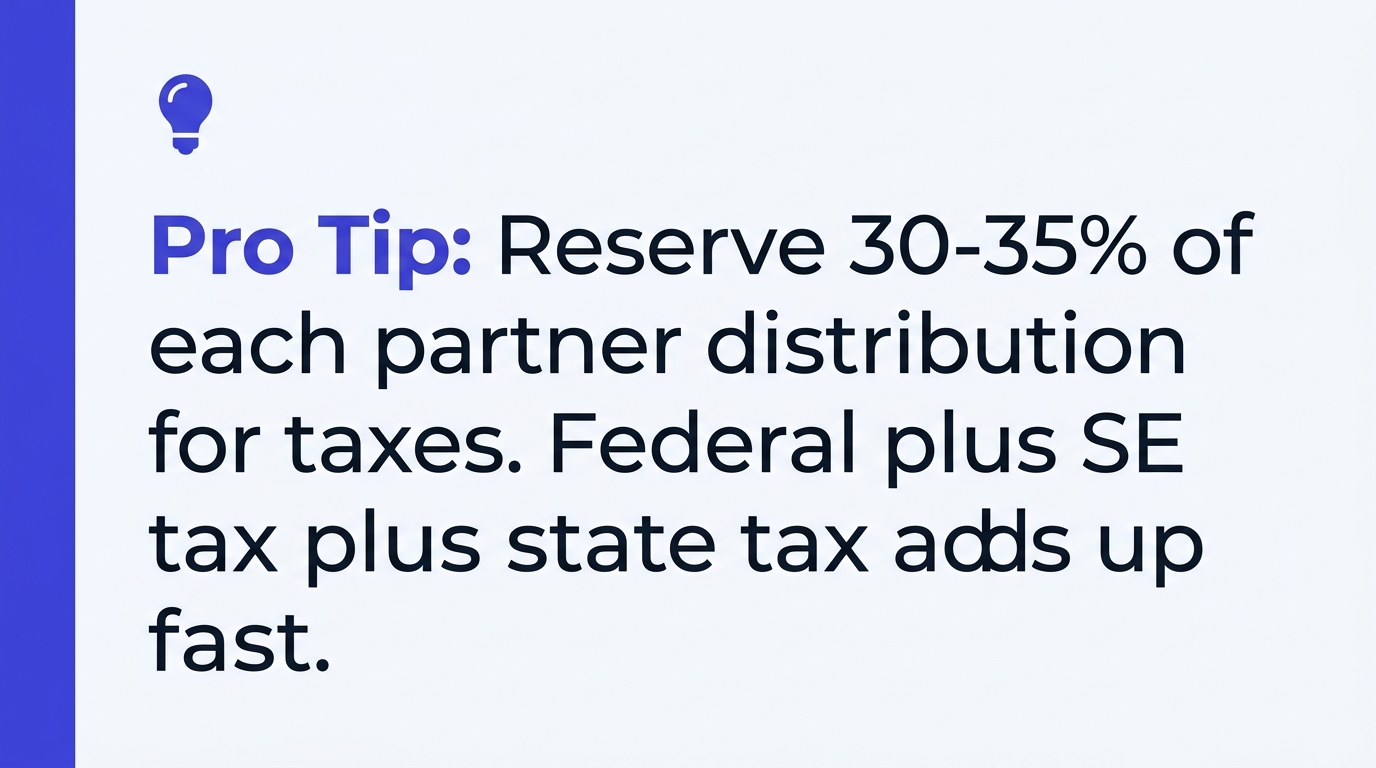
The 30-35% tax reserve rule. Because K-1 income triggers both income tax and self-employment tax, most well-run law firm partnerships hold back 30-35% of every profit distribution specifically for partner taxes. Some firms distribute this directly to partners with a clear "this is for taxes" label. Better-run firms maintain a separate partner tax reserve account — the firm holds the cash and issues estimated tax payments on behalf of partners, or at minimum wire the reserve to partners in line with IRS quarterly estimated tax due dates (April 15, June 15, September 15, January 15).
Cash flow warning: Never let draws exceed 70% of collected (not billed) revenue. Draws pulled against accrued but uncollected fees create a silent liquidity crisis that doesn't show up until a receivable slips. The firm earns the money in January, collects in April, and by March the drawing account looks like the firm is hemorrhaging cash.
Negative basis is the other risk. If cumulative draws exceed a partner's share of profit plus contributed capital, the partner's basis goes negative. Under IRC §731, distributions in excess of basis are taxable gain. This is an easy trap to fall into during a down year, and most partners don't discover it until their CPA prepares the K-1 in March.
Distributions are only as clean as the trust accounting underneath
We handle three-way IOLTA reconciliation, partner capital accounts, and monthly financials built for how law firms actually distribute profit.
Get an instant quoteTalk to us firstEvery dollar of partnership profit flows through to the partners via Schedule K-1 and gets reported on each partner's individual Form 1040, Schedule E. The partnership itself pays no income tax — that is the defining feature of pass-through taxation. What gets allocated to whom is controlled by the partnership agreement.
In the default case, allocation follows ownership percentage. A partner who owns 20% of the firm is allocated 20% of profit and 20% of loss. But partnership agreements routinely modify this default, and law firms more than most. You'll see:
These are called special allocations, and under IRC §704(b) they must have "substantial economic effect" to be respected by the IRS. Translation: the allocation has to actually affect the partner's economic position, not just shuffle taxes around. The partnership agreement must contain specific language around capital accounts, liquidation provisions, and deficit restoration obligations to satisfy the safe harbor. This is one area where "we'll just handle it informally" is actively dangerous — the IRS can collapse a non-compliant special allocation and reallocate income by ownership percentage, which may create an enormous tax surprise.
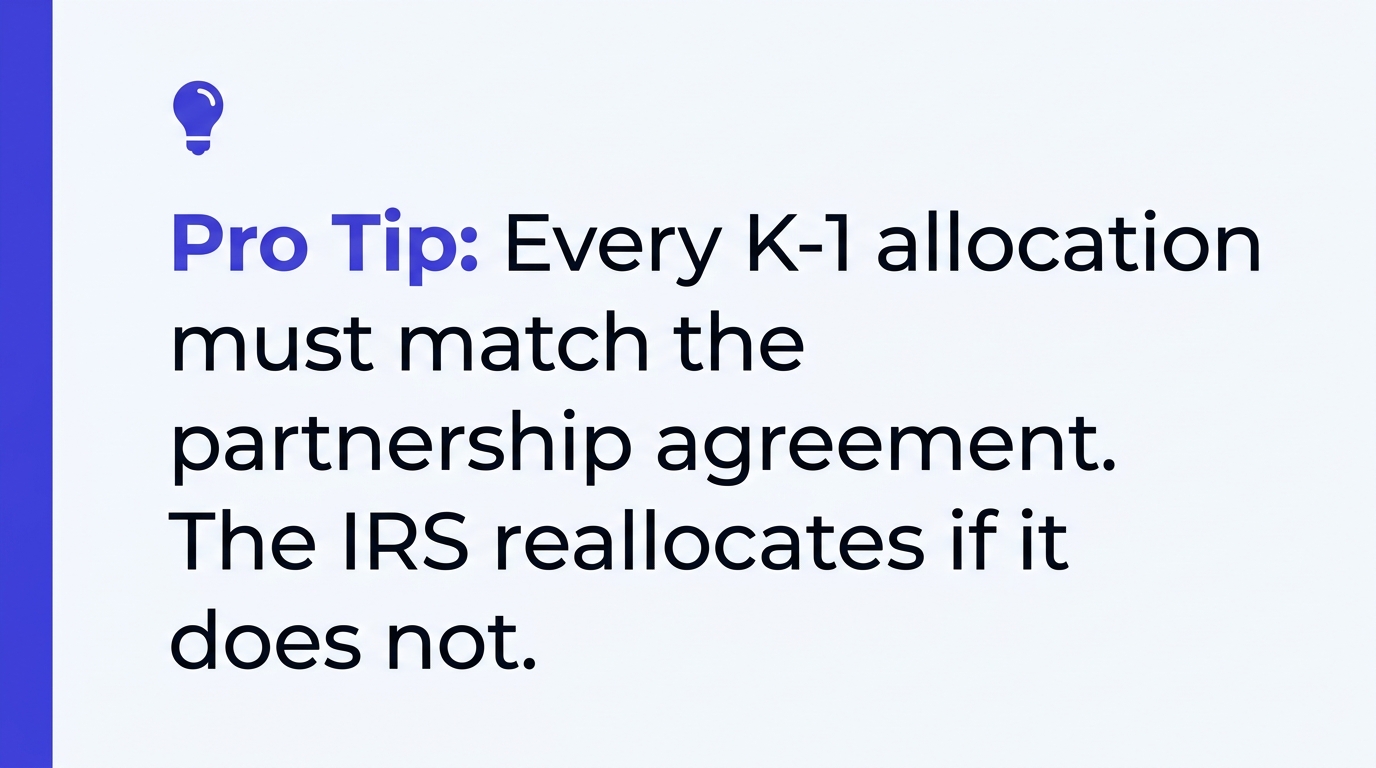
The single most important operational rule: your K-1s must match your partnership agreement. If the agreement says origination credits are 10% of fees collected, and the K-1s allocate profit by flat ownership percentage, you have a problem that gets worse every year it continues. This is the first thing we check when we onboard a law firm client.
Modern law firms increasingly use a two-tier partnership structure: equity partners who own a share of the firm, and non-equity (or "income") partners who hold the partner title and receive partner-level compensation but have no ownership stake.
Equity partners own a documented percentage of the firm. They receive a K-1 reflecting their distributive share of profit. They participate in capital calls when the firm needs investment. They share in the firm's value on dissolution or sale. They vote on partnership matters per the agreement. They are, unambiguously, partners for both legal and tax purposes.
Income partners are a more ambiguous category. Typically they receive a higher base salary or a guaranteed payment, hold the partner title externally, but have no equity, no K-1, and no capital account. Income partnership is often used as a stepping-stone toward equity — a way to test whether an attorney can perform at partner level before the equity partners vote them in.
The tax structure for income partners matters. There are three common approaches:
If you're converting an associate to an income partner, the tax and benefits consequences depend entirely on which structure you choose. Document this explicitly in the partnership agreement and the individual's offer letter.
Law firm compensation models span a spectrum. At one end, lockstep — compensation determined almost entirely by seniority. At the other end, eat-what-you-kill — compensation tracks what each partner individually brings in and works on. Most modern firms land somewhere in the middle.
Lockstep assigns each partner a "points" value based on seniority and class year. Equal-year partners receive equal distributions. The model promotes collaboration — there's no incentive to hoard clients or hours because you won't be individually rewarded for them. But lockstep is vulnerable to the free-rider problem: if one senior partner coasts, their peers can't easily adjust compensation. Many legacy firms have moved away from pure lockstep over the past two decades.
Eat-what-you-kill (EWYK) compensation tracks origination credits (who brought the client in) and working attorney credits (who did the billable work). A partner who originated a $2M matter they also staffed might take home a dramatically larger share than a partner who worked the same hours on smaller matters. The model drives production. It also creates internal competition, discourages cross-selling, and can make client transitions difficult (origination credits are sticky).
Hybrid formula-based systems are now the dominant model. A typical structure: a base guaranteed payment (predictability) + origination bonus (rainmaking incentive) + working attorney bonus (production incentive) + residual firm profit share (teamwork incentive). The weights assigned to each component reflect the firm's culture and strategy.
| Model | Strength | Weakness | Best For |
|---|---|---|---|
| Lockstep | Promotes collaboration, simple admin, easier succession planning | Free-rider problem, may drive out top performers, hard to attract laterals | Established firms with strong culture and long-tenured partners |
| Eat-What-You-Kill | Drives production, attracts rainmakers, objective metrics | Internal competition, discourages cross-sell, client-hoarding | Litigation boutiques, firms with distinct practice silos |
| Hybrid / Formula | Balances incentives, flexible, market-standard | Complex to administer, formula fights every year, requires good reporting | Most small-to-mid law firms (2-50 attorneys) |
Whichever model you use, the partnership agreement must define it with mathematical precision. "Origination credits will be awarded fairly" is not a compensation formula — it's a lawsuit.
Almost every partnership dispute we've ever seen traces back to one root cause: the firm distributed cash it hadn't collected.
Here's how it happens. The firm bills $400K in January. Partners look at the P&L on accrual basis, see a strong month, and draw accordingly in February. The clients pay in April. But then a $150K matter slips — the client disputes the bill, or a contingency settles for less, or a corporate client stretches payment to 90 days. Suddenly the cash that partners already pulled isn't there to support March and April operations. The firm dips into its line of credit. Partners are asked to repay draws. Accusations start flying.
The best practice is structural, not procedural:
Cash flow warning: If your firm has to draw on a line of credit to fund partner distributions, you are distributing borrowed money. That's not a partner compensation event — it's a capital call in reverse, and it is the single most reliable predictor of partnership conflict we've ever tracked.
A well-run law firm delivers the following package to every partner, every month, by no later than the 15th of the following month:
If your firm's monthly reporting package doesn't include these elements, you're flying blind — and you're setting up the exact information asymmetries that lead to partnership disputes.
For the full operational picture of running a financially sound law firm, start with our pillar guide: Law Firm Bookkeeping Guide.
More on specific topics:
Most law firms don't need a more complex compensation formula. They need accurate, on-time reporting against the formula they already have. They need a bookkeeper who understands the difference between a guaranteed payment and a draw, who can produce a K-1-ready trial balance, and who maintains the partner capital accounts as a living document rather than an afterthought that gets reconciled once a year.
Steph's Books provides specialized bookkeeping for law firms, including partner capital account maintenance, guaranteed payment and distribution tracking, origination credit reporting, and K-1-ready year-end closes. We work with managing partners and firm administrators at firms from solo-plus-one up to 50-attorney partnerships.
Learn more about our law firm bookkeeping services, or see our pricing to understand what specialized law firm bookkeeping costs. If you're running a firm and the compensation conversation with your partners has started to feel tense, the problem is almost never the formula — it's the books. We can help you fix that.
Answer a few quick questions for an instant, no-obligation quote — no sales call required. See how Steph's Books saves you 40-60% vs. hiring in-house.