Steph's Books
Services
Industries
Pricing
About
Tools
Contact Us
Get a Quote
Steph's Books

Expert outsourced bookkeeping for professional services firms with $1MM-$10MM revenue.

Stay in the loop

Bookkeeping tips and fraud prevention insights. No spam.

Services

  • Bookkeeping
  • Payroll
  • AR/AP Services
  • Bank Reconciliation
  • Tax Prep
  • Catch-Up Bookkeeping
  • QuickBooks Training

Company

  • Home
  • All Services
  • Industries Served
  • Pricing
  • Meet the Team
  • Blog
  • Contact Us
  • Get Started

Areas Served

ChicagoNapervilleSchaumburgArlington HeightsBarringtonBuffalo GroveVernon HillsLake ZurichWaukeganElginMcHenryWoodstockMarengoLake ForestWaucondaFox LakeLakemoorGreen Oaks

Contact

  • (815) 271-5646
  • steph@stephsbooks.com
  • 4318 W Crystal Lake Rd
    Suite J
    McHenry, IL 60050

Mon – Fri: 9am – 5pm CST

© 2026 Steph's Books. All rights reserved.

Privacy PolicyTerms of ServiceEULA
Back to Blog

Outsourced Bookkeeping vs. Virtual CFO: Which Does Your Firm Need?

March 16, 2026

When professional services firm owners start looking for financial help beyond their tax CPA, two terms dominate the search results: outsourced bookkeeping and virtual CFO. They sound similar — both involve an outside financial professional working on your books — but they serve fundamentally different functions. Hiring one when you need the other is like bringing a plumber to rewire your electrical panel: skilled professional, wrong job.

Understanding the difference between outsourced bookkeeping vs. virtual CFO services isn't just semantics. It determines whether you get accurate historical records or forward-looking financial strategy — and for most growing firms, the answer is that you need both, just not necessarily at the same time.

What Outsourced Bookkeeping Actually Does

An outsourced bookkeeper handles the day-to-day financial record-keeping that keeps your accounting system accurate and current. Think of it as the operational engine of your financial data. Without clean books, nothing else works — not your tax return, not your financial reports, not your CFO's analysis.

Here's what falls under the outsourced bookkeeping umbrella:

  • Transaction categorization: Every expense, deposit, and transfer properly coded in your chart of accounts
  • Bank and credit card reconciliation: Monthly proof that your books match your bank statements
  • Accounts payable: Bill entry, vendor payment scheduling, 1099 tracking
  • Accounts receivable: Invoice tracking, payment application, aging report management
  • Payroll recording: Posting payroll journal entries and reconciling payroll liabilities (the bookkeeper typically doesn't run payroll — that's the payroll provider's job)
  • Month-end close: Accruals, deferrals, and adjusting entries to produce accurate financial statements
  • Financial statement preparation: P&L, Balance Sheet, and Cash Flow Statement delivered monthly

The operative word is historical. A bookkeeper records what already happened. They tell you: "Last month you spent $42,000 on payroll, $8,000 on software, and your net income was $18,500."
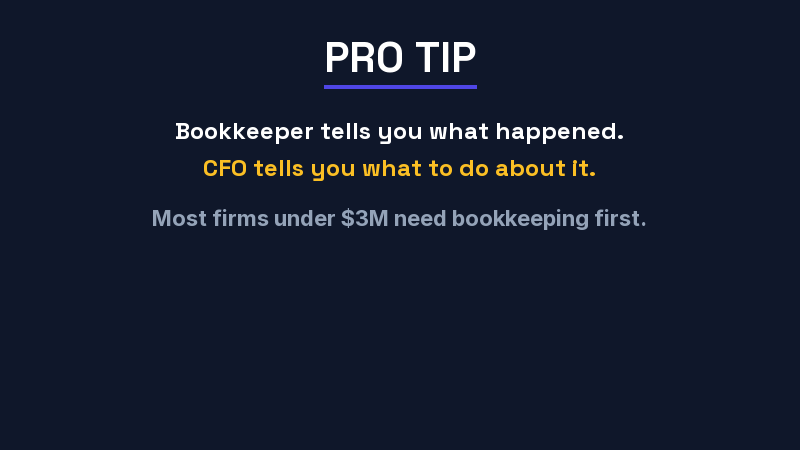
Pro tip: Bookkeeping answers 'what happened?' — CFO services answer 'what should we do next?'
The distinction is simple: bookkeeping is backward-looking accuracy, CFO is forward-looking strategy.

What a Virtual CFO Actually Does

A virtual CFO (vCFO) takes your clean financial data and turns it into strategic insight and forward-looking planning. They don't enter transactions or reconcile bank statements — they analyze the numbers your bookkeeper produces and help you make better business decisions.

Virtual CFO services typically include:

  • Financial forecasting: Revenue projections, expense modeling, and scenario planning ("What happens if we add two associates in Q3?")
  • Cash flow management: 13-week cash flow forecasts, working capital optimization, and collections strategy
  • KPI dashboards: Leading indicators like utilization rate, realization rate, revenue per partner, and work-in-progress aging
  • Pricing strategy: Analyzing effective hourly rates by practice area, client profitability analysis, and fee structure recommendations
  • Budget creation and variance analysis: Annual operating budget with monthly actuals-to-budget review
  • Fundraising and lending support: Financial packages for bank loans, SBA applications, or investor presentations
  • Tax planning coordination: Working with your CPA on estimated taxes, entity structure, and year-end strategies (the vCFO doesn't file taxes — they optimize the plan)
  • Board and partner reporting: Executive-level financial summaries for partners, investors, or advisory boards

The operative word is forward. A CFO tells you: "Based on current trends, you'll have a cash shortfall in August unless you collect $60,000 in outstanding receivables by July 15. Here's the priority list."

Outsourced Bookkeeping vs. Virtual CFO: Side-by-Side Comparison

Dimension Outsourced Bookkeeping Virtual CFO
Primary function Record and classify transactions Analyze data and advise on strategy
Time orientation Backward-looking (what happened) Forward-looking (what will happen)
Deliverables Clean financials, reconciled accounts Forecasts, KPIs, strategic recommendations
Frequency Daily/weekly transaction work, monthly close Monthly or quarterly strategic meetings
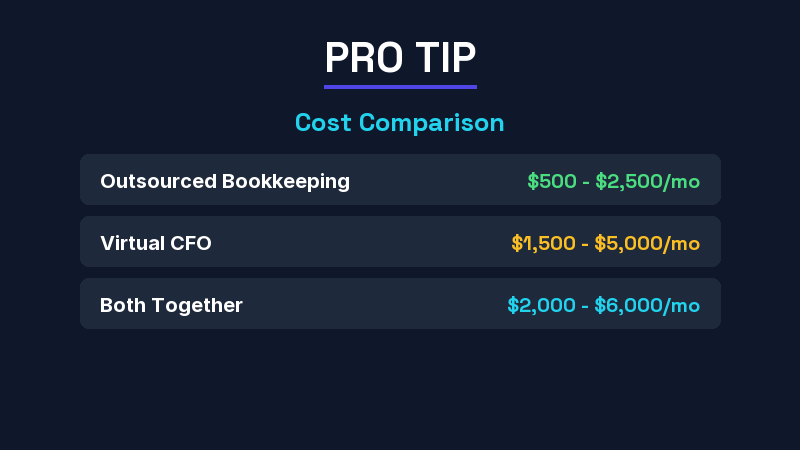
Typical cost $500 – $2,500/month $1,500 – $5,000/month
Required at Any revenue level Usually $1M+ revenue
Reports to Office manager / ops director Owner / managing partner
Dependency Needs access to bank accounts, QBO Needs clean books from bookkeeper
Pro tip: A virtual CFO without a bookkeeper is like a navigator without a map — the strategy only works if the data is clean
Never hire a vCFO before your bookkeeping is in order. Bad data in means bad strategy out.

When You Need Outsourced Bookkeeping (But Not a CFO Yet)

Most professional services firms under $2M in revenue need a bookkeeper before they need a CFO. Here are the signs:

  • Your books are 3+ months behind on reconciliation
  • You or your office manager spend 10+ hours/month on data entry and categorization
  • Your CPA complains about the state of your books every tax season
  • You have uncategorized transactions piling up in QuickBooks
  • You're not sure if your P&L is accurate because nobody closes the books monthly
  • Your financial decisions are based on your bank balance rather than actual reports

At this stage, you don't need a $3,000/month CFO telling you what your numbers mean — you need someone to make the numbers exist in the first place.

When You Need a Virtual CFO (In Addition to Bookkeeping)

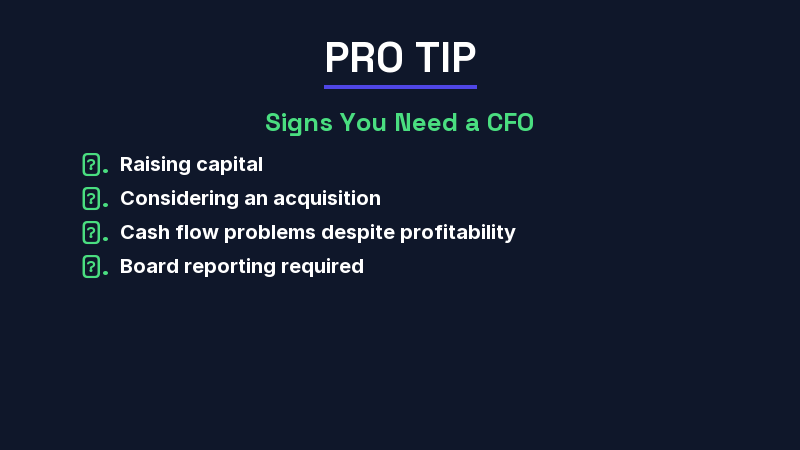
Once your books are clean and current, a virtual CFO becomes valuable when your firm faces decisions that financial statements alone can't answer:

  • You're considering hiring a senior associate or partner and need to model the financial impact over 12-24 months
  • Your revenue is growing 20%+ annually and you're not sure if your cash can keep pace
  • You want to open a second office or new practice area and need a financial business case
  • You're preparing for a bank loan or SBA loan and need professional financial projections
  • Your profit margins are shrinking despite growing revenue — and you don't know why
  • Partners are disagreeing about distributions, compensation, or reinvestment and need data-driven answers
  • You want to set prices based on actual data rather than what competitors charge

Pro Tip: The inflection point for most firms is around $1.5M-$3M in revenue. Below that, a good bookkeeper with clean monthly reports is usually sufficient. Above $3M, the complexity of payroll, project accounting, and growth planning makes CFO-level oversight a genuine ROI-positive investment.

Cost Comparison: What You'll Actually Pay

Understanding the cost differential helps you budget appropriately and avoid overpaying for services you don't need yet.

Service Monthly Cost Range What's Included
Outsourced bookkeeping only $500 – $2,500 Transaction coding, reconciliation, monthly close, financial statements
Virtual CFO only $1,500 – $5,000 Forecasting, KPIs, strategic meetings, cash flow planning
Bookkeeping + CFO bundle $2,000 – $6,000 Full stack: daily bookkeeping through strategic advisory
Full-time in-house controller $7,000 – $12,000+ Salary + benefits + management overhead for a single employee

For a $3M law firm, outsourced bookkeeping at $1,500/month plus a vCFO at $2,500/month ($4,000 total) replaces what would be a $90,000-$120,000/year controller hire — at less than half the cost, with no PTO, benefits, or turnover risk.
Pro tip: Outsourced bookkeeping + virtual CFO costs $48K/year vs. $100K+ for a full-time controller — with less turnover risk
The outsourced model delivers senior-level expertise at a fraction of in-house costs.

How Outsourced Bookkeeping and a Virtual CFO Work Together

The most effective financial teams we build for professional services firms look like a relay race — the bookkeeper hands clean data to the CFO, who turns it into strategy.

The Monthly Workflow

  1. Weeks 1-3: The bookkeeping team categorizes transactions, processes AP/AR, and records payroll entries as they happen throughout the month
  2. Week 4 (Days 1-5): Month-end close — the bookkeeper posts accruals, runs reconciliations, and prepares financial statements
  3. Week 4 (Days 5-7): The vCFO reviews the financials, updates forecasts and KPI dashboards, and prepares variance analysis
  4. First week of next month: The vCFO meets with you to review performance, discuss trends, and adjust strategy

When both services come from the same provider, you eliminate the handoff friction. The CFO isn't waiting for a third-party bookkeeper to deliver files, and the bookkeeper understands exactly what the CFO needs for reporting.

Signs You've Outgrown Bookkeeping-Only

You started with outsourced bookkeeping and it's working great — clean books every month. But you keep thinking: "Now that I have the data, what do I actually do with it?" That's the moment to layer in CFO services.

Specific triggers:

  • You receive beautiful financial statements but aren't sure what actions to take based on them
  • You're making $500K+ decisions (new hire, office lease, equipment purchase) without financial modeling
  • Your accountant files taxes but never proactively suggests tax-saving strategies
  • Partners ask questions your bookkeeper can't answer: "What's our break-even by practice area?" or "Can we afford to hire before the revenue comes in?"

The Decision Framework

Use this quick framework to determine what your firm needs right now:

Your Situation What You Need Estimated Cost
Books are behind, no monthly close, bank balance is your "report" Outsourced bookkeeping (start here) $500 – $2,500/mo
Books are clean but you need forecasts, KPIs, and strategic guidance Add virtual CFO $1,500 – $5,000/mo
Preparing for a loan, acquisition, or major growth initiative Bookkeeping + CFO (full stack) $2,000 – $6,000/mo
Revenue under $500K, simple operations DIY with quarterly CPA review $200 – $800/quarter

Not sure where you stand? Take our instant quote assessment to get a personalized recommendation based on your firm's size, complexity, and current bookkeeping situation. It takes 2 minutes and there's no commitment. Or schedule a free consultation to talk through your specific needs with our team.

Related Reading

  • The Complete Guide to Outsourced Bookkeeping for Professional Services Firms
  • Leading Financial Indicators Every Professional Services Firm Should Track
  • Steph's Books Pricing

Need help with your bookkeeping?

Get a free quote and see how Steph's Books can save you 40-60% vs hiring in-house.

Get a Free QuoteCall (815) 271-5646