You have a problem most CPA firms won’t admit publicly: clients keep asking for bookkeeping, and you keep saying no.
Not because you don’t understand the value. You know that bundling bookkeeping with tax prep and advisory creates stickier, higher-value engagements. You know that every client you send to an outside bookkeeper is a client who might not come back. You know the math works.
The problem is execution. Hiring a full-time bookkeeper means $45,000–$65,000 in salary before you add benefits, software, training, and management overhead. It means absorbing the risk of turnover, sick days, and coverage gaps. For most CPA firms under $5M in revenue, that hire doesn’t pencil out until you have enough bookkeeping clients to keep them busy 40 hours a week.
White label bookkeeping services solve this problem completely. You keep the client relationship, add recurring monthly revenue, and maintain your brand — while a dedicated team handles the actual bookkeeping behind the scenes.
Here’s exactly how it works, what it costs, and what to look for in a partner.
White label bookkeeping is a partnership model where an outsourced bookkeeping provider handles your clients’ books under your firm’s brand. Your clients see your name on reports, your firm on communications, and your team as their point of contact. The bookkeeping provider operates entirely behind the scenes.
Think of it like a private-label product. The grocery store puts its brand on the cereal box, but a specialized manufacturer makes the cereal. Same concept, applied to professional services.
In practice, this means:
This is fundamentally different from referring a client to a separate bookkeeping firm. With referrals, the client relationship shifts. With white label, the relationship stays with you.
The AICPA has been beating the “advisory services” drum for years. But here’s what the advisory conversation misses: advisory without bookkeeping is a house built on sand.
You can’t deliver meaningful financial advisory if the underlying books are a mess. And if you’re not the one managing the books, you’re at the mercy of whoever is.
Here’s the client attrition pattern most CPA firms experience:
The bookkeeping relationship is the entry point to everything else. Whoever owns the books owns the client. If you’re ceding bookkeeping to someone else, you’re handing them the keys to your client base.
The math on client attrition: If your average tax client pays $3,500/year and you lose just 5 clients annually because they consolidated with a bookkeeping-first firm, that’s $17,500 in recurring revenue gone — every year, compounding. Over five years, that’s $87,500 in lost revenue from a problem white label bookkeeping solves for a fraction of that cost.

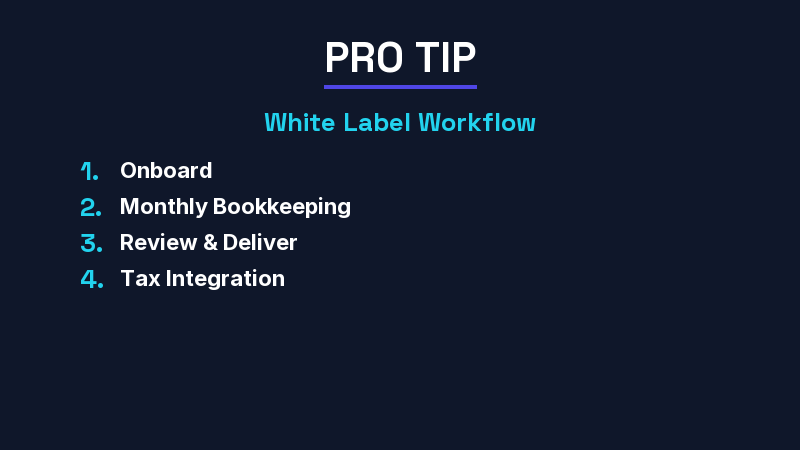
The mechanics vary by provider, but a well-run white label bookkeeping partnership follows a predictable workflow:
You introduce bookkeeping as a new service to your client. The partner provides onboarding checklists, QuickBooks Online setup (or cleanup), and bank/credit card connection. Your client sees this as your firm expanding its offerings.
The white label team handles the daily and monthly work:
Books are closed by the 15th of the following month — sometimes earlier. You receive the completed financials for review before they go to the client.
You review the work, add any advisory commentary, and deliver the financials to your client under your brand. The white label partner remains invisible. If your client has questions, they come to you first. You escalate to the partner only when needed.
This is where the real leverage shows up. Because you control the books and the tax prep, year-end close is seamless. No more chasing down a third-party bookkeeper for trial balances. No more reclassifying six months of miscoded transactions in February. The books are clean, reconciled, and tax-ready because your partner maintained them all year.
Most CPA firm owners compare white label pricing to the monthly fee alone. That’s the wrong comparison. You need to compare the fully loaded cost of hiring in-house against the white label model.
| Cost Factor | In-House Bookkeeper | White Label Partner |
|---|---|---|
| Base Salary / Monthly Fee | $50,000–$65,000/year | $300–$800/client/month |
| Benefits (Health, PTO, 401k) | $12,000–$18,000/year | $0 |
| Payroll Taxes (FICA, FUTA) | $4,000–$5,000/year | $0 |
| Software Licenses (QBO, etc.) | $1,200–$3,600/year | Included |
| Training & Continuing Education | $1,000–$2,500/year | Included |
| Management Overhead | 5–10 hrs/week of partner time | 1–2 hrs/week review |
| Turnover / Vacancy Risk | $8,000–$15,000 per replacement | $0 — team-based coverage |
| Scalability | Fixed (1 person = ~15–20 clients) | Elastic — add clients anytime |
| Total Year-One Cost (15 clients) | $70,000–$95,000 | $54,000–$144,000 |
The in-house model looks cheaper on paper — until you factor in the hidden costs. Management overhead alone is the silent killer. If you or a senior staff member spend 5 hours per week supervising a bookkeeper, at a $200/hour billing rate, that’s $52,000/year in opportunity cost.
With white label, you review finished work. You don’t manage a process.
Different providers structure pricing differently. Here are the three most common models:
You pay a fixed monthly fee per client based on their complexity (transaction volume, number of accounts, service scope). This is the most predictable model and easiest to mark up.
Typical range: $300–$800/client/month
The per-client rate decreases as you add more clients. For example, clients 1–5 might be $500/month each, while clients 6–15 drop to $400/month. This rewards you for growing the partnership.
Some providers take a percentage of what you charge your client. If you bill the client $1,000/month for bookkeeping, the partner takes 60–70% and you keep the rest. Less common but eliminates upfront cost.
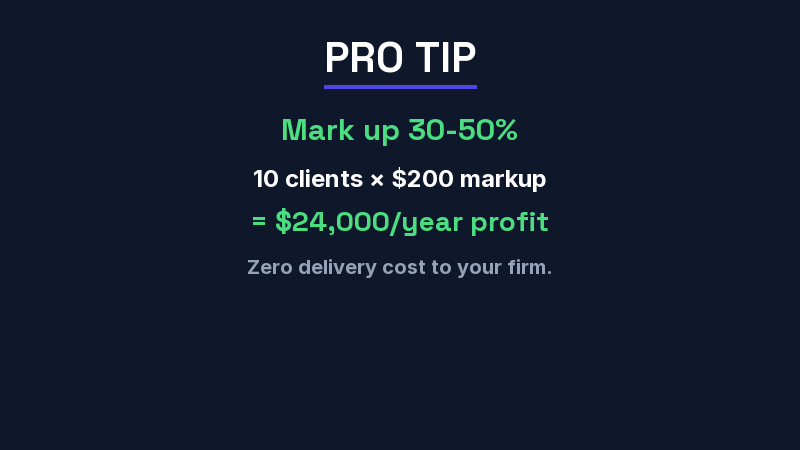
Margin tip: Most CPA firms using white label bookkeeping services mark up 30–50% over their partner’s rate. If your partner charges $500/client and you bill the client $700, that’s $2,400/year in pure margin per client — with zero delivery cost on your end. Ten clients = $24,000 in new annual profit.
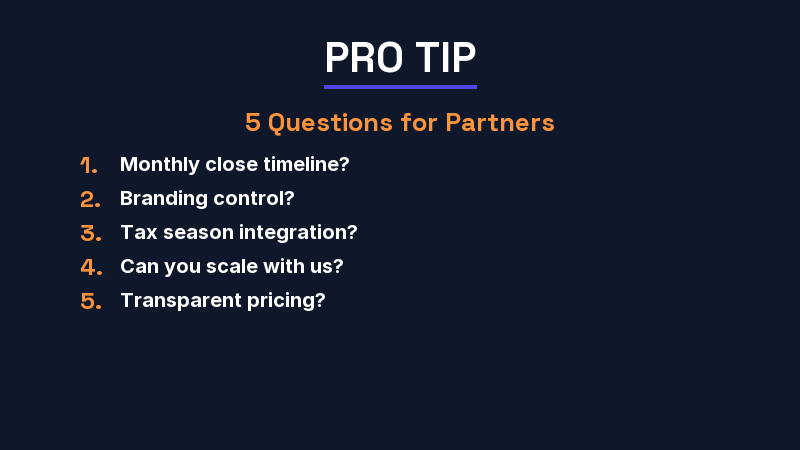
Not all outsourced bookkeeping providers are set up for white label partnerships. Here’s what separates a genuine partner from a vendor who slaps your logo on a template:
| Feature | Must-Have | Nice-to-Have |
|---|---|---|
| White-Labeled Reporting | Your logo, your brand on all deliverables | Custom report templates |
| QuickBooks Online Expertise | QBO ProAdvisor certified team | Multi-platform (Xero, Sage) |
| Industry Specialization | Experience with professional services firms | Niche expertise (law, medical, PM) |
| Communication Protocol | Defined escalation path, regular check-ins | Dedicated account manager |
| Close Timeline | Books closed by the 15th | Books closed by the 5th–10th |
| Tax Season Readiness | Year-end close package for your tax team | Direct communication with your CPA staff |
| Scalability | Can onboard 5+ clients without delays | Unlimited capacity with predictable timelines |
| Data Security | SOC 2 compliance or equivalent controls | Cyber liability insurance |
Red flags to watch for: providers who won’t let you review work before it goes to clients, offshore-only teams with no U.S. oversight, vague pricing that changes month to month, and no defined onboarding process.
At Steph’s Books, we built our white label program specifically for CPA firms serving professional services clients between $1M and $10M in revenue.
Here’s what the partnership includes:
The onboarding process takes 2–3 weeks per client. We handle the QBO setup or cleanup, connect bank feeds, establish the chart of accounts, and start processing within the first month.
Let’s run the numbers on what adding white label bookkeeping looks like for a mid-size CPA firm.
Scenario: You have 200 tax clients. 30% of them (60 clients) have expressed interest in bookkeeping or would benefit from it. You start with 10 and grow to 25 over 12 months.
Year-one revenue impact:
That’s $42,000 in new recurring profit without hiring anyone, buying any software, or managing any bookkeeping staff. And it compounds: by year two, you’re running 25+ clients at $60,000+/year in pure margin.
The real value is even higher when you account for client retention. If white label bookkeeping prevents just 5 clients from leaving for a full-service competitor, that’s another $17,500/year in preserved tax revenue.
If you’re considering adding white label bookkeeping services to your CPA firm, here’s the practical path forward:
Ready to explore a partnership? Visit our CPA Partner page to learn more about Steph’s Books white label bookkeeping program, or get an instant quote to estimate per-client pricing for your firm.
White label bookkeeping is a service where an outsourced bookkeeping provider handles your clients’ books under your firm’s brand. Your clients see your firm’s name on reports and communications, while a dedicated team does the day-to-day work behind the scenes.
Most white label bookkeeping partners charge between $300 and $800 per client per month depending on transaction volume, number of accounts, and service scope. CPA firms typically mark up 30–50% to their clients, creating a new recurring revenue stream without any hiring costs.
No. A true white label partner operates completely behind the scenes. All reports, communications, and deliverables carry your firm’s branding. Your clients experience it as a seamless extension of your practice.
Outsourced bookkeeping is when a business hires a provider directly for their own books. White label bookkeeping is when a CPA firm partners with a bookkeeping provider to serve the CPA firm’s clients under the CPA firm’s brand. The end client relationship stays with the CPA firm.
Start by evaluating your client base for bookkeeping demand. Then contact a white label partner like Steph’s Books to discuss your volume, client types, and reporting requirements. Most firms can onboard their first clients within 2–3 weeks of signing a partnership agreement.
Answer a few quick questions for an instant, no-obligation quote — no sales call required. See how Steph's Books saves you 40-60% vs. hiring in-house.